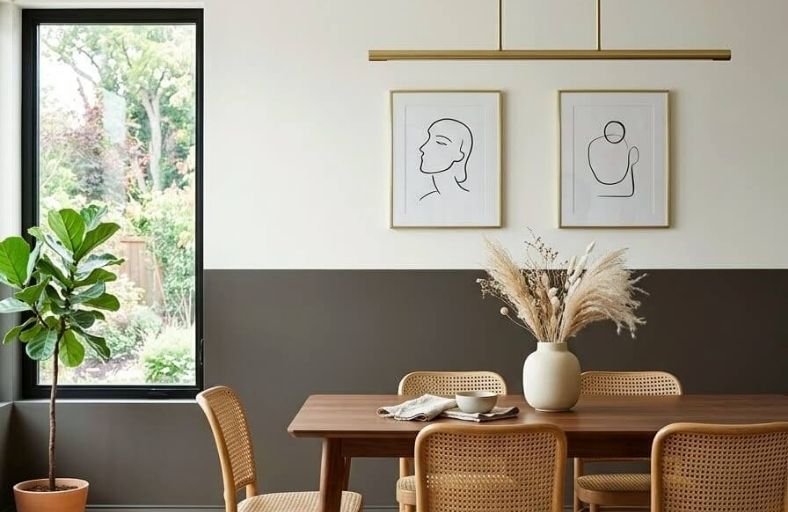
The strategic application of a two-color paint palette transforms residential interiors by recalibrating room proportions, defining architectural boundaries, and directing visual hierarchy.
Rather than relying on monochromatic schemes, master painting contractors and interior architects use contrasting or harmonious dual-tone configurations to optimize natural light reflection and spatial perception.
Dual-color treatments allow home design professionals to anchor large open-plan living areas, accentuate historic trim profiles, or inject architectural depth into featureless drywall environments.
Achieving a flawless finish requires understanding Light Reflectance Values (LRV), precise line isolation techniques using low-tack masking films, and complementary sheen selection across adjoining surfaces.
Focal Accent Wall Method
The focal accent wall method isolates a single vertical wall, frequently positioned behind a bed, fireplace, or primary architectural focal point, and coats it in a deep, saturated shade while keeping the surrounding three walls light and neutral.
This visual contrast pulls the darker wall forward or creates a feeling of infinite depth depending on natural room illumination.
To achieve color harmony across the interior space, the selected accent tone should share identical undertones with the primary neutral walls.
Employing flat or matte sheens on dark accent surfaces eliminates harsh reflections across deep pigments, whereas eggshell or satin finishes on adjacent light walls ensure clean durability.
Designers frequently select dramatic navy blues or rich charcoals for bedroom headboards and living room fireplace walls.
When combined with clean white perimeter surfaces, the dark focal plane anchors the room’s furniture arrangement without overwhelming the broader architectural footprint.
The result is a balanced contrast that elevates basic residential layouts into curated environments.
Horizontal Split (Wainscoting Effect)
Dividing walls horizontally establishes a visual grounding line that anchors furniture and shields lower wall zones from daily wear and abrasion.
Professional interior standards dictate positioning the horizontal boundary line along classical golden ratio proportions, typically one-third of the overall wall height (36 to 42 inches above the floor) or at two-thirds height in spaces with soaring ceilings.
Coating the lower section in a darker hue provides visual weight that stabilizes the room, while applying a lighter, high-Light Reflectance Value (LRV) paint to the upper section bounces daylight across the ceiling canopy.
The dividing seam can remain a clean, razor-sharp painted transition or be capped with decorative chair rail molding to add structural texture.
This horizontal approach is particularly effective in high-traffic hallways, dining rooms, and children’s bedrooms where lower walls require dark, wipeable finishes.
By keeping the upper two-thirds bright, the room maintains an open, airy atmosphere while benefiting from functional color zoning.
Ceiling Color-Blocking
Treating the ceiling as an active fifth wall introduces dramatic volumetric contrast and spatial recalibration.
Coating ceiling planes in soft sage greens, deep navies, or muted greiges while keeping perimeter walls neutral draws the eye upward, altering perceived ceiling height.
In lofty, expansive rooms, dark ceiling colors bring the ceiling plane down visually, establishing a cozy, intimate atmosphere.
Conversely, painting low ceilings in a lighter tone than the vertical walls expands vertical space.
When executing dark ceiling schemes, flat or ultra-flat paint sheens are essential to eliminate reflective glare and mask subtle drywall seams.
This approach integrates ceiling architecture directly into the color scheme rather than treating overhead drywall as an afterthought.
Ceilings painted in cool, muted shades reflect ambient light softly into adjacent living spaces, adding atmospheric warmth without encroaching on floor space.
Architectural Alcove and Nook Isolation
Open-concept residential layouts benefit immensely from isolated color-zoning applied to recessed wall segments, reading alcoves, window seats, or arched doorways.
Coating the interior surfaces of a wall recess in a distinct tone establishes a functional sub-zone without introducing physical room dividers.
For soft, elegant transitions, pairing a mid-tone greige with a pale warm white yields gentle spatial depth.
Furthermore, painting built-in cabinetry backings or bookcase interiors in a contrasting deeper hue establishes a striking background that highlights displayed art, ceramics, and books.
This technique directs focus toward unique architectural details, converting minor wall cutouts into compelling spatial highlights.
Selecting muted, organic tones for alcoves prevents distinct functional areas from visually competing with main living spaces.
As light shifts throughout the day, the recessed shade creates subtle shadows that enhance three-dimensional depth.
High-Contrast Trim and Door Framing
Reversing traditional trim rules by painting interior doors, door frames, baseboards, window casings, and crown moldings in deep, dramatic shades against pale wall surfaces frames room geometry with crisp clarity.
High-contrast trim creates graphic perimeter lines that draw attention to fine woodworking in historic homes or add architectural interest to featureless modern drywall constructions.
To ensure lasting performance, semi-gloss or satin enamel finishes should be used on trim surfaces.
These higher sheens provide scuff resistance and smooth washability while establishing a refined surface sheen contrast against eggshell or matte wall finishes.
Combining deep navy or charcoal trim with warm off-white walls creates a refined, tailored aesthetic.
This framing technique unifies adjoining rooms when applied consistently across connecting hallways and interior doorways, providing cohesive visual structure throughout an entire home floor plan.
Geometric Stripe and Diagonal Color-Splitting
Modern two-tone designs frequently employ graphic geometric splits, wide vertical bands, or sharp diagonal color breaks directly across flat wall planes.
These geometric color treatments dynamically reshape perceived spatial proportions; wide vertical stripes visually raise low ceilings, whereas sharp diagonal color splits inject energy into home offices, playrooms, or creative studios.
Achieving crisp geometric boundaries requires precision prep work: layout lines must be plotted with a laser level, masked with premium low-tack tape, and sealed along the tape edge using the base wall color before applying the contrasting secondary paint.
When executed properly, geometric paint splits eliminate the need for expensive decorative wall moldings or heavy wall art.
The sharp division between contrasting hues serves as its own standalone artwork, making geometric color-blocking an efficient, high-impact solution for modern interior spaces.
Picture Rail Upper-Third Split
Positioning a horizontal color division at picture rail height, approximately 12 to 18 inches below the ceiling line, creates an elegant upper frieze band that scales tall rooms down to human proportions.
Painting this upper frieze and the ceiling in a single, darker hue extends the ceiling plane visually downward, wrapping the room in a comfortable enclosure.
Meanwhile, coating the lower wall surfaces in a lighter neutral keeps living areas feeling spacious and provides an unobstructed backdrop for furniture and artwork.
This two-third upper split technique is particularly well-suited for historic homes with elevated ceilings, as it preserves classic proportions without cluttering living areas.
The upper color band acts as an architectural frame that draws eyes across the perimeter of the room, emphasizing structural elegance while maintaining cozy, functional comfort at eye level.
Color Palette Pairing and Technical Specifications
Selecting complementary paint pairs requires assessing color undertones, Light Reflectance Values (LRV), and finish sheens across surfaces.
High contrast combinations (LRV differential greater than 50) generate bold modern edges, while low contrast combinations (LRV differential between 15 and 30) yield subtle, relaxing transitions.
| Design Technique | Primary Color & Code | Secondary Color & Code | LRV Contrast Delta | Recommended Sheen Combination |
|---|---|---|---|---|
| Focal Accent Wall | BM Hale Navy HC-154 | BM Chantilly Lace OC-65 | 84 (High) | Wall: Matte / Accent: Flat |
| Horizontal Split | SW Urbane Bronze SW 7048 | SW Alabaster SW 7008 | 74 (High) | Lower: Satin / Upper: Eggshell |
| Ceiling Block | SW Sea Salt SW 6204 | SW Pure White SW 7005 | 21 (Low-Medium) | Ceiling: Flat / Wall: Eggshell |
| Nook Isolation | BM Revere Pewter HC-172 | BM White Dove OC-17 | 29 (Medium) | Wall: Eggshell / Nook: Matte |
| Contrast Trim | FB Hague Blue No. 30 | BM Simply White OC-117 | 82 (High) | Wall: Eggshell / Trim: Semi-Gloss |
| Geometric Split | SW Evergreen Fog SW 9130 | SW Repose Gray SW 7015 | 28 (Medium) | Wall: Matte / Accent: Matte |
| Picture Rail Split | FB Railings No. 31 | FB Skimming Stone No. 241 | 52 (High) | Upper: Flat / Lower: Eggshell |
Technical Execution and Surface Preparation Protocols
Achieving a professional-grade two-tone finish requires executing a structured, five-stage application process.
Omitting surface prep or mismanaging tape line mechanics introduces paint bleed and uneven sheen lines.
- Phase 1: Surface Preparation and Primer Base: Clean wall surfaces with trisodium phosphate (TSP) to remove dust and oils. Fill nail holes, sand smooth, and apply a high-adhesion stain-blocking primer over repaired areas.
- Phase 2: Base Coat and Primary Light Color: Apply two full coats of the lighter paint color across the entire wall area or extending slightly past the intended division line. Allow the base coat to cure for 24 hours to handle tape pressure.
- Phase 3: Precision Marking and Laser Leveling: Project a self-leveling cross-line laser across the surface. Mark light pencil guides at two-foot intervals, then apply low-tack, high-adhesion painter’s tape along the line, burnishing the edge firmly with a putty knife.
- Phase 4: Tape Edge Sealing Protocol: Paint over the tape edge using a thin layer of the lighter base color. This initial coat fills microscopic gaps under the tape edge, creating a permanent seal that prevents bleeding.
- Phase 5: Secondary Dark Application and Tape Peel: Apply two coats of the darker secondary color over the sealed boundary. Peel the painter’s tape slowly at a 45-degree angle while the final coat is still slightly damp to release a sharp, perfect edge.
Technical Summary for Design Success
Successfully executing a two-color room scheme depends on balancing natural illumination, spatial scale, and precision surface prep.
Low-contrast color pairings and lower-third horizontal splits keep compact or dim rooms feeling open and bright.
In larger rooms with high ceilings, high-contrast palette pairings, saturated accent planes, and dramatic ceiling blocking introduce grounding warmth and architectural structure.
Testing physical paint samples across morning and evening light conditions ensures that undertones remain complementary throughout the day.