Waking up to find your fitted sheet has snapped back like a rogue rubber band, leaving you tangled in a chaotic nest of fabric and cold, exposed mattress, is an absolute morning mood-killer.
This common domestic struggle often turns a peaceful sanctuary into a nightly battleground of tugging and tucking.
Usually, this failure is a simple mismatch between textile physics and mattress dimensions. Whether you are dealing with a deep pillow-top or a restless sleeping style, maintaining a crisp surface is achievable.
By mastering a few professional anchoring techniques, you can finally ensure your sheets stay securely in place from dusk until dawn.
The Two-Inch Rule
The most frequent cause of bedding failure is a fundamental mismatch between the mattress stack and the sheet pocket depth. Many homeowners buy sheets based on surface size (King or Queen) but ignore the vertical dimension.
Your “mattress stack” includes the mattress core plus any auxiliary layers like plush toppers or quilted protectors.
To achieve a professional-grade anchor, you must follow the “Two-Inch Rule.” This principle dictates that your fitted sheet’s pocket depth should be at least two inches greater than the total height of your mattress stack.
This extra fabric allows the elastic hem to wrap fully beneath the mattress base, using the weight of the mattress itself to lock the sheet in place.
| Mattress Profile | Height Range | Required Pocket Depth |
| Standard | 8 to 12 inches | 14 to 15 inches |
| Deep / Thick | 12 to 17 inches | 18 to 19 inches |
| Extra Deep | 18+ inches | 20+ inches |
Selecting the Right Textile
While the buttery smoothness of silk or bamboo rayon feels indulgent against the skin, these low-friction materials are the primary culprits behind “pop-offs.” High-thread-count sateen weaves have long yarn “floats” that create a slippery surface, offering almost no natural grip against the mattress.
If you struggle with shifting sheets, prioritize fabrics with a matte finish and higher surface irregularity. Cotton percale, with its classic one-over-one-under weave, provides a crisp texture that naturally resists lateral movement.
For maximum stability, European linen is the gold standard; its natural “slubs” and heavier weight create a high-friction interface that stays grounded even if you toss and turn throughout the night.
Three-Point Corner Suspenders
When dimensional alignment and fabric choice aren’t enough to combat a restless sleeper, mechanical intervention becomes necessary. Sheet suspenders, often called sheet straps, act as the “hipster braces” for your bed.
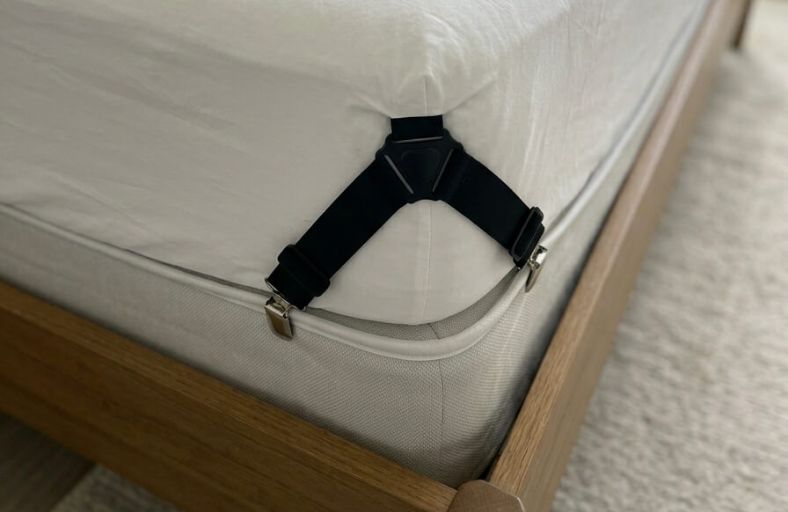
The most effective versions utilize a triangular, three-point design that clips onto the edges of the fitted sheet corner.
These straps create a “bear hug” effect by pulling the fabric toward the center of the mattress corner from multiple angles. Modern versions feature nylon “teeth” within the clips to protect delicate fibers while maintaining a firm grip.
By adjusting the tension buckles, you can eliminate excess fabric and create a drum-tight surface that simply cannot budge, regardless of nocturnal movement.
Hidden Friction Anchors
Rug grippers are traditionally designed to keep carpets from sliding across hardwood floors, but they are secretly a bedding enthusiast’s best friend. These small, textured pads are engineered to maximize friction, making them perfect for anchoring slippery fabrics like silk or bamboorayon.
By placing a non-slip rug pad at each corner of the mattress before you put on your fitted sheet, you create a high-grip foundation that resists the tension of your movements.
This method is particularly effective because it works invisibly. Unlike bulky clips, these pads sit flat and are completely undetectable once the bed is made. When you press the sheet corner against the gripper, the fabric “locks” into the texture of the pad.
It is a low-cost, zero-maintenance DIY fix that provides surprising stability for active sleepers who don’t want to deal with mechanical straps.
360-Degree Bungee Lockdown
For those who demand a “drum-tight” finish that absolutely cannot budge, a 360-degree bungee system is the gold standard. Products like the Bed Scrunchie utilize a heavy-duty bungee cord equipped with multiple clips that attach to the entire perimeter of the sheet.
Once the clips are secured, you pull the drawstring to tighten the cord under the mattress, effectively converting any flat or ill-fitting sheet into a custom-fitted masterpiece.
This system is widely considered the most robust solution for non-standard setups, such as RV mattresses, boat beds, or adjustable bases. Because the tension is distributed evenly around the full 360-degree circumference rather than just at the corners, the sheet remains taut even when the bed frame moves or tilts.
While it requires a slightly longer setup time during laundry day, the result is a flawless, hotel-quality surface that stays put for a full week.
The Textured Interlayer Strategy
Many modern sleep systems fail because they pair a slick memory foam mattress with a smooth, high-thread-count sheet.
This creates a “slide-on-slide” effect where there is zero resistance to hold the fabric in place. The strategic fix is to introduce a “Textured Interlayer”, a high-friction bridge between the two surfaces.
Placing a rougher fabric, such as a flannel flat sheet or a quilted cotton mattress protector, directly over the mattress provides the necessary “bite” for your top sheet to cling to.
| Interlayer Material | Best For | Stability Level |
| Cotton Quilted Protector | Standard protection and grip | High |
| Flannel Sheet | Winter warmth and maximum friction | Maximum |
| Egyptian Cotton Pad | Breathable summer grip | Moderate |
Using a cotton-filled protector is often the best choice for year-round stability. These protectors not only shield your mattress from allergens but also feature a textured surface that acts like “velcro” for your fitted sheet.
By increasing the total coefficient of friction in your bedding stack, you can enjoy your favorite luxury sheets without them bunching toward the center of the bed by midnight.
Mastering Hospital Corners
While fitted sheets are the standard, many luxury seekers prefer using high-quality flat sheets as a bottom layer. To keep a flat sheet from bunching, you must master the “Hospital Corner.”
This is a time-tested mechanical fold that utilizes the weight of the mattress to lock the fabric into a permanent 45-degree angle.
To execute this, start by tucking the foot of the sheet tightly under the mattress. Lift the hanging side of the sheet to form a triangle and lay it on top of the bed. Tuck the bottom flap under the mattress, then fold the triangle back down and secure it firmly.
This fold creates a high-tension anchor point that prevents the “bagging” effect often seen in simple tucks. It is the secret used by boutique hotels to achieve that signature, unyielding look that lasts through a full night of sleep.
Preserving Elastic Integrity
Even the most expensive fitted sheet will eventually fail if its elastic becomes brittle. The elastic band in your sheets is a polymer that is highly sensitive to thermal degradation.
High heat during washing or drying is the primary cause of “elastic fatigue,” where the rubber loses its rebound capacity and becomes “crunchy” to the touch.
Once the elastic is compromised, the sheet can no longer maintain the “bear hug” needed to stay on the mattress corners.
To maximize the lifespan of your sheets, always wash them in warm or cool water and avoid the highest heat settings on your dryer. Experts recommend removing sheets while they are still slightly damp and allowing them to finish drying naturally to preserve the rubber’s elasticity.
By maintaining the structural integrity of the elastic, you ensure that the sheet’s built-in anchoring system remains strong enough to resist the lateral forces of a sleeper’s movement.