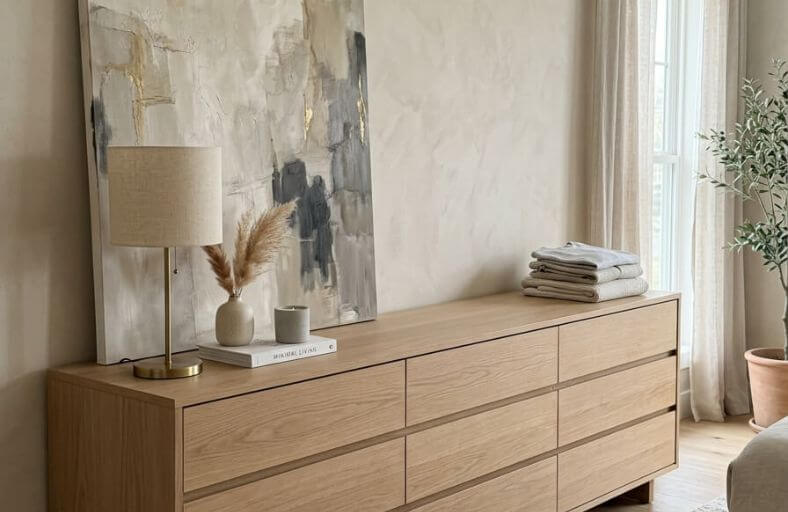
Most people treat their bedroom dresser as purely functional, a place to store folded clothes and drop whatever is in their pockets.
But in the hands of a thoughtful decorator, a dresser becomes one of the most expressive surfaces in the room.
The top of your dresser is essentially a small stage, and what you place on it tells a story about your style, your habits, and your taste.
These tips will help you see your dresser with fresh eyes and give you a clear, practical approach to styling it in a way that looks beautiful, stays organized, and suits your bedroom perfectly.
Strategic Anchoring through Vertical Focal Points
The first step in styling is to establish an “anchor” that dictates the visual boundaries of your arrangement. Without a large-scale element, decorative items often look like they are floating aimlessly on the surface.
Designers typically use a large mirror or a piece of framed artwork to serve as this primary focal point. Mirrors are particularly effective in bedrooms because they reflect light and create an illusion of depth, making a small room feel significantly larger and more inviting.
A circular mirror is a popular choice among experts because its soft curves provide a beautiful contrast to the rigid, horizontal lines of the dresser drawers. If you have a wide dresser, you do not always have to center the anchor.
Placing the mirror to one side allows you to “read” the dresser from left to right like a book, ending the gaze on a secondary tall object like a lamp. This creates an asymmetrical balance that feels modern and intentional rather than stiffly formal.
Mastering Vertical Dynamics and Staggered Height
A common mistake in home decor is placing objects of uniform height in a straight line, which creates a flat and uninspiring visual plane. To achieve a professional look, you must introduce vertical interest by staggering heights. Think of your dresser top as a skyline.
You need a tall element, such as a tapered candlestick or a sleek table lamp, to pull the eye upward.
To bridge the gap between your tall anchor and the flat dresser surface, use “risers” like stacked coffee table books. Stacking two or three beautiful books horizontally creates a platform that elevates smaller items, such as a crystal sphere or a ceramic bowl, into the middle ground of your arrangement.
This layering technique adds three-dimensionality and encourages the eye to move naturally through different levels.
| Height Level | Common Objects | Design Function |
| Primary (Tall) | Lamps, Tall Vases, Tapered Candles | Establishes the visual frame and height. |
| Secondary (Medium) | Framed Photos, Small Sculptures, Risers | Bridges the gap between tall and low elements. |
| Tertiary (Low) | Trinket Bowls, Trays, Small Candles | Grounds the vignette and adds fine detail. |
The Rule of Three and Cluster Theory
The “Rule of Three” is a fundamental design secret based on the idea that things grouped in odd numbers are more visually appealing and harmonious to the human brain.
Grouping three items of varying heights, textures, or shapes creates a recognizable pattern that feels complete without being overcrowded. This technique prevents a space from feeling too symmetrical or “stuffy”.
When applying this to your dresser, you can create “clusters” that act as single units. For example, a stack of books with a small candle on top can be counted as one part of your trio. You might pair that stack with a medium-sized vase and a tall lamp to complete the set.
Using the Gestalt principle of “similarity,” you can tie these three different objects together by choosing a common thread, such as a similar color palette or matching material like brass or wood. This ensures your dresser looks curated and intentional rather than like a collection of random objects.
Ambient Illumination and Circadian Harmony
Lighting is the ultimate mood-setter in a bedroom, dictating the sensory experience of the room after the sun goes down. Most dressers benefit significantly from a dedicated table lamp, which provides warm, low-level illumination.
This ambient light is far more conducive to relaxation than harsh overhead fixtures, helping your body lower cortisol levels and prepare for sleep. From a design perspective, a lamp is a heavy-hitter that contributes substantial “visual weight” and height to your arrangement.
When choosing a lamp, consider the material and the “vibe” it projects. Crystal or glass lamps, like the Beverly or Winnie models, offer a glamorous, translucent look that reflects light beautifully even when turned off. If you prefer an earthy or rustic feel, look for clay or ceramic bases with matte finishes.
Pairing your lamp with a scented candle on a decorative dish further enhances the sensory experience, promoting a relaxing tone and making the room smell incredible.
| Lighting Type | Aesthetic Impact | Best For |
| Crystal/Glass Lamp | Adds “shimmer” and luxury; feels light. | Modern or Glam bedrooms. |
| Matte Ceramic Lamp | Provides a grounded, artisan feel. | Farmhouse or Boho styles. |
| Scented Candles | Introduces warmth and soft flickering light. | Evening relaxation and intimacy. |
Micro-Organizational Infrastructure via Trays and Vessels
The dresser top is often the primary victim of “micro-clutter”, those small daily items like jewelry, perfumes, and keys that seem to multiply overnight. To solve this, professional stylists use decorative trays to “corral” these essentials into a single, cohesive unit.
A tray acts as a frame for your accessories, signaling to the brain that these items are a deliberate part of the design rather than random mess.
Choosing the right tray material can reinforce your room’s theme. A marble or glass tray creates a polished, high-end feel, while a rattan or wicker tray adds warmth and a rustic touch.
For items you want to keep accessible but out of sight, like vitamins or hair ties, use decorative bowls or small ceramic boxes. This strategy effectively prevents “visual noise” and the Zeigarnik effect, where unfinished visual tasks (like looking at a mess) prevent your mind from truly relaxing.
Biophilic Integration and the “Lively” Dresser
Integrating organic elements is a key strategy for softening the hard lines of wooden or metal furniture. Biophilic design, incorporating nature into your space, has been scientifically shown to reduce stress and improve focus.
You can “enliven” your dresser by adding fresh flowers in a simple glass vase or low-maintenance houseplants like ferns and succulents.
If you don’t have a green thumb, faux plants or “artifacts of life” are just as effective. Items like preserved coral, sea shells, or large crystals introduce organic shapes and textures that cannot be replicated by manufactured decor.
These natural elements provide a quiet, peaceful edge, especially in white or neutral color palettes. When choosing greenery, aim for something with height, like Snapdragons or a Fishtail Palm, to draw the eye upward and complement your mirror or lamp.
Narrative Layering and Sentimental Curation
Your bedroom is the most personal space in your home, and your dresser surface should reflect your identity. Unlike the living room which is designed for guests, a dresser top is a private gallery for items that hold sentimental value.
This might include a cherished jewelry box, travel souvenirs, or even vintage records. These “narrative” pieces add soul to the room, preventing it from feeling like a sterile furniture showroom.
The key to successful personalization is curation rather than accumulation. To keep a personal collection from looking messy, arrange them neatly within a trinket tray or a dedicated “hobby corral”.
Framed photos are a classic choice, but using matching frames can help unify different pictures and maintain a cohesive look. By choosing items that bring peace or highlight happy memories, you create an environment that supports emotional well-being every time you enter the room.
Materiality, Contrast, and Textural Conversations
The visual richness of a dresser vignette is often determined by the interplay of different materials. A space that uses only one material, such as wood on wood on wood, can feel monotonous and flat. Professional design thrives on “textural conversations” where contrasting materials highlight one another’s unique qualities.
Experts recommend mixing at least three distinct textures: the smoothness of glass, the warmth of wood, and the cool hardness of stone or metal.
Texture also adds depth to a monochromatic color scheme. In a white bedroom, a dresser can be made interesting through the use of a bone-inlay vase, a linen-covered book, and a glossy ceramic bowl.
This follows the 60-30-10 rule of design, where 60% of the room consists of the main texture, 30% is a secondary complementary texture, and 10% is a bold accent. This variety creates a “staggered” tactile experience that prevents the eye from becoming bored.
| Material | Visual Effect | Pairing Tip |
| Polished Marble | Cool, luxurious, and heavy. | Pair with soft textiles or warm wood. |
| Natural Wood | Warm, organic, and grounding. | Mix with reflective glass or metal. |
| Brushed Brass | Warm metallic, adds a “pop”. | Use for small accents like frames or trays. |
Strategic Negative Space and Functional Clearance
The final rule of dresser styling is knowing when to stop. “Negative space,” which is the empty area on your dresser surface, is a critical design tool that creates a sense of calm and prevents sensory overload.
A dresser that is completely covered in decor is functionally useless and psychologically taxing. Leaving approximately 20% to 30% of the surface clear provides “breathing room” for the brain to process the styled elements.
Functional clearance is also essential for the daily rituals of the bedroom. A dresser top must serve as a temporary landing spot for items like a glass of water, folded clothes, or the outfit for the next morning.
By intentionally leaving empty space, you ensure that your dresser remains a tool for organization rather than a source of stress. This balance between “intentional decoration” and “practical utility” is what defines a truly successful bedroom design.