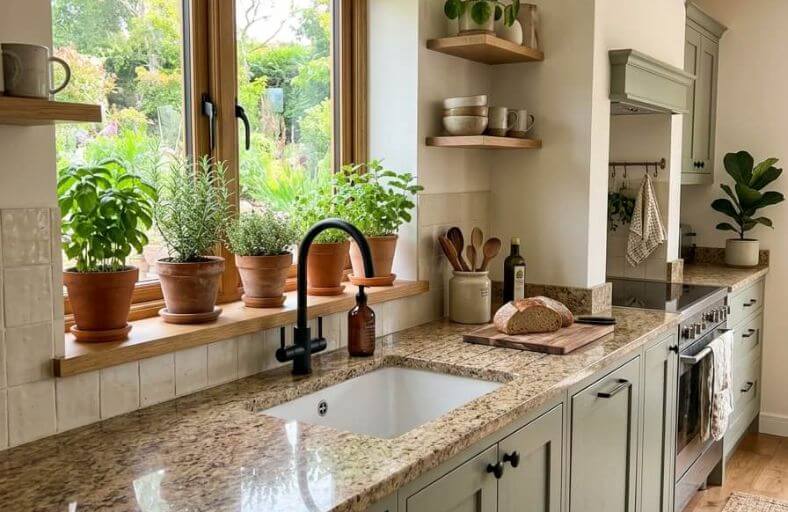
Sunlight hits a slab of Baltic Brown granite and suddenly those pinkish beige rosettes jump out at you.
Many homeowners treat brown granite as a single dark block of color but these natural stones are actually a complex mix of minerals like feldspar and quartz.
Choosing the wrong cabinet paint can turn your kitchen into a visual mud pit. The secret to a professional look lies in identifying the subtle undertones hiding within the stone.
Whether your granite leans toward gold, red, or deep espresso, the right pigment can transform a dated space into a modern sanctuary.
Creamy Off-Whites and Ivories
Creamy off-whites are the gold standard for neutralizing the visual weight of dark brown granite.
Unlike stark clinical whites that create a jarring and disjointed transition, shades like Sherwin-Williams Alabaster or Benjamin Moore White Dove possess subtle warm pigments that echo the stone’s natural minerals.
These colors carry a high Light Reflectance Value (LRV), typically between 75 and 85, allowing them to act as secondary light sources that brighten the entire room.
This combination is particularly effective for granites with golden or reddish flecks such as Santa Cecilia or Giallo Ornamental.
By softening the transition between the vertical cabinet planes and the horizontal stone surfaces, creamy whites create an inviting atmosphere that promotes a sense of cleanliness and organizational efficiency. It is a timeless choice that makes even smaller kitchens feel expansive and airy.
Beige and Taupe
Selecting warm neutrals like beige or taupe is a low-contrast design strategy that prioritizes visual cohesion and grounding.
When you choose a paint color that closely matches one of the mid-tones within the granite’s pattern, the cabinetry and countertops begin to function as a unified visual unit.
This approach is rooted in biophilic design, providing a sense of stability and comfort in the heart of the home.
Professional designers often rely on the 60-30-10 rule to structure these spaces, making the cabinets the 60 percent foundation.
| Paint Color | Manufacturer | Best Pairing |
| Accessible Beige | Sherwin-Williams | Tan Brown Granite |
| Shaker Beige | Benjamin Moore | Coffee Brown Granite |
| Manchester Tan | Benjamin Moore | Golden-flecked Granite |
| Kilim Beige | Sherwin-Williams | Traditional Styles |
These shades are especially effective in traditional or rustic kitchens where the goal is a cozy, sun-drenched aesthetic.
Sophisticated Greige
Greige has emerged as a vital tool for modernizing brown granite because it bridges the gap between traditional warmth and modern sleekness.
This hybrid of gray and beige provides enough coolness to feel contemporary without making the granite look orange or dated.
If your stone contains gray or black mineral deposits, a warm greige like Benjamin Moore Revere Pewter or Sherwin-Williams Agreeable Gray pulls those cooler flecks to the foreground while acknowledging the brown base.
The psychological impact of greige is one of mindful balance. Studies indicate that environments using balanced neutrals reduce visual fatigue and promote more thoughtful task completion during meal preparation.
It is an ideal choice for homeowners who want a clean, updated look but fear the clinical feel of pure white.
Biophilic Sage and Muted Greens
Green cabinetry is a top design trend, and because brown is found extensively in nature, it serves as the perfect organic partner for green.
Muted sage or olive greens act as visual anchors that draw the eye away from the chaotic mottling of busy granite patterns, creating a more harmonious environment.
In color psychology, green is associated with growth, renewal, and balance. Research from the University of Georgia indicates that rooms featuring sage green promote harmony and more meaningful social interactions.
For granites with pinkish-beige undertones like Baltic Brown, a green with a slight blue base, such as Sherwin-Williams Evergreen Fog, can neutralize clashing colors for a sophisticated, updated look.
Deep Navy and Moody Blues
Navy blue cabinetry offers a sophisticated departure from traditional neutrals and creates a dramatic contrast with brown stone.
This pairing is grounded in complementary color theory, as blue sits directly opposite the orange and golden tones often hidden within brown granite.
High-value contrast between dark cabinets and medium-toned countertops creates a sense of depth and luxury that works particularly well in modern farmhouse or transitional designs.
Psychologically, blue is associated with tranquility and a 12 percent increase in accuracy for detail-oriented tasks.
Designers often recommend “inky” shades like Benjamin Moore Hale Navy or Sherwin-Williams Naval to provide the visual weight needed to balance a heavy granite island.
This bold choice highlights the iridescent mineral flecks in the stone, making the entire surface sparkle under proper lighting.
Monochromatic Espresso and Rich Browns
Rich espresso or dark chocolate cabinetry creates a luxurious, monochromatic “night kitchen” aesthetic that feels both grounded and expensive.
This strategy is most successful when you prioritize a variety of textures to avoid a flat or muddy look.
For instance, pairing a highly polished granite surface with a matte or satin cabinet finish creates tactile interest that defines each architectural plane.
| Design Element | Recommended Strategy | Benefit |
| Cabinet Finish | Matte or Satin | Softens visual weight |
| Granite Sheen | Polished or Leathered | Adds geological depth |
| Hardware | Soft Gold or Brass | Enhances warm highlights |
Dark browns promote feelings of stability and comfort. However, because dark surfaces absorb more light, professionals suggest increasing your artificial lighting by 25 to 30 percent.
Incorporating glass-front doors or open shelving can also provide the “visual breathing room” necessary to prevent the space from feeling cave-like.
Soft Light Gray
Light gray is a modern, minimalist alternative for homeowners who want to move away from traditional beige but find stark white too maintenance-heavy.
Gray acts as a “chameleon” color, and its effectiveness depends entirely on matching the secondary flecks within your granite.
If your stone features silver, charcoal, or black mineral inclusions, a cool-toned gray will pull those modern elements to the foreground.
In smaller kitchens, light gray vertical surfaces help the room feel airier while the brown granite provides a solid horizontal anchor.
This neutral tone is proven to reduce stress and promote mindful cooking practices, encouraging a calmer morning routine.
Popular choices like Sherwin-Williams Repose Gray provide a sleek, updated look that bridges the gap between classic and contemporary styles.
Natural Wood Tones
Natural wood cabinetry creates an organic, biophilic connection that triggers the release of stress-reducing hormones. The key to a successful pairing is avoiding “orange-on-brown” clashes.
Modern updates focus on cooler or more neutral wood stains, such as white oak with a clear matte finish or a medium walnut, which balance the granite’s inherent warmth.
Homeowners with natural wood cabinets report feeling more confident in their cooking abilities, perhaps due to the grounded, traditional atmosphere these materials create.
For deep brown stones like Antique Brown or Coffee Brown, a light maple or sand-toned wood provides a cozy balance that feels lived-in and timeless.
This combination celebrates the raw beauty of natural materials, making the kitchen feel like a true extension of the natural world.
Charcoal and Matte Black
Charcoal or matte black cabinetry creates a bold statement environment that modernizes even the most traditional brown granite.
This strategy is particularly effective with granites containing black mineral inclusions or dark veining, such as Coffee Brown or Black Forest.
While dark granite and dark cabinets together can create a sophisticated “night kitchen” aesthetic, it requires careful lighting to succeed.
To execute this look without overwhelming the space, designers suggest incorporating glass-front doors or open shelving to provide “visual breathing room.”
Additionally, under-cabinet LED lighting is crucial to highlight the stone’s texture and prevent the dark cabinetry from absorbing all available light.
Popular choices include Sherwin-Williams Peppercorn or Benjamin Moore Wenge for an elegant, industrial-chic finish.
Mint and Soft Lavender
For the adventurous homeowner, muted pastels offer an unexpected and chic contrast to the earthy tones of brown granite.
While initially appearing risky, these colors can highlight specific, rare minerals within the stone.
A light lavender or “dusty lilac” can beautifully complement golden highlights through subtle color opposition, while mint green provides a refreshing coastal feel.
| Pastel Shade | Mood | Best Granite Highlight |
| Mint Green | Refreshing / Airy | Earthy browns & grays |
| Dusty Lavender | Sophisticated / Chic | Golden & warm flecks |
| Soft Aqua | Coastal / Tranquil | White & tan inclusions |
The psychological impact of these lighter, cooler tones is one of freshness and tranquility, ideal for reducing the stress of a high-traffic household.
Designers suggest using these colors in transitional spaces, such as a butler’s pantry, before committing to a full kitchen renovation.
Terracotta and Burnt Orange
Leaning into the natural warmth of the stone, terracotta and clay-based tones create a Mediterranean or Southwestern vibe that feels organic and lived-in.
This strategy is most effective with granites that already possess red or copper highlights, such as Dakota Mahogany or Juparana Bordeaux.
Warm, bold tones like red and orange are scientifically known to stimulate the appetite and encourage lively conversation.
In a kitchen setting, these colors can increase food consumption by up to 25 percent, making them a strategic choice for homeowners who frequently host dinner parties.
To avoid an “overheated” look, balance these bold colors with neutral backsplashes and flooring to celebrate the “earthy” nature of the granite without clashing.
Two-Tone Cabinetry Dynamics
One of the most effective ways to balance the visual weight of brown granite is the “two-tone” approach: using a dark color for the base cabinets or island and a lighter color for the upper cabinets. In color theory, dark colors carry more visual weight.
Placing a dark color like espresso or navy on the bottom creates a solid “base” that supports the heavy granite.
Conversely, using a light color like white or cream on the upper cabinets helps draw the eye upward, making the ceiling feel higher and the overall space feel less cramped. This strategy is particularly effective for large islands.
A contrasting island cabinet color acts as a standalone furniture piece, breaking up the expanse of granite and making the kitchen feel curated rather than mass-produced.