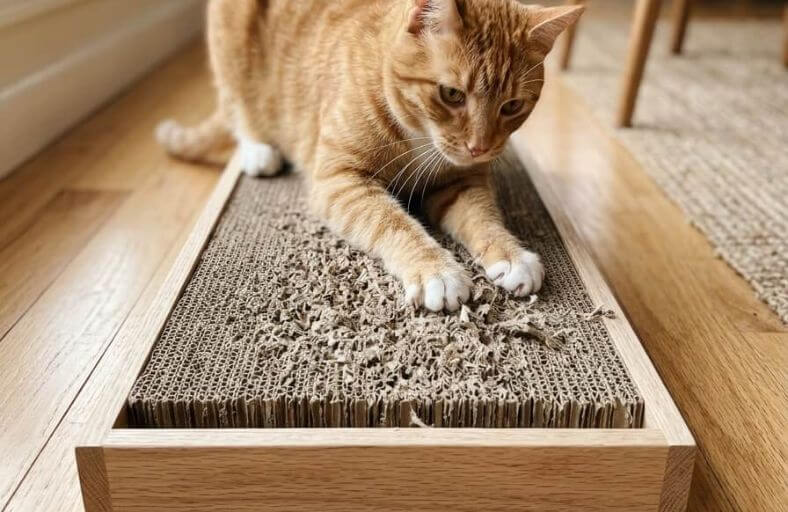
Few things are more disheartening for a cat owner than watching a beloved piece of furniture slowly get destroyed by determined little claws.
Scratching is hardwired into cat behavior, which means punishment and deterrents alone will never fully solve the problem.
What actually works is a combination of making your furniture less appealing to scratch, providing genuinely attractive alternatives that meet your cat’s natural needs, and using a few simple environmental adjustments that shift the behavior over time.
These tips are grounded in real feline behavior rather than quick fixes, giving you a strategy that protects your home and respects your cat at the same time.
Strategic Implementation of Vertical Sisal Columns
The most common mistake in feline management is choosing a scratching post based on human aesthetics rather than cat physics.
To successfully redirect a cat away from a sofa arm, you must provide a vertical surface that is at least 3 feet (0.9 meters) tall.
This height is non-negotiable because it allows your cat to achieve a full-body stretch, which is essential for musculoskeletal health and tension release.
The material matters just as much as the height. Sisal rope is widely considered the gold standard by experts because its rough, bark-like texture provides the perfect resistance for shedding old claw sheaths.
Crucially, the base must be heavy and stable; if a post wobbles or topples during a vigorous scratch, your cat will likely never use it again and return to the reliable stability of your heavy furniture.
Utilization of Horizontal Cardboard Substrates
While many cats are “vertical rakers,” a significant portion of the feline population prefers horizontal surfaces, often targeting expensive area rugs or the top cushions of ottomans. Corrugated cardboard substrates are an ideal solution for these “pickers.”
Cardboard is highly appealing because it is incredibly shreddable, providing immediate visual and tactile feedback that a territorial mark has been successfully made.
Research indicates that different life stages may influence these preferences. For instance, kittens and senior cats often gravitate toward the softer, more yielding texture of cardboard compared to the abrasive resistance of sisal.
Offering S-shaped or slanted cardboard designs can also provide varying angles for stretching, keeping your pet engaged and away from the floor-level textiles you want to protect.
Proximity and Social Significance in Placement
You could buy the world’s most luxurious scratching post, but if you hide it in a quiet corner of the laundry room, it will remain untouched.
Cats scratch to leave “chemical signposts” through scent glands in their paws, marking areas that are socially significant to the household.
They often target the furniture where you spend the most time because they want to pair their scent with yours.
To redirect the behavior, you must place the “legal” scratching alternative directly next to the object being targeted. If your cat is clawing the corner of the sectional, that is exactly where the new post should go.
Once the cat is consistently using the post, you can move it very gradually, only a few inches at a time, to a more convenient location, provided it remains within a prominent social area.
Leveraging Silvervine as a Potent Olfactory Attractant
If your cat seems indifferent to new scratching surfaces, it might be time to look beyond traditional catnip.
While roughly 30% of cats are genetically non-responsive to catnip, scientific studies show that nearly 80% of domestic cats respond positively to Silvervine (Actinidia polygama).
| Feature | Sisal Columns (Vertical) | Cardboard Pads (Horizontal) |
| Primary Benefit | Full-body muscle stretching | Satisfying shredding feedback |
| Ideal For | Cats targeting sofa arms/drapes | Cats targeting rugs/cushions |
| Recommended Size | At least 3 feet high | Varies; large enough to stand on |
| Durability | High (lasts for years) | Low (requires regular replacemen |
This botanical from East Asia contains multiple active compounds that create a more intense and comprehensive sensory experience than catnip alone.
Silvervine is most effective in powder form or as dried fruit galls, which can be rubbed or sprinkled onto a new sisal post or cardboard pad.
This creates a “euphoric anchor” that draws the cat’s attention to the designated area.
By rewarding the initial investigation with these potent scents, you help your cat form a positive association with the “legal” scratcher, significantly speeding up the training process.
Synthetic Pheromone Therapy (Feliway Classic)
Feliway Classic utilizes a synthetic version of the F3 feline facial pheromone to create a pervasive sense of security in the domestic environment.
This semiochemical mimics the natural messages cats leave when they rub their faces against furniture, signaling that the area is safe and “owned”.
By saturating the air with these safety signals, owners can significantly reduce a cat’s perceived need to engage in high-intensity territorial scratching due to anxiety.
In a rigorous triple-blind study involving over 1,000 cat-owner pairs, 83.5% of cats using the pheromone diffuser showed a measurable reduction in scratching frequency within 28 days, compared to only 68.5% in the placebo group.
This clinical approach is especially effective for households experiencing social tension or those introducing a cat to a new, unfamiliar home environment where they may feel the need to over-mark their territory.
Targeted Redirection with Feliscratch
While Feliway Classic calms the general atmosphere, Feliscratch by Feliway is an innovative tool designed for the precision redirection of scratching to a specific post.
This triple-action liquid formula integrates three essential attractants: a synthetic version of the interdigital semiochemical, catnip, and a distinctive blue dye.
The blue dye is particularly clever because it creates “visual lacerations” that mimic the sight of an existing scratch mark, triggering a cat’s biological urge to refresh the boundary. Meanwhile, the semiochemicals tell the cat that the treated surface is the primary location for territorial communication.
Large-scale clinical evaluations have shown that 74% of cats with deeply established furniture-scratching habits successfully transitioned to their designated posts within four weeks of using the product.
It serves as a highly effective “bridge” for cats that have previously ignored traditional scratching furniture.
Adhesive Textures
Double-sided adhesive tapes, popularly known as “training tape,” function as a high-efficiency tactile deterrent by exploiting a cat’s extreme sensitivity to texture.
Most felines find the sensation of a sticky or tacky surface on their paw pads to be deeply unpleasant, causing them to immediately withdraw from the targeted furniture.
These tapes, such as Sticky Paws, are generally non-toxic and transparent, allowing them to protect high-end upholstery like leather or velvet without ruining the room’s aesthetic. However, it is vital to remember that deterrents must always be paired with an attractive “legal” alternative.
If a cat’s primary scratching spot is blocked without a nearby post to accommodate their physical need, the animal may experience heightened frustration.
This emotional stress can backfire, resulting in new behavioral problems such as inappropriate urination, chewing on electrical cords, or increased aggression.
Precision Nail Trimming Protocols
Regularly maintaining the length and sharpness of your cat’s claws is one of the most effective ways to mitigate the physical impact of scratching behavior on your home.
Veterinary professionals recommend a trimming frequency of every 10 to 14 days to keep the claws blunt and prevent them from snagging on delicate fabric loops.
During the process, it is critical to identify the “quick,” which is the pink, vascularized core of the nail containing sensitive nerves; cutting into this area causes pain and bleeding.
For a stress-free experience, it is best to wait until the cat is sleepy or relaxed, such as after a meal, and use sharp, professional-grade clippers to avoid crushing the nail.
By pairing the sound of the clippers and the handling of the paws with high-value treats, you can build a positive association that makes long-term maintenance easier for both pet and owner.
Comparison of Clinical and Physical Interventions
| Method | Primary Mechanism | Success Rate/Efficacy | Best For |
| Pheromone Diffuser | Olfactory “safety” signals | 83.5% frequency reduction | Stress-related scratching |
| Feliscratch Liquid | Triple-action attractant | 74% total redirection | Training to use new posts |
| Training Tape | Negative tactile feedback | Immediate (but may backfire) | Protecting specific “hot spots” |
| Nail Trimming | Mechanical blunting | High damage reduction | Preventing fabric snags |
Implementation of Soft Plastic Claw Caps
For homeowners with high-value antique furniture or those dealing with aggressive scratchers, soft plastic claw caps offer an immediate and humane solution.
These small, vinyl sleeves are applied to a cat’s individual claws using a non-toxic, surgical-grade adhesive.
Unlike the traumatic and permanent nature of declawing, which involves bone amputation, these caps simply blunt the sharp tips of the claws without interfering with a cat’s ability to extend or retract them.
Claw caps typically remain in place for four to six weeks, eventually falling off naturally as the outer nail sheath is shed.
They come in a variety of sizes and colors, including transparent options for those who prefer a discreet look.
While the initial application may require some patience or a “two-person job” to keep the cat still, most felines quickly acclimate to the sensation within a few hours.
This method is particularly useful during the training phase when you are still teaching your cat to use their new scratching posts.
Enzymatic Scent Neutralization and Deodorization
A major reason cats return to the same sofa corner is the “scent-loop.” Felines possess specialized scent glands in their paw pads that release pheromones during the act of scratching, effectively claiming the furniture as their own.
Traditional household cleaners, especially those containing ammonia, often fail to remove these invisible chemical markers.
In fact, ammonia can sometimes mimic the scent of urine, potentially encouraging the cat to mark the area even more vigorously.
Enzymatic cleaners are specifically formulated with biological catalysts that “digest” the proteins and uric acid found in feline secretions.
To break the cycle of destruction, you should thoroughly saturate the targeted area with a professional-strength enzymatic spray and allow it to air dry naturally.
This process eliminates the territorial “anchor” that draws the cat back to the spot. For wooden furniture or doorframes, washing with unscented soapy water followed by a synthetic pheromone spray can replace anxiety markers with a sense of security.
High-Performance Fabric Selection
If you are currently shopping for new furniture, your choice of upholstery can determine whether your living room becomes a target or a sanctuary. Certain textiles are naturally resistant to feline claws because they lack a “snag point.”
Microfiber and synthetic suedes are highly recommended by interior experts because their weave is so tight that claws simply slide across the surface rather than penetrating and pulling the fibers.
Conversely, you should avoid looped or nubby fabrics like bouclé, tweed, and linen, which provide a satisfying “grip” for cats to rake against.
Another emerging trend in pet-friendly design is the use of heavy-duty outdoor fabrics, such as Olefin or high-denier polyester.
These materials are engineered for extreme durability and mechanical abrasion, making them nearly impossible for a domestic cat to shred.
By selecting fabrics with a smooth pile or a technical weave, you reduce the tactile reward the cat receives from scratching your furniture.
Fabric Performance Guide for Cat Owners
| Fabric Type | Scratch Resistance | Why Cats Love/Hate It |
| Microfiber | High | Tight weave; no loops to catch claws |
| Velvet | Moderate to High | Smooth pile; provides little “shredding” feedback |
| Outdoor Olefin | Very High | Industrial-grade durability; snag-resistant |
| Bouclé / Tweed | Very Low | Looped fibers are easy to hook and shred |
| Leather | Low | Susceptible to visible punctures and scuffs |
Environmental Enrichment (Cat-ification)
Destructive scratching is frequently a symptom of boredom or a lack of vertical territory. In a confined domestic environment, a cat that lacks a “cat highway” may turn to the back of a sofa or the top of a bookshelf to satisfy its need for elevation. “
Cat-ification” involves integrating feline-specific structures into your home’s vertical space, such as floating wall shelves, bridges, and floor-to-ceiling climbing poles.
By providing a dedicated vertical playground, you move the cat’s activity away from the floor-level furniture.
Modern systems often use high-end materials like English Chestnut bamboo and charcoal gray canvas, allowing the structures to function as stylish decor rather than an eyesore.
These elevated pathways allow your cat to survey their kingdom from a position of security, fulfilling their natural predatory instincts without damaging your upholstery.
Integration of Dedicated Furniture-Draped Scratchers
For cats that refuse to abandon a specific piece of furniture, “furniture-integrated” scratchers provide a perfect compromise.
These products include sisal-wrapped panels that drape over the armrest of a sofa or corner protectors that adhere directly to the fabric.
By covering the “hot spot” with a desirable scratching material, you allow the cat to continue marking its preferred location while the damage is confined to an easily replaceable protective layer.
This approach acknowledges the cat’s territorial preferences rather than fighting them, leading to a higher success rate in long-term management.
Some advanced designs even integrate scratching surfaces into the furniture itself, such as ottomans with sisal bases or side tables with rope-wrapped legs.
These “hidden in plain sight” solutions are especially effective for smaller homes where space for large cat trees is limited, ensuring both the cat’s needs and your aesthetic standards are met.
Energy Diversion through Interactive Play
A tired cat is a well-behaved cat. Much like human nail-biting, feline scratching can be a displacement behavior for excess energy or stress.
By engaging your cat in daily interactive play sessions using feather wands, laser pointers, or puzzle toys, you can significantly reduce their overall arousal levels.
| Strategy | Primary Goal | Recommended Tools |
| Cat-ification | Provide vertical territory | Floating shelves, cat bridges |
| Draped Scratchers | Protect specific furniture | Sisal armrest covers, corner pads |
| Interactive Play | Burn energy and reduce stress | Wand toys, food puzzles |
These sessions help burn calories and provide the mental stimulation necessary to prevent destructive habits from forming.
For the best results, play sessions should mimic the “predatory sequence”: stalk, pounce, kill, and eat.
By ending a play session with a high-protein treat or a meal, you help your cat transition into a relaxed “sleep and digest” state, leaving them with far less energy for scratching.
Foraging toys and food puzzles further enrich their environment, reducing the likelihood that your cat will turn to your furniture for entertainment.