The sharp sound of a six-foot Douglas fir slamming onto hardwood floors at 3:00 AM is a holiday jump scare no homeowner wants to experience.
One moment, your living room is a Pinterest-worthy sanctuary of twinkling lights; the next, it is a crime scene of shattered glass and pine needles.
For a cat, that beautifully decorated tree is not a symbol of peace; it is a giant, multi-level playground delivered straight to their territory.
These tips cover everything from physical barriers and scent deterrents to tree placement and ornament choices that dramatically reduce the risk of a holiday decorating catastrophe.
Location is Everything
Positioning your tree in the center of the room might look grand, but it provides a 360-degree invitation for a feline ambush.
Cats rarely leap from a standstill on the floor; instead, they utilize surrounding furniture as intermediate launchpads to reach the higher, more tempting branches.
Place your tree in a corner to limit the angles of approach and move it far away from sofas, bookshelves, or side tables that could act as jumping-off points.
This simple spatial adjustment forces your cat to rethink their strategy, as the floor-to-branch jump is much less appealing than a horizontal pounce from the couch.
If possible, choose a room that can be closed off entirely when you are not around to supervise their curious whiskers.
Aluminum Foil Moat Technique
Visual aesthetics and feline comfort rarely overlap, and that is exactly why aluminum foil is a legendary tool in the cat-proofing handbook.
Cats have highly sensitive paw pads and generally detest the crinkly sound, metallic texture, and unpredictable reflections of foil.
You can wrap the base of the tree trunk directly or create a physical “moat” by placing sheets of crinkled foil on the floor around the tree skirt.
For a more subtle look that still deters, try placing double-sided sticky tape on the tree skirt or the trunk itself.
Most cats find the sticky residue on their paws incredibly annoying and will quickly associate the tree with a “no-go” zone without you having to say a word.
Scent-Based Invisible Fences
While we associate the smell of pine and cinnamon with holiday cheer, your cat likely finds these intense aromas quite offensive.
You can harness this biological aversion to create an invisible scent barrier around your festive display.
| Scent | Effect on Cats | How to Apply |
| Citrus (Lemon/Orange) | Strong biological aversion | Spritz diluted oil or place fresh peels |
| Cinnamon | Highly irritating aroma | Mist branches or use scented pinecones |
| Peppermint | Unpleasant cooling scent |
Mix water with a few drops of citrus or cinnamon essential oil and lightly mist the lower branches and the tree skirt.
Citrus scents like lemon, orange, or lime are particularly effective because they trigger a natural rejection reflex in most felines.
Anchoring for Structural Integrity
Even the most well-behaved cat might experience a “zoomie” moment that leads them directly into the center of your festive display. To prevent a catastrophic tilt, you must treat your tree like a structural installation.
Start with a heavy, wide-based stand that offers significantly more stability than the flimsy plastic versions often found in stores.
For high-energy climbers, the most reliable safety net is clear monofilament line, also known as high-test fishing line.
Secure the trunk of the tree to a wall stud or the top of the tree to a ceiling hook using this nearly invisible line.
This anchoring system acts as a crucial tether, ensuring that if your cat does decide to scale the heights, the tree remains upright and the cat stays safe from blunt force trauma or falling ornaments.
Strategic Ornament Curation
The aesthetic of your tree should prioritize durability over delicacy to survive curious paws. When selecting your holiday palette, opt for shatterproof materials like wood, felt, or high-quality plastic.
These items can withstand being batted across the room without leaving behind dangerous glass shards.
| Material | Safety Rating | Best Placement |
| Wood or Bamboo | High | Lower branches and base area |
| Felt or Fabric | High | Any level; great for “batting” |
| Shatterproof Plastic | Moderate | Middle sections for color volume |
| Glass or Crystal | Low | Top third only; out of reach |
A professional styling secret is to leave the bottom third of the tree completely bare or decorated only with low-interest, flat items.
By removing the “prey signature” from your cat’s Eye level, you reduce the initial trigger that starts the climbing cycle. Use the table below to guide your material choices for a cat-friendly tree.
Invisible Cable Management
Twinkling lights are essentially “electrified toys” to a curious kitten. Chewing on a live wire can result in severe electrical shocks or oral burns.
To mitigate this risk, wrap all exposed power cords in heavy-duty plastic cord protectors or split-loom tubing.
This makes the cables impenetrable to sharp feline teeth. Additionally, consider winding your lights deeper into the branches, closer to the trunk, rather than letting them dangle near the tips. Using battery-operated LED lights is a safer alternative as they operate at lower voltages and do not generate heat.
Always remember to unplug the display entirely when you are not in the room to supervise your pet’s behavior.
Positive Redirection
Successfully deterring a cat from your Christmas tree often requires offering a “Yes” to balance the “No.” If you take away their favorite climbing spot, you must provide an equally enticing alternative.
This is known as the “Decoy Tree” strategy. Set up a dedicated cat tower or a small, inexpensive artificial tree in the same room, specifically decorated with catnip toys, feathers, and treats.
Reward your cat with praise and high-value treats whenever they choose their tower over your festive display.
This redirects their biological urge for vertical territory toward a safe, rewarding outlet, effectively turning the holiday season into an enrichment opportunity rather than a territorial battle.
Utilizing Physical Barriers
While we often prefer invisible solutions, sometimes a literal perimeter is the only way to guarantee a peaceful night’s sleep.
Physical barriers like pet gates or transparent playpens have become essential tools for owners of particularly adventurous kittens.
These barriers serve as a dedicated “moat” that prevents your cat from getting within swatting distance of those tempting lower branches.
You can choose a high-quality extra-tall pet gate to block off the entire room where the tree is located, or use a decorative “x-pen” to encircle the tree itself.
The key to making this work without ruining your holiday aesthetic is choosing a gate that matches your interior design. Modern black or white steel gates can look quite sophisticated when paired with the right decor.
Using a barrier is particularly important during the first few days when the tree is a “novelty” item, or whenever you are out of the house and cannot supervise the interaction.
By creating this physical distance, you eliminate the possibility of the tree toppling over and causing blunt force trauma to your pet or significant damage to your home.
High-End Design
If your cat views every traditional tree as a personal challenge, it might be time to embrace the trend of alternative arboreal displays.
One of the most effective high-end solutions is the “Parasol” or “Half-Tree.”
| Alternative Tree Type | Primary Benefit for Cats | Best Aesthetic Match |
| Parasol (Half) Tree | No lower branches for climbing | Contemporary & Sleek |
| Wall-Mounted Tree | Zero floor footprint and unreachable | Minimalist & Artful |
| Tabletop Tree | Can be placed on high surfaces | Traditional & Quaint |
These trees feature a standard trunk but the foliage only begins halfway up, typically around three to four feet from the floor.
This design removes the “rungs” that cats usually use to climb and places all ornaments and lights well above their jumping height.
Another artful alternative is the wall-mounted tree, which consists of festive boughs or garlands arranged in a triangular shape directly on the wall. Since these displays have no depth or trunk, they are virtually impossible for a cat to scale.
This approach is not just functional; it is a major interior design statement that saves floor space in smaller apartments while maintaining a lush, festive atmosphere.
“Under-the-Tree” Tunnel Hack
A brilliant hack that has recently gone viral on platforms like TikTok involves leaning into your cat’s natural desire for a safe “den” or hideout.
Instead of fighting their urge to be near the tree, you can provide a designated safe zone directly at its base.
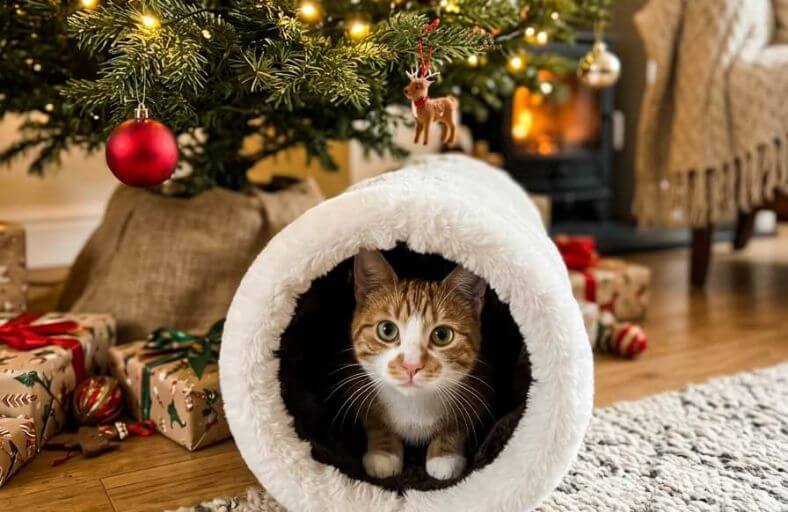
By building or placing a cozy, plush cat tunnel or a decorative “cat cave” under the tree, you redirect their focus from the branches to a comfortable sleeping spot.
This strategy works because it satisfies the feline instinct to seek cover and observe their territory from a hidden vantage point.
Many owners have found success by decorating the tunnel with festive, soft embellishments so it blends into the tree skirt.
When your cat has a warm, inviting place to curl up right beneath the twinkling lights, they are far less likely to feel the need to explore the vertical heights of the tree.
It transforms the tree from a target into a backdrop for their favorite new nap spot, keeping both your ornaments and your cat perfectly safe.