A rug that constantly slides, bunches, or creeps across your carpet is more than just a decorating annoyance.
It is a genuine tripping hazard that can make even the most beautifully styled room feel frustrating to live in.
The challenge of keeping a rug in place on top of carpet is one that far more homeowners struggle with than you might expect, and the standard advice of simply buying a rug pad does not always tell the full story.
These tips give you a range of proven solutions that work for different rug types, carpet piles, and household situations.
Specialized Dual-Surface Rug Pads
For a long-term, professional-grade solution, a dual-surface rug pad is the absolute gold standard for home safety.
Unlike standard pads made for hardwood, these are specifically engineered to bridge the gap between two textile surfaces using a unique “hook and grip” mechanism.
The construction typically features a needle-punched felt side and a natural rubber side. When installing, you must place the felt side facing down to interlock with the underlying carpet fibers.
This creates the mechanical friction needed to resist the natural shift of the carpet pile.
The rubber side faces upward, acting as a high-friction “hug” for your area rug’s backing. Beyond stability, these pads add a layer of luxury underfoot, absorb noise, and protect your floor’s integrity.
Experts suggest sizing the pad about one inch shorter than the rug on all sides to allow the edges to taper naturally toward the floor, preventing any visible ridges or trip points.
Strategic Furniture Anchoring
Sometimes the most effective stabilizer is already sitting in your room. Using heavy furniture to pin down a rug is a practical, no-cost method that doubles as a core design fundamental.
By placing the weight of your decor strategically, you can physically ground the rug against the carpet’s movement.
In a living room setting, the “front legs on” rule is a popular compromise; ensuring the front two legs of your sofa and armchairs rest on the rug creates a visual connection and provides enough weight to ground the textile.
For maximum stability, aim to have all four legs of your major pieces planted firmly on the rug.
In the dining room, the rug must be large enough to accommodate both the table and the chairs, extending at least 24 to 30 inches beyond the table edges so chairs remain anchored even when pulled out.
While weight alone helps, it does not protect the center of the rug from buckling, so consider combining this with a slim rug pad for high-traffic areas.
Silicone-Based Double-Sided Carpet Tape
For a quick fix that offers an immediate, high-friction bond, double-sided carpet tape is a reliable go-to for smaller rugs and runners.
This adhesive is typically applied along the perimeter or in a strategic “X” pattern every 30 centimeters to maximize surface contact.
| Factor | Silicone-Based Tape | Standard Rubber Tape |
| Residue Risk | Minimal to none | High risk of stickiness |
| Removal Ease | High (with heat) | Difficult; may pull fibers |
| Best Use | Long-term rug stability | Very temporary fixes |
However, not all tapes are safe for your home. You should choose silicone-based adhesives rather than traditional rubber-based versions.
Silicone options are specifically designed to be removed without leaving a sticky residue or pulling out precious carpet fibers.
To ensure a safe removal later, use a hair dryer on a low setting to soften the bonds before gently peeling the tape away. This prevents damage to the pile and keeps your base carpet in pristine condition.
Adhesive Rug Corner Grippers
If your rug is perfectly flat in the center but constantly curling at the corners, adhesive rug grippers are your targeted solution.
These small, often triangular pads are designed to stop movement where it usually begins.
They feature a dual-sided design: one side adheres permanently to the rug’s underside, while the other features a non-slip silicone surface that “grabs” the carpet fibers.
The beauty of silicone grippers lies in their reusability. Unlike tape, many of these can be wiped clean with a damp cloth to refresh their stickiness if they accumulate dust.
They are incredibly low-profile and invisible from above, which is essential for maintaining a high-end look in entryways or bedrooms where furniture might not anchor every corner.
By concentrating the friction at the perimeter, they prevent the rug from rucking up and catching your toes as you walk by.
The DIY Silicone Caulk Grid Method
For a budget-friendly alternative that works wonders on inexpensive synthetic rugs, you can create your own non-slip backing using 100% silicone caulk.
This method turns the underside of your rug into a custom-fitted gripper that bonds with the carpet pile.
| DIY Method | Recommended Rug Type | Drying Time |
| Silicone Caulk | Inexpensive/Synthetic | 24 – 48 Hours |
| Hot Glue | Very lightweight mats | Immediate |
To start, flip your rug over and apply dots or thin lines of clear caulk in a grid pattern across the center and along the edges.
It is critical to flatten these beads with a putty knife or spatula to avoid creating uncomfortable lumps that you would feel when walking.
The golden rule for this method is patience: allow the caulk to air dry completely for at least 24 to 48 hours before placing the rug back on the carpet.
If the silicone is still even slightly tacky, it may create a permanent bond with your base carpet, leading to a major cleaning disaster.
Hook-and-Loop (Velcro) Fasteners
Velcro strips offer a surprisingly powerful and adjustable way to lock a rug into position, especially in homes with kids or high-speed pets.
This hook-and-loop technology provides a reliable interlocking grip that holds even lightweight rugs firm against the shifting forces of a carpeted floor.
Application is a simple DIY project: cut the strips to length, peel the adhesive backing, and press one side onto the rug and the other onto the carpet.
While it offers a satisfying “click” into place, remember that the adhesive used on Velcro can sometimes be stronger than other tapes.
It is wise to test a small, hidden patch of your carpet first to ensure the adhesive won’t leave a stubborn residue or pull up fibers during removal.
This method is perfect for landing spots where you need to remove the rug frequently for washing or deep cleaning.
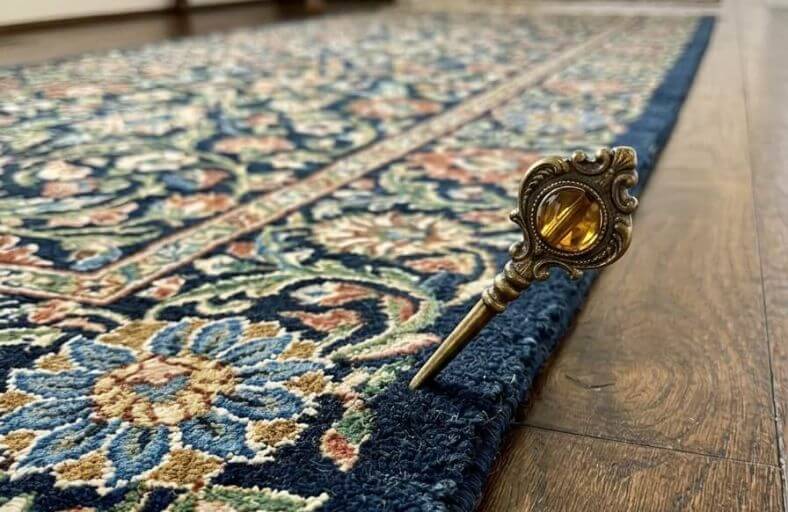
Targeted Rug Pins
For those dealing with stubborn runners or mats in high-traffic zones, specialized rug pins offer a traditional yet highly effective mechanical anchor.
These are not your average office supplies; they are engineered with a specific curve that allows them to angle through the rug’s backing and deep into the carpet pile.
The primary benefit of rug pins is their ability to physically “lock” the rug to the carpet’s foundation without ever piercing the subfloor or leaving visible damage.
They are particularly useful for stopping the leading edges of a rug from sliding forward under the weight of a footstep.
Because they are small and can be placed at an angle, they remain nearly invisible under the rug’s fibers.
This is a favorite method for designers working with low-to-medium pile carpets where adhesive solutions might struggle to find a grip. For the best results, place a pin every 12 inches along the edges most prone to moving.
Smart Material Selection
Sometimes the most effective way to stop a rug from moving is to choose the right materials from the beginning.
The physics of “rug creep” dictates that lighter, thinner rugs are significantly more likely to travel across a carpeted surface than their heavier counterparts.
| Rug Type | Stability Rating | Mechanism |
| Heavy Wool | High | Mass anchors rug into pile |
| Hand-Knotted | High | Dense weave resists shifting |
| Cotton Flatweave | Low | Needs additional padding |
| Jute / Sisal | Medium | Rough backing helps grip |
When shopping, prioritize high-density rugs, specifically those with a density of at least 250 grams per square meter.
Heavier materials like thick wool or hand-knotted silk provide the natural mass needed to increase static friction and stay grounded.
Additionally, look for rugs with natural latex backings, which offer a built-in grip compared to the slippery jute backings of lower-end machine-made rugs.
Pairing a low-pile area rug over a low-pile carpet is also a winning strategy for maximum stability and a refined look.