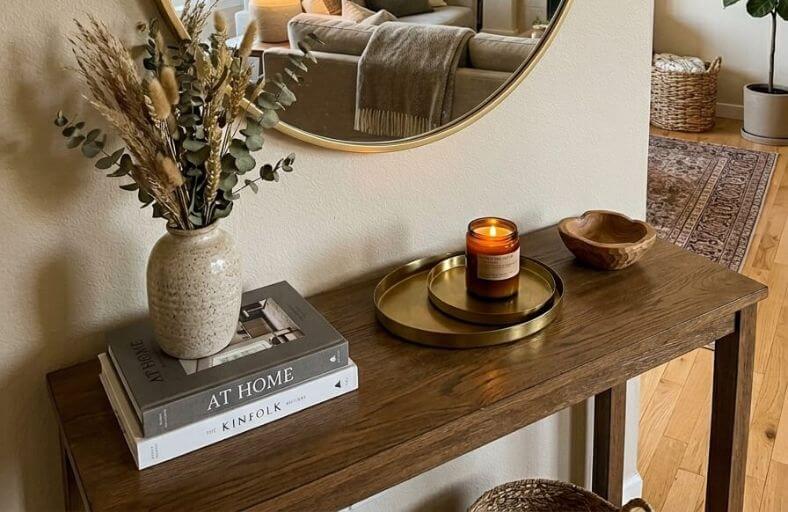
The entryway table is a small surface with a surprisingly large job to do. It needs to look beautiful, feel welcoming, reflect the personality of the home, and often serve a practical function at the same time, holding keys, mail, and everyday items that need a designated landing spot near the front door.
Balancing all of these needs without letting the table look cluttered or feel like an afterthought is where most people struggle.
These easy tips cover everything from choosing the right decorative objects and layering them at varying heights to incorporating functional elements that make your entryway table as useful as it is visually appealing.
Achieving Architectural Scale and Proportion
The most fundamental error in entryway design begins not with the decor, but with the furniture itself.
When the scale of a console table is disconnected from the architectural volume of the hallway, it creates a sense of spatial dissonance.
In large foyers with high or two-story ceilings, a thin, delicate table can appear neglected or underutilized, literally disappearing into the vastness of the room. Conversely, in narrow urban corridors, a bulky, deep console can obstruct movement and ruin the spatial flow.
Professional interior design standards suggest that for a narrow hallway, a console table should ideally be less than 12 inches deep to maintain a clear path of at least 36 inches for traffic.
However, the height and length must be substantial enough to anchor the wall. A table that is too small for its wall becomes a “floating” island that lacks authority.
Expert designers often recommend a table that spans approximately two-thirds of the available wall length to create a grounded, intentional look.
| Hallway Type | Recommended Table Depth | Suggested Material / Style |
| Narrow Corridor | 8 – 12 inches | Slim iron or floating shelf |
| Grand Foyer | 16 – 20+ inches | Heavy walnut or pedestal stone |
| Transitional Space | 12 – 15 inches | Classic wood with drawers |
The concept of “visual weight” also plays a role here. A table with open legs (like a Parsons table) feels lighter and is excellent for small spaces as it allows the eye to see the floor through it, creating an illusion of more area.
A solid chest or a skirted table, on the other hand, provides “visual gravity,” which is perfect for anchoring large, airy spaces.
The Power of the Vertical Anchor
Once the table is selected, the area above it must be treated as a frame. Without a vertical anchor, the objects on the table lack a cohesive background and appear to be drifting in space. The most effective vertical anchor is a large mirror or a significant piece of artwork.
Mirrors are the “secret weapon” of content strategists and designers because they fulfill a dual purpose: they are functionally necessary for a final appearance check before leaving and they are aesthetically transformative.
A mirror bounces light into windowless hallways, making dark entries feel invited and expansive.
The placement is critical: a mirror should be centered over the table with its bottom edge positioned roughly 6 to 8 inches above the tabletop.
Hanging a mirror too high is a common mistake that disconnects it from the furniture, making the room feel off-kilter.
For those who prefer artwork, the piece should be large enough to carry the visual weight of the console.
A single, bold canvas often works better than a cluster of small photos, which can contribute to a cluttered feeling in a high-traffic zone. The center of the art should ideally be at eye level, roughly 57 to 60 inches from the floor.
Mastering the Rule of Three and Odd Numbers
The human brain is hardwired to find beauty in patterns, but it is specifically more engaged by odd numbers. This is known as the “Rule of Three” or the “Rule of Odds.”
In interior design, grouping objects in sets of three, five, or seven creates a dynamic focal point that feels natural and relaxed, whereas even-numbered pairs often feel stiff, clinical, or overly staged.
With three items, the eye instinctively identifies a dominant center, a secondary element, and a supporting one. This creates a “visual triangle” that provides stability.
For example, a successful trio on an entryway table might include a tall lamp, a medium-sized vase, and a low stack of books.
Even when items are different in shape and texture, the group of three acts as a single, cohesive unit or “vignette” that guides the viewer’s gaze across the display.
Strategic Layering through Height and Dimension
Depth in a vignette is achieved by ensuring that no two adjacent objects are the same height. If every item on your table is the same size, the display will look flat and uninteresting, much like a grocery store shelf.
Professional decorators use a “skyline” strategy, mixing tall, mid-height, and low-profile objects to create visual movement.
A tall lamp or a high-reaching branch in a vase provides the “peak” of the skyline. Mid-height items like decorative sculptures or medium vases bridge the gap, while low items like trays, shallow bowls, or horizontal stacks of books ground the arrangement.
Layering also involves placing items slightly in front of or behind one another. For instance, leaning a small framed photo against the base of a larger mirror creates a sense of depth and “collected” history.
Taming the Chaos with a Landing Zone
The entryway is the home’s primary “transition zone,” which means it is naturally prone to clutter. The “Landing Zone” concept addresses this by creating designated spots for the items we carry daily.
Without a clear place for keys, mail, and sunglasses, these items will inevitably scatter across the table surface, destroying your beautiful styling in minutes.
The solution is to use trays, bowls, or decorative boxes to “corral the chaos”. A shallow ceramic dish or a leather tray acts as a boundary; any object placed inside it is perceived by the brain as “organized,” even if it is just a messy pile of keys.
This strategy allows the table to remain functional without sacrificing its aesthetic appeal. Expert tip: use a tray that matches the finish of your door hardware or table legs to create a cohesive look.
Integrating Seating for Ergonomic Transitions
One of the most frequent mistakes in foyer design is focusing solely on the table while ignoring the physical needs of people entering the home.
Arriving home often involves the ritual of removing shoes, and yet many entryways lack a place to sit.
This can lead to guests awkwardly leaning against walls or hopping on one foot. If space permits, tucking a pair of stools or a small bench underneath an open-leg console table is a brilliant use of square footage.
Ceramic garden stools are particularly popular because they offer a pop of color and texture while being narrow enough to fit under most tables.
For a more modern look, a Scandinavian-inspired wooden stool adds warmth and a practical perch for the daily shoe-change ritual.
Creating a Warm Welcome with Layered Lighting
Lighting is the “vibe-setter” of the home. Relying only on a harsh overhead fluorescent or LED fixture can make an entryway feel like a cold hospital corridor. To create a welcoming, high-end look, you must layer your light sources.
A table lamp is the standard choice for entryway consoles because it provides a soft, localized glow at eye level.
Content strategists recommend using warm-toned bulbs, specifically around 2700K, to mimic the inviting feel of sunset or candlelight.
| Light Source | Purpose | Recommended Bulb |
| Table Lamp | Task & Mood | 2700K Warm White |
| Wall Sconce | Architectural Accent | Dimmable LED |
| Picture Light | Art Focal Point | High CRI (Color Rendering Index) |
| Motion Sensor | Practical Safety | Warm LED for night arrivals |
If the table is long enough, placing a pair of matching lamps at each end creates a formal, symmetrical frame for the display.
In smaller spaces, a single lamp offset to one side works perfectly within the Rule of Three.
For a more dramatic effect, consider adding wall sconces or a picture light above your vertical anchor to highlight artwork.
Textural Variety
A monochromatic or single-material entryway can feel flat and uninspired. To create a space that feels “curated” rather than “purchased as a set,” you must mix your textures. This is a primary principle used by professional interior stylists to add depth.
If your console table is a smooth, dark walnut wood, you should balance that “hard” surface with “soft” or “organic” textures.
This might include a woven seagrass basket tucked underneath, a rough-hewn ceramic vase on top, or a metallic tray for keys.
Combining materials like glass, metal, stone, and fabric creates a rich tactile experience that keeps the eye moving. The goal is to have a mix of smooth, rough, shiny, and matte surfaces within your vignette.
Bringing Life with Biophilic Elements
The fastest way to “humanize” a piece of furniture is to add something living. Biophilic design, the practice of incorporating nature into our interiors, has been scientifically shown to reduce stress and improve mood. In the entryway, greenery serves to soften the straight lines of the table and walls.
You do not need a green thumb to master this. A single tall branch of eucalyptus or a cluster of dried hydrangeas in a heavy vase can add significant drama and height to your table.
For those with low-light hallways, high-quality faux branches or “ever-lasting” preserved moss bowls are excellent alternatives that provide the organic look without the maintenance.
If you have natural light, a small potted plant like a snake plant or a pothos can add a vibrant green pop that feels fresh and welcoming.
Navigating Color with the 60-30-10 Rule
Color is a powerful tool for setting the tone of your home, but it must be applied with intention.
A common mistake is either using too much color (which creates visual noise) or too little (which feels sterile). Designers often follow the 60-30-10 rule to ensure a balanced palette.
In an entryway, this typically looks like:
- 60% Main Color: The dominant tone, usually the wall color or the large rug.
- 30% Secondary Color: Found in the entryway table itself or large upholstered pieces like a bench.
- 10% Accent Color: A “pop” of color used in small items like a decorative vase, a candle, or a piece of art.
Trends are leaning toward “moody” colors like deep forest green, navy, or charcoal to create a grounded, luxurious feeling that makes the light-filled rooms further in the house feel even brighter by comparison.
Strategic Under-Table Storage
While the top of the table is for styling, the bottom is for survival. In homes without a dedicated mudroom, the entryway table must work double-duty. Utilizing the “negative space” underneath the console is key to maintaining a tidy home.
Woven baskets are a designer favorite because they provide “closed storage”, hiding messy items like kids’ shoes, umbrellas, or reusable grocery bags, while adding a beautiful, natural texture to the floor level.
If your table is long, a set of three matching baskets underneath looks incredibly organized and intentional.
For a more modern vibe, a sleek metal shoe rack or a slim cabinet can keep footwear out of sight and off the floor, which is a major win for both aesthetics and hygiene.
Storytelling and the Personal Layer
An entryway that looks like a page from a generic catalog can feel cold and impersonal. To make your house feel like a home from the second you walk in, you must add a layer of “storytelling”.
These are the small, personal details that reveal something about the people who live there.
This could be a vintage bowl you found at a flea market on your honeymoon, a collection of smooth stones from a favorite beach, or a framed family photograph.
The key is to avoid “theme in excess” (like having 20 different seashells in a coastal home). Instead, choose one or two high-impact personal items that blend seamlessly with your other decor.
These items act as conversation starters for guests and provide a sense of comfort for you every time you return home.
Seasonal Adaptability and Freshness
A static entryway table can eventually become “invisible” to you. To keep the space feeling lively and fresh, professional decorators recommend seasonal rotation.
This does not mean redecorating the whole table every three months; it means swapping out one or two small items to reflect the time of year.
In the spring, you might swap a heavy ceramic vase for a clear glass one with fresh tulips. In the fall, you can add a small heirloom pumpkin or change your candle to a scent like spiced apple or cedar.
Winter is the perfect time for a bowl of pinecones or a small evergreen sprig. These subtle shifts keep the entryway from feeling stagnant and celebrate the changing seasons with minimal effort.
Prioritizing Spatial Flow and Ergonomics
The most beautiful table in the world is a failure if you bump into it every time you carry in the groceries. Spatial flow is the “invisible” part of interior design that determines how comfortable a room feels.
When placing your table, ensure there is ample “swing space” for the front door to open fully without hitting any furniture. Also, be mindful of “visual clutter” on the floor.
Rugs should be low-pile so they don’t trip guests or catch on the door. If your hallway is exceptionally tight, consider a “floating” wall-mounted console.
This clears the floor space entirely, making the hallway look wider and making it much easier to clean.
Advanced Composition
For long entryway tables or large foyers, the basic Rule of Three might feel too sparse. This is where the 3-5-7 system comes in. This advanced layering technique treats the table as three distinct zones of detail.
- The 3 Large Anchors: A lamp, a large mirror, and the table itself.
- The 5 Medium Supports: A vase, a stack of books, a medium sculpture, a candle, and a decorative box.
- The 7 Small Details: Personal trinkets, a small bowl for keys, a single flower, a matchbox, a small photo frame, a textured bead string, and a scent diffuser.
By scaling up the number of items but maintaining an odd-numbered balance, you can fill a large space without it feeling cluttered or “staged.”
It creates a rich, layered look that feels like it was collected over many years rather than bought all at once.