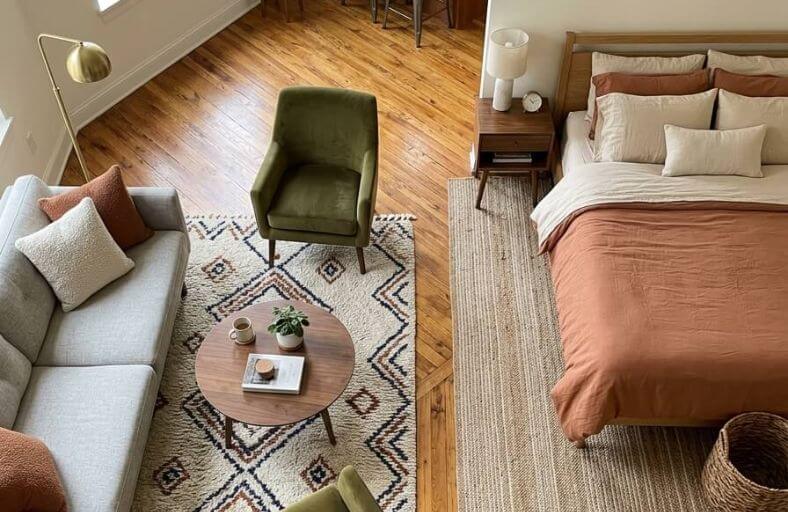
A laptop sits dangerously close to a half-eaten salad while a mountain of clean laundry threatens to avalanche from the bed onto your only “office” floor.
This spatial identity crisis is the reality of studio living, where the lines between resting, working, and eating don’t just blur; they vanish completely.
However, a small footprint does not require a small life. By applying architectural psychology and smart zoning, you can transform a single room into a sophisticated sanctuary.
It is time to stop surviving in a box and start thriving in a curated home designed for your unique daily rhythm.
Establish “Functional Zones” with the Big 3 and Triangle Theory
The primary challenge of a studio is the “hodgepodge” effect where furniture feels like a random collection rather than a home.
To fix this, you should adopt the “Big 3” concept, which involves selecting exactly three major furniture pieces to serve as your anchors.
For most, this includes the bed, a sofa, and either a desk or a dining table. By limiting yourself to three dominant items, you effectively budget your limited square footage and prevent visual clutter.
Once selected, arrange these pieces to form a visual triangle. The human eye is naturally drawn to triangular compositions because they provide a sense of balance and stability.
This geometric layout creates an “invisible architecture” that unifies the space. Instead of seeing one messy room, your brain begins to perceive three distinct, intentional zones that act as an antidote to visual chaos.
Leverage the “Cathedral Effect” for Mental Clarity
In a compact apartment, the vertical dimension is your best friend. Environmental psychology identifies the “Cathedral Effect,” a phenomenon where ceiling height directly influences how you process information.
Higher ceilings activate brain regions associated with visuospatial exploration and abstract thinking, while lower ceilings promote detail-oriented focus.
You can “hack” this effect by using vertical lines to draw the eye upward, making the room feel lighter and more expansive.
| Ceiling Height | Psychological Impact | Recommended Activity |
| High (approx 3 meters) | Fosters creativity, abstract thought, and freedom. | Socializing, brainstorming. |
| Standard (approx 2.4 meters) | Encourages focus, analytical tasks, and security. | Deep work, relaxation. |
To achieve this, mount your drapery as close to the ceiling as possible rather than just above the window frame.
Using tall, narrow bookshelves or vertical artwork also stretches the room’s proportions, tricking your brain into feeling less compressed.
Create “Invisible Walls” with Area Rugs
One of the most effective ways to designate a “room” without building a single wall is through the strategic placement of rugs. Designers refer to rugs as “islands” of function.
A rug acts as a physical and visual boundary; everything placed upon it is perceived as belonging to one specific zone.
For example, a plush rug under your bed marks the “sleeping quarters,” while a different texture under your coffee table defines the “social zone.”
Rugs provide a tactile shift that informs your subconscious when you have transitioned from one area to another. This cognitive structure is vital in a studio because it helps your brain “shut off” work mode when you step onto the rug in your sleeping area.
For the best results, ensure the rug is large enough to ground all the furniture in that specific zone so the pieces don’t look like they are “floating” in a sea of floor space.
Expand Dimensions with Optical Engineering
Mirrors are not just for checking your outfit; they are architectural tools that can visually double the size of your studio. The secret lies in “optical engineering,” or positioning mirrors to reflect light and outdoor scenery.
Placing a large mirror directly opposite a window acts as a secondary light source, bouncing natural light into the darkest corners of the apartment.
Instead of scattering multiple small mirrors, which can create “visual noise,” opt for one full-height leaning mirror or a large statement piece above a console. This creates an illusion of depth that tricks the eye into perceiving a continuous, expansive space beyond the wall.
Furthermore, using mirrored or glass furniture allows the piece to “disappear” into the room, maintaining a clear sightline and a sense of transparency.
Master Kinetic Furniture for Dual-Purpose Living
In an environment where every square foot is precious, static furniture is a luxury you cannot afford. Kinetic furniture refers to pieces that transform or move to serve multiple roles throughout the day.
A classic example is the lift-top coffee table, which functions as a standard leisure surface but elevates to become an ergonomic desk or dining table.
This eliminates the need for a separate, bulky home office setup that remains unused half the time.
Other essential “kinetic” items include storage ottomans and Murphy beds. A storage ottoman can serve as a footrest, extra guest seating, and a coffee table, all while hiding “emotional clutter” like extra blankets or shoes inside.
When choosing these pieces, focus on the “Clearance Rule”: ensure you maintain at least 30 to 36 inches of walking space around them when they are in their fully expanded state to prevent the room from feeling like a storage unit.
Design with Layered Lighting to Eliminate Shadows
Relying on a single overhead fixture is one of the quickest ways to make a studio feel flat, sterile, and small.
High-performance design requires “Layered Lighting,” which uses different light sources to create depth, warmth, and visual interest.
| Light Layer | Purpose | Examples |
| Ambient | General illumination; sets the base mood. | Ceiling fixtures, chandeliers. |
| Task | Focused light for specific activities. | Desk lamps, under-cabinet LEDs. |
| Accent | Highlights art or architectural features. | Wall sconces, uplighting for plants. |
By illuminating the corners of your room, you visually push the walls outward, making the boundaries of the apartment feel less restrictive.
For a cozy, inviting atmosphere, choose bulbs with a warm color temperature between 2700K and 3000K.
This mimicry of natural twilight helps regulate your circadian rhythms and adds a sense of comfort to the space.
Prioritize Visual Lightness with Exposed Legs
The concept of “visual weight” is critical in micro-habitation. Furniture that sits flush against the floor acts as a visual roadblock, making the floor area look smaller than it is. To counteract this, prioritize furniture with exposed, slender legs.
This allows the eye to see the floor extending all the way to the walls, creating a sense of “visual transparency” that keeps the room feeling airy.
Mid-century modern pieces are particularly effective for this strategy because they often feature tapered legs and light silhouettes.
When you can see the light and space beneath your sofa, bed, and coffee table, the entire apartment feels less crowded.
Additionally, avoid “perimeter error,” which is the instinct to push all furniture against the walls.
By floating even one chair or a small table slightly away from the wall, you create layers and depth that make the studio feel like a sophisticated home rather than a diorama.