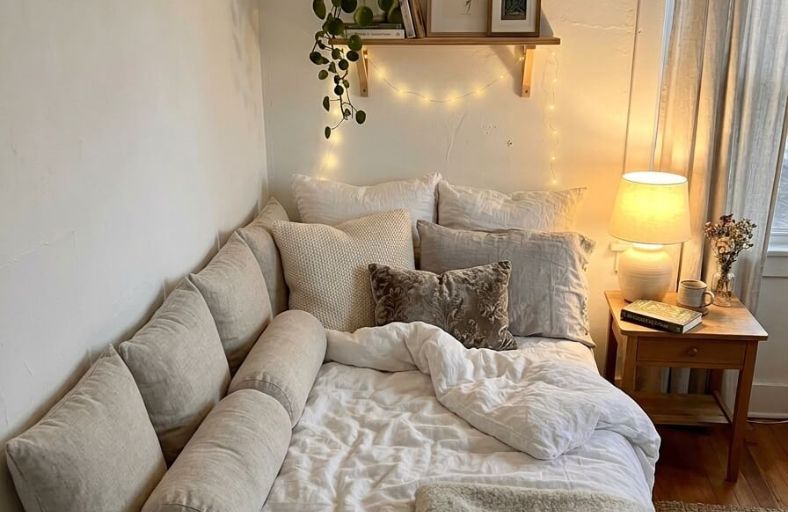
Waking up in a bedroom where every step feels like a tactical maneuver around furniture corners is a universal aesthetic nightmare.
You trip over a charging cable, bruise a shin on the bed frame, and suddenly your sanctuary feels like a storage unit with a mattress.
Designing a small space is not about merely fitting things in; it is about reclaiming the flow of your daily life.
By applying architectural ergonomics and a touch of ancient spatial wisdom, you can transform a cramped box into a curated retreat.
The right bed placement dictates everything from your sleep quality to the room’s perceived volume.
The Symmetrical Anchor
Positioning your bed in the center of the most visible wall, typically the one facing the doorway, is the gold standard for creating a sense of order. This layout relies on symmetry to trick the brain into perceiving the room as more sophisticated and organized rather than cramped.
By centering the bed, you create two equal corridors for movement, which is essential for couples to ensure both partners have easy access.
To make this work in a tight footprint, you must be disciplined with clearances. Experts recommend a minimum of 30 inches of walking space around the perimeter to avoid a claustrophobic feel.
If floor space is at a premium, replace bulky nightstands with floating shelves or wall-mounted sconces to keep the “floor breathing”.
| Layout Feature | Recommendation | Spatial Impact |
| Minimum Clearance | 30 inches | Prevents bruised shins and tight pathways |
| Side Tables | Floating or Slim | Frees up floor area for a lighter look |
| Lighting | Wall Sconces | Eliminates surface clutter on nightstands |
Perimeter Efficiency
When square footage is so restricted that a centered bed blocks the door or closet, the “Perimeter Efficiency” model is your best recovery strategy. Tucking the bed into a corner, aligning it against two perpendicular walls, immediately consolidates the floor space.
This move “parks” the largest object in the room out of the primary traffic lane, opening up a larger, contiguous area in the center for other activities like dressing or a small desk setup.
While often considered a choice for single sleepers, this layout can feel incredibly cozy and intentional. To prevent it from looking like a dorm room, treat the long side of the bed as a daybed by adding a row of plush bolster pillows against the wall.
This creates a comfortable “nook” that serves as both a sleeping sanctuary and a daytime lounge spot.
The Short Wall Rotation
In long, narrow “railroad” style bedrooms, placing the bed against the longest wall often creates two awkward, unusable pockets of space at the head and foot. The professional solution is to rotate the bed 90 degrees and place the headboard against the shorter wall.
This layout mimics high-end boutique hotels, where the entry corridor leads past storage and utilities straight into the sleeping sanctuary at the far end.
By utilizing the short wall, you preserve the entire length of the room as a wide, functional corridor. This often provides enough clearance to place a slim dresser or a shallow sideboard along the long wall without obstructing movement.
Furthermore, if the short wall has a window, this rotation allows you to wake up to natural light and a view, which significantly improves the morning experience in a small space.
Architectural Window Headboard
Standard design advice often cautions against placing a bed in front of a window due to potential drafts or light blockage. However, in micro-bedrooms, this is often the only logical placement. The “Window Integration” solution treats the window as an architectural headboard, framing your sleep space with natural light.
To prevent the room from feeling dark or heavy, designers recommend using a “see-through” headboard, such as an open metal frame or a slatted wooden design.
Layered window treatments are vital for this layout. Use sheer curtains for daytime privacy and light diffusion, paired with blackout shades mounted inside the window frame for a restorative sleep environment.
Hanging a curtain rod near the ceiling rather than just above the frame can also draw the eye upward, making the walls feel much taller than they actually are.
Loft Systems (Vertical Space Reclaim)
When the floor area is completely exhausted, the only direction left to expand is up. Loft beds are elevated platforms that detach the mattress from the floor, allowing you to reclaim 100% of the square footage underneath.
This creates two distinct zones: a dedicated “sleeping deck” and a flexible “lower level” that can house a full-sized desk, a wardrobe, or even a small sofa.
Success with a loft bed depends heavily on your ceiling height. You should have enough clearance to sit up comfortably in bed without feeling claustrophobic.
To keep the room looking modern rather than like a college dorm, look for industrial metal frames or solid wood systems that integrate lighting or shelving into the structure.
Murphy Beds
For multipurpose rooms that must serve as an office or gym during the day, the Murphy bed is the ultimate spatial magician. These units use hydraulic or spring-loaded systems to fold into a cabinet or wall when not in use.
Unlike a sofa bed, a Murphy bed uses a real mattress, ensuring you don’t have to sacrifice sleep quality for floor space.
Modern Murphy beds have evolved to be incredibly functional, often featuring integrated desks that remain horizontal when the bed is lowered.
This means your workspace stays intact even when it’s time for bed. Because these units are heavy, professional installation is mandatory to ensure they are securely anchored to the wall studs for safety.
| Murphy Bed Feature | Benefit | Pro Tip |
| Fold-down Desk | Dual-function space | Keeps work/sleep zones separate |
| LED Lighting | Built-in ambiance | Eliminates need for floor lamps |
| Cabinet Design | Hidden storage | Blends seamlessly with existing decor |
Hybrid Daybeds and Trundles
Hybrid Daybeds and Trundles offer a dual-purpose solution that disguises the sleeping area as social furniture. A daybed mimics a deep sofa during daylight hours, preventing the bedroom from feeling like it has been taken over by a large mattress.
This is particularly effective in studio apartments or multipurpose guest rooms where a traditional bed frame might appear visually heavy.
Many modern daybeds incorporate a trundle bed, which is essentially a “ghost footprint” stored in a low-profile drawer. This second mattress only consumes floor space during actual hours of sleep, making it ideal for guests or siblings sharing a room.
This setup ensures the central floor remains open for movement and daily activities until it is time to wind down.
Optical Expansion (Mirrors & Colors)
Optical Expansion uses the science of light and color to change how your brain interprets the room’s boundaries. One of the most effective tricks is color drenching (painting walls, trim, and ceilings the same light, neutral shade).
This technique erases the harsh shadow lines that define the edges of the room, creating a sense of boundlessness.
Strategic mirror placement further enhances this effect. Placing a large mirror directly opposite a window acts as an artificial window, reflecting natural light and views back into the space.
Mirrored closet doors that span from floor to ceiling can instantly double the perceived visual square footage by reflecting the floor plane.
Built-in Niches (Recessed Storage)
Custom built-in systems allow for the complete integration of the bed into the room’s architecture. By building shallow cabinetry, no more than 12 inches deep, around the headboard, you can gain significant storage without encroaching on central floor space.
These built-ins serve as wardrobes, bookshelves, and nightstands simultaneously, eliminating the need for separate furniture pieces that clutter pathways.
Recessing the bed in the middle of these shelving units prevents the frame from sticking out too far into the room.
This structuralist approach is excellent for navigating architectural obstacles like radiators or sloped ceilings that render traditional furniture unusable.
The Clutter-Free Sanctuary
The Clutter-Free Sanctuary focuses on environmental psychology to improve sleep quality in confined areas.
Research suggests that a messy room sends constant signals of unfinished business to the brain, keeping it alert and anxious rather than allowing it to wind down.
| Environmental Factor | Target Setting | Psychological Benefit |
| Temperature | 16-18°C (60-65°F) | Supports natural drop in core temp |
| Lighting | Dimmable/Warm Sconces | Signals melatonin production |
| Surfaces | Minimalist/Clean | Reduces visual noise and anxiety |
Ruthless decluttering, especially on surfaces visible from the bed, helps the mind settle into a restorative state.
Experts recommend keeping the area under the bed empty or limited to soft items like linens to avoid trapping stagnant energy and disrupting the flow of the room.
Regulating the sensory environment through lighting and temperature further supports the body’s natural circadian rhythm.