A midnight snack usually sounds like a peaceful ritual until the flick of a light switch reveals a brown, shimmering carpet of movement across your granite countertops.
This is the daunting reality of a German cockroach infestation, a pest that has evolved over 300 million years to thrive specifically in the climate-controlled comfort of our kitchens.
While a sighting feels like a personal hygiene failure, these survivors are masters of adaptation, often hitchhiking into homes through grocery bags or structural gaps.
Achieving a permanent, roach-free zone requires a strategic shift from temporary sprays to a science-backed framework of Integrated Pest Management.
Deep Clean the Hidden Grease Zones
The primary reason cockroaches linger in kitchens is the abundance of high-calorie grease and food debris hidden in hard-to-reach areas.
Standard surface cleaning often misses the zones behind the refrigerator and oven, where heat from compressor motors creates a perfect incubator for egg cases.
To start your eradication journey, you must pull these appliances out and degrease the side panels and floor with hot, soapy water.
Using a vacuum equipped with a High Efficiency Particulate Air (HEPA) filter is essential during this stage.
It allows you to physically remove live insects, shed skins, and oothecae (egg cases) without aerosolizing potent allergens that trigger asthma.
Focus your efforts on the refrigerator’s drip pan and the rear coils, which provide both moisture and warmth.
Removing this biological sludge effectively starves the colony’s base and makes your subsequent baiting efforts significantly more attractive to hungry foragers.
Seal the Structural Highways
Cockroaches are thigmotactic, meaning they have a biological preference for tight spaces where their bodies touch surfaces on all sides.
In many homes, especially apartments, they utilize plumbing penetrations and electrical conduits as highways to migrate between rooms or units. A permanent solution requires you to close these roads permanently.
Inspect the areas under your sink and behind the dishwasher for gaps where pipes enter the walls. Use silicone-based caulk or expanding foam to seal these openings tightly.
Do not overlook the baseboards or the junctions where cabinets meet the wall. Small cracks might seem insignificant to you, but for a German cockroach, they are the main entrance to a safe nesting site.
By creating a physical barrier, you prevent the constant re-seeding of your kitchen from neighboring infestations and force the current population to remain in areas where your treatments are active.
Transition to an Airtight Food Fortress
Cardboard boxes and thin plastic bags are an open invitation for pests. Cockroaches can easily chew through paper packaging, and they even find nutrition in the cellulose and glue found in cardboard.
To drive them out permanently, you must adopt an Aesthetic of Order by transferring all pantry staples into hard-sided, airtight containers.
This reflects the “Mix & Maximalist” organization trends, prioritizing high-quality glass and metal over flimsy disposables.
| Container Type | Material Benefit | Pest Protection Level |
| Glass Jars with Gaskets | Impervious to chewing; seals in scents | Maximum |
| Heavy-Duty Plastic Bins | Durable and stackable; blocks entry | High |
| Metal Tins with Seals | Chew-proof; scent-resistant | High |
| Original Cardboard | Porous; provides nesting material | Zero |
By using containers with silicone or rubber gaskets, you do more than just block physical entry; you seal in the food odors that act as a homing beacon for foraging roaches.
When the buffet no longer smells like a meal, the pests are much less likely to stick around.
Strategic Gel Baiting
The most effective chemical tool for permanent eradication is professional-grade gel bait.
Unlike aerosol sprays that only kill the insects you see and often scatter the rest into deeper hiding spots, gel baits utilize the cockroach’s social behaviors to destroy the entire nest. These baits consist of a palatable food matrix mixed with a slow-acting toxin.
When an adult cockroach feeds on a gel bait like Indoxacarb, it doesn’t die immediately. Instead, it returns to its hiding spot and spreads the poison through three critical pathways:
- Coprophagy: Young nymphs consume the toxic feces of the adults.
- Necrophagy: Cockroaches feed on the carcasses of dead colony members, ingesting the residual toxin.
- Grooming: Shared social contact distributes the active ingredient throughout the group.
For best results, apply the gel in pea-sized dots in dark corners, cabinet hinges, and near water sources.
This “domino effect” allows a tiny amount of bait to eliminate hundreds of hidden roaches you would never be able to reach with a spray.
Disrupt the Lifecycle with IGRs
While baits target the adults, Insect Growth Regulators (IGRs) are the secret weapon for long term control. These “birth control” products for insects do not kill immediately.
Instead, they use synthetic hormones like hydroprene to mimic juvenile hormones, preventing nymphs from molting into reproductive adults.
When young roaches are exposed to IGRs (such as Gentrol Point Source disks), they often develop visible physical deformities, like crinkled or twisted wings.
These individuals are sterilized and will never contribute to the next generation. A major benefit of IGRs is their impact on gravid (pregnant) females; exposure often causes them to abort their egg cases or leads to non-viable embryos.
For a permanent solution, place these disks behind major appliances and inside every kitchen cabinet to ensure the population’s reproduction rate drops below a sustainable level.
Eliminate the Midnight Watering Hole
A cockroach can survive for weeks without food, but its survival without water is limited to about seven days.
This makes moisture control the most effective limiting factor in population growth. To win the war, you must strictly follow the “3-2-1 Rule” for nightly kitchen sanitation.
- 3 Minutes of Surface Drying: Every night, use a microfiber cloth to dry your sink, faucets, and countertops completely.
- 2 Sealed Barriers: Ensure pet water bowls are emptied and damp sponges are stored in airtight bags overnight.
- 1 Plumbing Audit: Regularly check for sweating pipes or slow drips under the sink. Small amounts of condensation provide enough hydration for a localized colony to thrive.
By removing standing water, you force the pests into the open to search for moisture, increasing the likelihood they will encounter your baits.
Long-Term Barrier with Desiccant Dusts
Once you have reduced the active population, you need a long-term insurance policy. Desiccant dusts, such as boric acid or food-grade diatomaceous earth, are perfect for this.
Unlike liquid sprays that dry up and lose power, these dusts remain effective for years as long as they stay dry.
These powders work through a physical process, clinging to the roach’s exoskeleton and abrading the waxy layer, leading to death by dehydration.
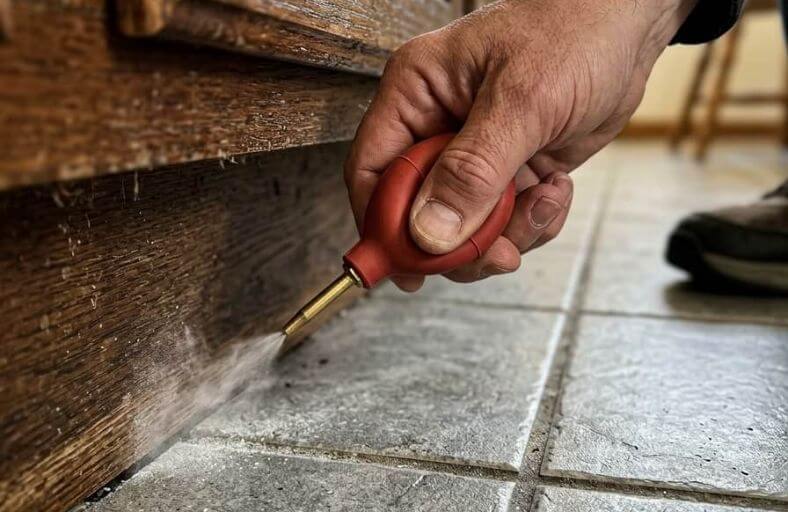
The key to success is a barely visible application. Use a hand duster to puff a fine cloud into wall voids, behind baseboards, and under the kickplates of your cabinets.
If the dust is visible to the human eye, it is too thick; cockroaches are smart enough to walk around large piles, but they will unknowingly walk through a light film and carry the toxin back to their nests.