The stillness of a midnight bedroom often shatters the moment a sleeper shifts, replaced by a sharp metallic shriek or a low wooden groan.
These sudden punctuations of sound do more than irritate; they trigger micro-arousals that reset the sleep cycle and spike stress hormones like cortisol.
A bedroom should remain a silent sanctuary for physical restoration and neurotoxin clearing. When a bed frame fails its structural duty, the resulting noise becomes an aesthetic and physiological nightmare.
Fortunately, reclaiming a silent night only requires a few household tools and a systematic approach to mechanical integrity.
Master Hardware Audit
Tightening all hardware is the most common and effective remedy for a noisy bed. Over time, the repeated dynamic load of a human body causes bolts, screws, and nuts to back out of their threads.
Even a fastener that feels secure can have enough “play” to create high-frequency friction under weight. To resolve this, remove the mattress and systematically inspect every connection point where the rails meet the headboard and footboard.
Use a wrench or hex key to ensure every bolt is snug. Be careful not to overtighten, as this can strip the threads or damage wooden components.
For a more permanent fix, applying a thread-locking adhesive to the bolt threads before re-securing them prevents vibrations from loosening the hardware again.
This simple audit restores the frame’s structural rigidity and often eliminates 90% of common squeaks.
Metal Assembly Lubrication
Metal-on-metal friction creates that unmistakable high-pitched shriek that pierces through a quiet room. When metal frame components rub together, they require a chemical barrier to reduce the coefficient of friction.
A silicone-based spray or a penetrative lubricant like WD-40 works best for these assemblies. Apply the lubricant directly to the joints, bolt heads, and any areas where the side rails hook into the frame.
For the best results, partially loosen the hardware before spraying to ensure the lubricant reaches the inner contact surfaces of the joints. Wipe away any excess to prevent staining your bedding or attracting dust over time.
This slick barrier allows the metal parts to move silently against each other, turning a mechanical failure back into a peaceful foundation for rest.
Organic Wood Lubrication
Wooden frames suffer from organic groaning caused by the natural expansion and contraction of timber. When pieces of wood rub together, they create a low-frequency noise that can be silenced using common household items like beeswax or a bar of soap.
These materials act as natural, wood-friendly lubricants that fill the grain and create a smooth surface. To apply, identify the contact points where the side rails meet the headboard or where the slats rest on the ledge.
Rub a white candle or a dry bar of soap directly onto these wooden faces until a visible layer of wax or soap residue remains.
| Material | Recommended Lubricant | Strategic Advantage |
| Metal Joints | Silicone Spray / WD-40 | Reduces high-pitched shrieking. |
| Wooden Joints | Beeswax / Bar Soap | Prevents organic groaning. |
| Fasteners | Thread-locker (Blue) | Prevents vibration-induced loosening. |
This simple coating eliminates the friction that causes the wood to groan, providing a long-lasting and scent-neutral solution.
Talcum Powder Friction Relief
For those narrow crevices where a candle or bar of soap cannot reach, talcum or baby powder acts as a brilliant dry lubricant.
This technique is particularly effective for wooden joints held together by nails or older mortise-and-tenon connections that have slightly dried out over time.
Simply sprinkle the powder directly into the cracks, holes, or gaps where the wood pieces meet. The fine particles of the powder coat the internal surfaces, significantly reducing the friction that leads to that sharp “cracking” sound when you shift your weight.
It is a clean, non-greasy method that works wonders on organic materials that have become too reactive to environmental humidity.
Plus, it leaves your bedroom smelling fresh while providing an immediate fix for deep-seated squeaks.
Slat Cushioning and Padding
The support slats under your mattress are a frequent, hidden source of noise in modern platform beds. When these slats shift or flex during movement, they rub against the side rail ledges, creating a rhythmic squeaking or thumping.
You can easily solve this by adding a soft barrier to eliminate the “clash” of materials. Use common household items like old socks, t-shirts, or kitchen towels to wrap the ends of each slat before placing them back onto the frame.
For a more permanent and professional look, apply self-adhesive felt tape or foam strips along the entire length of the rail ledge.
This cushioning prevents direct wood-on-wood or wood-on-metal contact and acts as a shock absorber for the frame’s mechanical vibrations.
Plastic Washer Buffering
If your initial hardware audit did not fully silence the bed, the issue might be the interface between the bolt head and the frame itself.
Traditional metal washers often rub against metal frames, creating a new, high-pitched source of noise.
Replacing these with plastic or rubber washers provides a much-needed buffer. These compressible materials distribute the pressure of the bolt more evenly and act as tiny shock absorbers.
Simply disassemble the noisy joint, slide a plastic washer onto the bolt, and tighten it back down securely.
| Solution Method | Best Household Material | Strategic Benefit |
| Cushioning Slats | Old Socks / Felt Tape | Absorbs wood-on-wood friction. |
| Joint Buffer | Plastic / Rubber Washers | Prevents metal-on-metal shrieking. |
| Crevice Lubrication | Talcum / Baby Powder | Reaches tight, un-waxable gaps. |
This creates a silent, stable connection that is far less likely to vibrate loose over time compared to standard metal-on-metal hardware.
Cork Wedge Stabilization
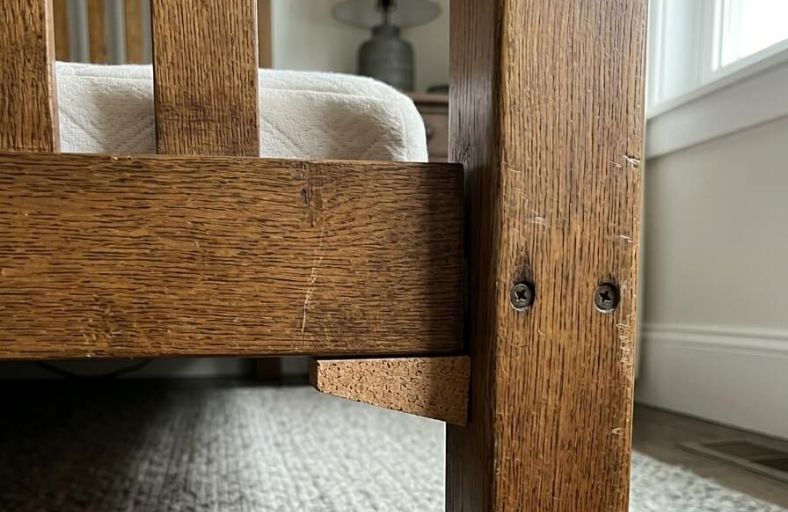
If mechanical tightening fails to bridge the gap in a loose joint, cork provides a professional-grade stabilization solution.
Unlike fabric, which can shift or compress too much over time, cork is a durable yet compressible material that creates a firm, silent cushion between two rubbing surfaces.
To apply this fix, cut small wedges or thin strips from a standard wine cork. Identify the specific gap in your wooden frame where the pieces are no longer fitting snugly and wedge the cork piece into the space.
This effectively dampens the vibration and fills the structural “play” that leads to groaning sounds.
Cork is particularly compatible with wooden frames because it responds similarly to humidity changes while maintaining its acoustic-dampening properties. It is a discrete, low-cost hack that offers a more permanent feel than temporary cloth padding.
Floor Interface and Rug Leveling
Sometimes the culprit behind a “squeaky bed” is not the frame at all, but the floor it sits on.
Uneven floorboards in older homes can prevent all four legs from making consistent contact, causing the frame to wobble and thump with every movement.
To test this, shift the frame slightly or check for a gap under each leg. You can resolve minor imbalances by placing furniture pads, cardboard shims, or even a folded towel under the shorter leg to level the structure.
For a more comprehensive fix, place a high-pile area rug beneath the entire bed. A rug acts as an acoustic absorber that prevents the legs from sliding on hardwood or tile and soaks up vibrations that would otherwise echo through the floorboards.
| Structural Issue | Mitigation Material | Acoustic Result |
| Loose Joint Gaps | Cork Wedges | Stabilizes and dampens wood groans. |
| Uneven Floor | Shims / Furniture Pads | Eliminates wobbling and thumping. |
| Floor Vibration | High-Pile Area Rug | Absorbs echoes and prevents sliding. |
This simple addition stabilizes the foundation and provides a quieter, more grounded sleeping experience.