Bed height matters more than most people realize, not just for comfort and ease of use, but for the overall look and feel of your bedroom as a whole.
A bed that sits at the right height feels more inviting, more proportional to the room around it, and significantly easier on your back and knees over time.
Whether you are dealing with a low platform bed that sits almost on the floor or simply want a more commanding, hotel-like presence in your bedroom, there are several effective ways to add height without replacing your entire bed setup.
These tips will walk you through every option clearly and practically.
High-Density Polypropylene Bed Risers
If you are looking for a quick and budget-friendly fix, heavy-duty polypropylene bed risers are the go-to choice. These sturdy plastic cups sit right under the legs of your bed frame, providing an instant boost of 3 to 8 inches.
Most high-density models can support up to 1,300 pounds, making them safe for standard mattress setups and two sleepers. They are perfect for renters because they require no tools for installation and can be removed in seconds.
To ensure maximum stability, look for models with non-slip rubber pads on the bottom to prevent the bed from sliding on hardwood or tile floors.
Carbon Steel and Reinforced Metal Extensions
For those with heavy luxury mattresses or a more modern aesthetic, metal risers offer superior structural integrity. Unlike plastic cups, these often come as screw-in replacement legs that integrate directly into the frame.
Many modern frames use a standardized M8 bolt system, allowing you to swap out short 2-inch legs for sleek 6-inch or 8-inch carbon steel versions.
These extensions can support significantly more weight, sometimes up to 9,000 pounds, and eliminate the wobble often associated with cheaper materials.
This method is a favorite for designers who want a built-in look without visible bulky blocks at the corners.
Custom Hardwood Block Elevators
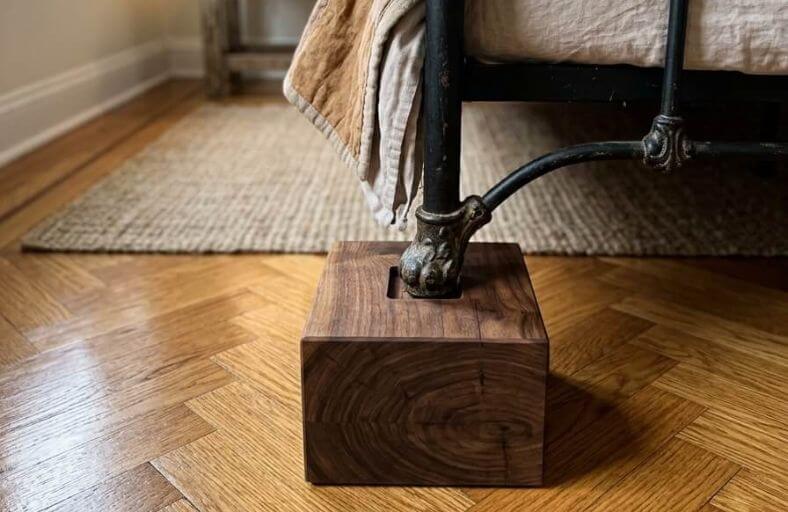
Solid wood risers are the gold standard for homeowners who value both strength and high-end design.
Crafted from hardwoods like oak or maple, these blocks can support over 3,000 pounds. The key to their safety is the vertical orientation of the wood grain, which mimics the natural weight-bearing structure of a tree.
For a professional finish, you can even drill a shallow nest into the top of each block to lock the bed leg in place, preventing any lateral shifting.
Since they are made of natural material, you can easily stain or paint them to match your existing furniture for a seamless, intentional appearance.
Modular Stackable and Adjustable Riser Systems
Flexibility is the primary benefit of modular riser systems. These kits usually come in sets of eight, allowing you to customize your height in specific increments by interlocking the components.
This is ideal if you are testing different ergonomic levels to find relief from back pain or if you plan to move the bed to a different room later. However, safety is paramount with stackable units.
| Riser Material | Est. Weight Capacity | Best For |
| Polypropylene | 1,300 lbs | Budget, temporary use |
| Hardwood | 3,000+ lbs | Aesthetics, durability |
| Carbon Steel | 9,000 lbs |
You must ensure the tiers have a deep interlocking lip or a secondary locking mechanism to prevent separation under lateral force. As a general rule, never stack them so high that the height exceeds the width of the base unit.
Mattress Foundations and Upholstered Bases
A mattress foundation is a rigid, modern alternative to a box spring that provides a significant height boost, often between 14 to 18 inches.
Unlike traditional springs, foundations like the Purple Foundation offer a solid, breathable surface that prevents sagging and is ideal for heavy memory foam or latex mattresses.
This structural replacement is more expensive than risers, but it adds incredible durability and structure to your bed while making the mattress much easier to access.
By using an upholstered foundation, you gain a sleek, mid-century modern look that feels like a deliberate design choice rather than a temporary fix.
High-Profile Box Springs vs. Low-Profile Alternatives
Box springs remain the classic method for adding height to traditional innerspring mattresses. A standard high-profile box spring typically adds about 8 to 9 inches to your bed’s profile.
If your current setup feels too low, upgrading from a low-profile version, which is usually only 4 to 5 inches tall, to a standard one is a reliable way to get that extra lift without changing your frame.
This “hidden” lift keeps your bed looking professional and uniform. However, it is important to remember that box springs are not recommended for most modern foam or hybrid mattresses, which require the unyielding support of a foundation or platform instead.
The Minimalist Lift of Bunkie Boards
Sometimes you only need a subtle change, and that is where the bunkie board becomes your “undercover hero.” Originally designed for bunk beds to maximize overhead clearance, these slim platforms are usually only 1 to 3 inches thick.
While they do not offer a dramatic height increase, they are excellent for platform beds that sit just an inch or two too low for comfortable entry.
They provide a flat, solid surface that is perfect for spreading weight uniformly across slats, which is essential for preserving the warranty of memory foam mattresses.
It is the most minimalist way to fine-tune your bed’s ergonomics without any visible structural modifications.
Standardized Replacement Bed Legs
For a truly seamless and aesthetic lift, replacing your bed legs is the professional’s choice. Many modern frames, especially from retailers like IKEA, use standardized M8 bolt attachments.
You can easily unscrew the original short legs and replace them with taller versions, such as 6-inch or 12-inch “pegs,” to create instant storage space underneath.
| Component | Typical Height | Best Mattress Compatibility |
| Mattress Foundation | 14 to 18 inches | Memory foam, latex, and hybrid |
| Standard Box Spring | 8 to 9 inches | Traditional innerspring |
| Bunkie Board | 1 to 3 inches | Foam or platform bed setups |
If your frame does not have pre-drilled holes, you can use universal fitting plates to secure new, higher legs safely.
This method avoids the bulky look of external risers and keeps the design of your bed intact. Just be sure to choose legs with a high weight capacity to maintain stability, especially for larger King or Queen setups.
Industrial Caster Wheels for Mobility and Elevation
Pushing your bed out of the way for a deep clean should not feel like a trip to the gym. Adding industrial-grade locking caster wheels to your frame can increase its height by 3 to 6 inches while adding a layer of functional mobility.
This is a fantastic solution for small or multipurpose rooms where you might need to rearrange furniture frequently.
When choosing wheels, it is essential to look for heavy-duty polyurethane or rubber models that can bear the combined weight of the mattress and sleepers without scuffing your floors.
Safety is the priority here, so ensure at least two of the wheels have a reliable locking mechanism to keep the bed perfectly stationary while you sleep.
Multi-Layered Mattress Toppers for “Top-Down” Height
Adding a cloud-like layer to the top of your mattress is the fastest way to get a subtle lift without touching the bed frame.
A high-quality mattress topper typically adds 2 to 4 inches of height and is available in materials like memory foam, latex, or down-alternative.
This is a “soft” height adjustment that is particularly beneficial for older mattresses that have become too stiff or uncomfortable.
While this method raises the sleeping surface for easier entry and exit, keep in mind that it does not create any extra storage space underneath the bed.
For hot sleepers, a natural latex topper is the best choice as it provides lift while maintaining excellent airflow.
Electronic Adjustable Bed Bases
High-tech comfort takes center stage with a motorized adjustable base. These frames are the ultimate investment in ergonomics, allowing you to raise the head and foot of the bed at the touch of a button.
Many modern models, like those from Nectar or Saatva, feature “segmental legs” that let you choose a specific base height (typically 6, 9, or 12 inches) during setup.
Beyond the vertical lift, these bases offer therapeutic benefits like “Zero Gravity” positioning to relieve back pressure and “Anti-Snore” modes to open up airways.
They often come with luxury extras like under-bed lighting and USB ports, making your bedroom feel like a high-end hotel suite.
Therapeutic Bed Wedges and Frame Inclines
Specific health needs often require a strategic incline rather than a uniform flat lift. Bed wedges are large, firm foam cushions designed to elevate just the head or the feet.
This is a common and effective recommendation for individuals dealing with acid reflux (GERD), snoring, or respiratory issues, as gravity helps keep airways clear.
| Method | Height Added | Primary Benefit |
| Caster Wheels | 3-6 inches | Ease of cleaning and mobility |
| Mattress Topper | 2-4 inches | Instant comfort and pressure relief |
| Adjustable Base | 6-12 inches | Therapeutic positioning and smart features |
| Bed Wedge | Variable angle | Relief for GERD and snoring |
Alternatively, you can use “inclined risers” to lift only the head-end of your bed frame, creating a gentle slope across the entire surface.
If you use an incline, consider adding a non-slip pad under the mattress to prevent it from slowly migrating toward the footboard during the night.
Full-Scale Loft Conversion Kits for Vertical Expansion
For those living in compact urban apartments or dorm rooms, a loft conversion kit is the ultimate solution for maximizing every square inch of vertical space.
These kits utilize heavy-duty metal or timber frames to lift your entire bed five to six feet off the floor, essentially creating a “room under a room” where you can place a desk, a cozy reading nook, or extra storage.
Safety is the primary concern here, so professional guidelines recommend leaving at least 30 inches of clearance between the top of the mattress and the ceiling to ensure you can sit up safely.
It is also vital to anchor the lofted frame to wall studs to prevent swaying, as the higher center of gravity makes the structure more susceptible to movement than a standard bed.
DIY Platform Frames and Furniture Upcycling
If you love a weekend project, building a custom platform or upcycling existing furniture is a creative way to achieve a specific height tailored to your needs.
Some clever “hacks” involve joining vintage file cabinets or sturdy wooden crates with flat connectors to create a unique, industrial-style bed base with integrated storage.
| Advanced Solution | Height Potential | Best Feature |
| Loft Conversion Kit | 60 to 72 inches | Maximum space utilization |
| DIY/Upcycled Base | Fully customizable | Unique design and built-in storage |
When building from scratch, using kiln-dried lumber is essential to prevent the wood from warping or squeaking over time.
For a modern “floating” look, you can design the platform with recessed supports set several inches inward from the edge.
This approach allows you to control the exact height down to the millimeter while ensuring the base is strong enough to handle both the weight of the mattress and the dynamic forces of movement.