Walking into a living room where every corner feels heavy with shadows and the air remains perpetually stagnant is a common design nightmare. Often, beautiful greenery is purchased on a whim only to find the space feeling cluttered rather than curated.
Transitioning from a collection of scattered pots to a professional-grade indoor garden requires more than a green thumb; it demands an understanding of spatial hierarchy and light physics.
By applying biophilic design principles, you can transform a basic seating area into a restorative sanctuary that balances architectural precision with organic warmth. This guide explores how to elevate your lifestyle through intentional botanical styling.
Establish Architectural Scale with Statement Trees
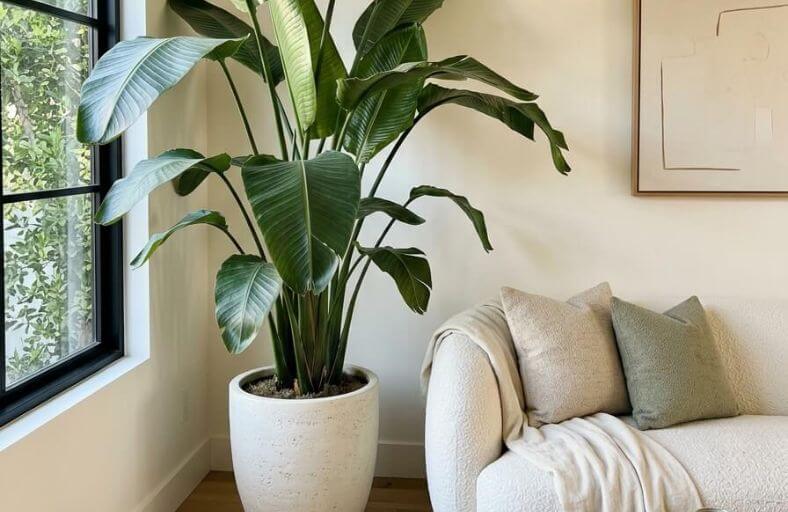
The first and most impactful step in living room arrangement is selecting a “statement” or “anchor” plant. These tree-sized specimens provide vertical emphasis and create a sense of permanence within the space.
By treating a large plant as a piece of furniture, you anchor the room’s layout and draw the eye upward, effectively increasing the perceived height of the ceiling.
A classic choice for this role is the Fiddle Leaf Fig (Ficus lyrata), prized for its broad, architectural leaves.
Alternatively, the Giant Bird of Paradise offers sweeping, tropical foliage that can reach heights of eight to ten feet indoors.
Placement is critical; these specimens are most effective when positioned in a corner to soften the transition between walls or standing sentry beside a primary seating element like a sofa.
The Power of Odd Numbers and the Rule of Threes
Once your anchor is established, focus on smaller clusters. The human brain is naturally wired to find odd-numbered groupings more harmonious and less rigid than even pairs.
The “Rule of Threes” suggests that three plants grouped together create a complete story for the eye to follow rather than a chaotic row of pots.
To apply this effectively, incorporate variations in height and volume within each cluster. Following the Golden Ratio, a cluster might feature a tall, upright Snake Plant, a mid-height, bushy Calathea, and a small, trailing Pothos.
This grouping also serves a biological purpose; tropical plants release moisture through transpiration, and clustering them creates a localized microclimate with higher humidity, helping them thrive in climate-controlled rooms.
Manipulate Texture and Leaf Morphology
The success of a plant arrangement is determined by the interplay of textures. A common pitfall is the monotone trap, where every plant has a similar leaf shape, resulting in a flat display.
To create depth, curate a diverse palette of leaf morphologies.
| Leaf Texture | Visual Impact | Recommended Species |
| Broad / Glossy | Provides weight and anchors the space | Rubber Plant, Monstera |
| Feathery / Fine | Adds airiness and softens hard edges | Parlor Palm, Ferns |
| Vertical / Sword-like | Creates height and architectural lines | Snake Plant, Yucca |
| Trailing / Cascading | Introduces movement and flow | Pothos, String of Hearts |
By pairing a bold Monstera with the delicate foliage of a fern, you create a vignette that mimics the layered complexity of a natural forest floor.
Utilize Vertical Layering and Hanging Planters
In urban apartments where floor space is limited, verticality is your greatest asset. Utilizing the full vertical volume of the room prevents the arrangement from feeling ground-heavy and allows for a more immersive experience.
Hanging planters are a primary tool for this layering, bringing greenery to eye level. Suspending plants like Pothos or Spider Plants at varying heights creates a “canopy effect” that softens the ceiling line.
High shelves and the tops of cabinets also offer prime real estate for trailing curtains of greenery.
A trailing plant on a bookshelf acts as a living waterfall, breaking up the geometric monotony of book spines and introducing organic movement to the room.
Elevate with Pedestals and Staging Tools
To move beyond the basic look of pots on the floor, professional designers use specialized staging tools like pedestals and plant stands.
These elements serve to lift plants into the visual hierarchy of the room, treating them as sculptures rather than mere accessories.
Pedestals are versatile pillars of design that can liven up a vacant corner or frame a room’s focal point, such as a fireplace or sofa.
For a modern aesthetic, a sleek metal or oak pedestal can highlight a single, unusual specimen without visually cluttering the space.
In more eclectic settings, upcycling old stools or vintage chairs as plant stands adds instant character.
Elevating plants also helps smaller specimens gain the necessary height to meet the room’s scale, ensuring they aren’t “lost” behind furniture.
Create Cohesive Surface Styling and Vignettes
The surfaces in your living room, such as coffee tables and sideboards, offer prime real estate for botanical styling. However, a lone plant in the center can feel disconnected.
The professional approach is to create a curated vignette by pairing plants with decorative objects like books, candles, or ceramic bowls.
When styling these surfaces, treat the plant as one part of a larger composition. You can apply the Rule of Three here by grouping a mid-sized plant with a stack of books and a small decorative object to create a balanced look.
To ensure the grouping feels perfectly proportioned, you can even use the mathematical Golden Ratio (1:1.618) to determine the ideal heights of your items.
This strategy ensures your greenery feels integrated into your daily lifestyle rather than standing as an isolated, forgotten object.
Explore Integrated Joinery and Room Dividers
A significant trend is integrated joinery, where plant life is built directly into the furniture or structure of the home. This approach moves plants from being add-ons to becoming integral components of the architectural design.
Examples of this include built-in planters within media consoles, shelving units that feature cascading greenery, or even open-shelving dividers that double as green walls.
In open-plan living rooms, using tall plants like Majesty Palms or Dracaenas in a row can create a living privacy screen.
This helps define distinct zones, such as separating a workspace from a relaxation area, while maintaining airflow and natural light.
Integrated joinery seamlessly merges nature with functionality, providing a lush, high-end feel that maximizes both floor space and biophilic benefits.
Curate Your Palette with Planter Materiality
The vessel that holds your plant is just as important as the plant itself for a cohesive room design.
Using mismatched plastic nursery pots can make a space look disorganized and cluttered. Instead, choose planters that relate to your room’s color scheme and material finishes.
A professional tip for choosing pots is to follow a three-color formula: pick one neutral base color, one complementary color with more presence, and one bright accent color.
For instance, you might use a large concrete grey planter for your anchor tree, a medium navy blue pot for a mid-sized cluster, and a small teal green pot for a pop of color.
To make care easier, you can use cachepots, simply nesting your plant’s functional plastic pot inside a larger decorative planter. This allows for easy rotation and maintenance without the stress of frequent repotting.
Manage Corners and Visual Weight
Living room corners are often under-utilized, which can make a space feel hollow.
Taller plants are the primary solution for rounding out these sharp angles and adding vertical interest. However, you must be conscious of the plant’s visual weight.
A dense, dark-leafed plant like the Rubber Plant (Ficus elastica) feels heavy and anchors a bright corner, while a wispy Kentia Palm feels lighter and more transparent, suitable for corners where you want to maintain a sense of space.
In small rooms, pushing all furniture against the walls is a common layout blunder that leaves the center cold and disconnected.
Strategically placing a large plant a few feet away from a corner, perhaps beside a floating armchair, helps to pull the room inward and create an intimate conversation zone. This approach resolves unused space without adding unnecessary clutter.
Design Dedicated Wellness Zones
Beyond aesthetics, your arrangement can be used to create dedicated wellness zones that support health and relaxation.
By clustering air-purifying plants near reading nooks or home offices, you create a high-oxygen environment that supports cognitive function.
NASA’s Clean Air Study highlighted species that efficiently filter indoor pollutants like formaldehyde and benzene.
| Air Purifying Species | Targeted Pollutant | Best Placement |
|---|---|---|
| Snake Plant | Formaldehyde, Nitrogen Oxides | Entryways or low-light corners |
| Peace Lily | Mold Spores, Alcohols, Acetone | Shaded reading spots |
| Spider Plant | Carbon Monoxide, Xylene | Hanging in bright kitchens |
| Boston Fern | Formaldehyde, Humidity | High shelves in living areas |
Integrating these species into high-traffic areas provides a functional health benefit while adding natural beauty.
Implement Maintenance-Driven Zoning
An arrangement that looks beautiful on day one but declines by day thirty is a failure of design. To prevent this, future-proof your living room by grouping plants with similar care needs.
This zoning approach ensures your maintenance routine is intuitive and no plant is neglected due to an inconvenient location.
Consider dividing your space into three categories. The Tropical Zone should house moisture-loving plants like Monsteras or Ferns in medium, indirect light.
The Arid Zone is perfect for high-light, drought-tolerant species like Succulents or Bird of Paradise.
Finally, create a Low-Maintenance Zone for resilient species like the ZZ Plant or Pothos that thrive in varied conditions.
This organization allows you to manage humidity and watering schedules efficiently, keeping your indoor garden healthy without constant stress.
Edit to Avoid Aesthetic Failures
The final step in plant styling is editing, which involves stepping back to ensure the space does not feel like an overcrowded retail store.
A common mistake is Uniform Height Syndrome, where all plants are placed at the same level, resulting in a flat and uninspired visual plane. To fix this, use stands or shelves to create varied levels.
Watch out for visible infrastructure like orange plastic nursery pots or messy drainage saucers, as these signal neglect rather than luxury.
Additionally, avoid the vampiric furniture effect, where large, solid coffee tables suck the energy out of a room.
Swapping these for pieces with slender legs allows air and light to circulate around your greenery. By refining these small details, your arrangement is elevated from a hobbyist collection to a professional-grade biophilic interior.