Removing old wallpaper is one of those home improvement projects that looks straightforward from a distance but quickly reveals its true nature once you actually get started.
Stubborn adhesive, layers of old paper, and walls that weren’t properly prepared before the original installation can turn what seems like a weekend job into a multi-day challenge.
That said, with the right tools, the correct technique, and a little patience, the process is entirely manageable for most homeowners without professional help.
These effective tips will walk you through the safest, most efficient methods for removing wallpaper without damaging the walls underneath, so your next decorating project starts on a clean, smooth surface.
Prep and Protect Your Room
Before wetting a single sheet of paper, you must safeguard your space because wallpaper removal is a wet, messy affair.
Start by clearing all furniture out of the room, or pushing it to the center and covering it with plastic sheets.
Next, turn off the power to the room at the breaker panel to prevent dangerous electrical shocks or fires, as water can easily seep into outlets. Keep your outlet covers on initially and cover them completely with painter’s tape.
Finally, lay old towels tightly against the baseboards to catch water runoff, and tape heavy-duty plastic drop cloths over them.
Having a large trash bin nearby will help you immediately toss wet, sticky strips, keeping your floors clean and slip-free.
Test and Identify Your Wall Type
Knowing whether your walls are plaster or drywall determines how much water and scraping they can handle. Homes built before 1950 usually feature plaster, while newer builds favor drywall.
Plaster is rock-hard and highly water-resistant, making it incredibly resilient against aggressive scrubbing and heavy moisture.
Drywall, however, has a delicate paper backing that easily waterlogs and gouges if you are too rough.
| Wall Type | Hardness | Moisture Tolerance | Knocking Sound |
| Drywall | Soft, papery core | Low, can blister easily | Hollow sound |
| Plaster | Dense, rock-hard | High, water-resistant | Solid, thick sound |
To test your wall, push a pin into an inconspicuous spot. If it goes in easily, you have drywall; if it resists, it is plaster.
Score the Surface for Maximum Penetration
If your wallpaper is vinyl-coated, foil, or washable, water cannot easily reach the glue underneath.
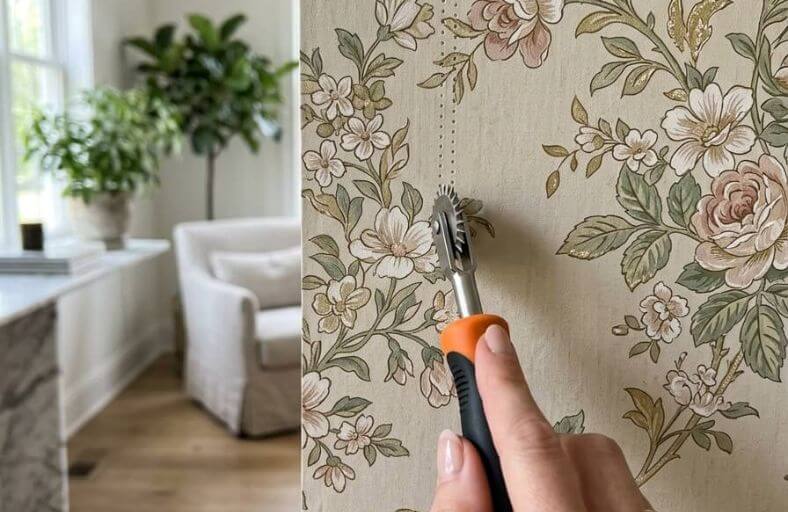
To break this barrier, you need to perforate the surface using a rotary scoring tool. Gently move the tool in light, circular scrubbing motions across the wall.
This creates thousands of tiny, shallow incisions in the outer face without slicing deep lines into the underlying drywall.
Avoid using a standard box cutter or utility knife for this step, as they can easily cut too deep, leaving long, costly scars on your walls that will require intensive patching later.
Proper scoring ensures that your stripping liquid or steam can travel straight to the adhesive layer, softening it quickly and allowing the paper to release in much larger sheets.
Soak and Strip with the Right Method
Depending on your wallpaper, choose between liquid chemical strippers, polymer gels, or steam.
Water-resistant wallpapers react best to chemical removers that break down tough glues. Gels are highly recommended for unprimed drywall because they won’t drip, run, or oversaturate the delicate cardboard face.
For historic, thick, or stubborn multi-layer papers, a thermodynamic wallpaper steamer is your best weapon.
Hold the steam plate against the scored wallpaper for about 10 to 30 seconds to melt the adhesive.
Keep your scraping knife flat, at about a 45-degree angle, and push upward to scrape the softened sheets away easily without gouging the wall.
Always wear safety goggles and rubber gloves to protect your skin from caustic strippers or hot steam.
Clean and Dissolve Residual Adhesive
Stripping the paper is only half the battle; invisible, sticky adhesive residue almost always remains on the wall.
If you paint over this residue, the water in the paint will reactivate the old glue, leading to immediate bubbling, cracking, and peeling.
To completely dissolve the paste, mix a simple DIY cleaning solution: one gallon of hot water, a tablespoon of liquid dish soap, and a tablespoon of baking soda (or a cup of white vinegar).
Wash the walls in small 3×3-foot sections using a damp sponge. Once the glue swells and takes on a soft, jelly-like texture, gently scrape it off using a flexible plastic putty knife.
Finish by wiping the entire wall down with fresh, clean water and a clean microfiber towel, then let it dry thoroughly.
Patch and Prime for a Flawless Finish
Once the walls are dry, inspect them for scratches or gouges caused by the scraping tools.
Fill any surface imperfections with professional joint compound, avoid using lightweight spackle, which is prone to shrinking. Let it dry, then sand the patches smooth with a 220-grit sanding sponge.
Finally, you must prime the entire wall. Do not use standard latex primers, as they will reactivate any microscopic glue residue you missed.
Instead, apply a high-quality oil-based primer or use a specialty acrylic sealer like Zinsser GARDZ.
| Primer Type | Best For | Glue Locking Power |
| Oil-Based | Stubborn glue & stains | High (solvent-based) |
| Zinsser GARDZ | Damaged drywall | High (dries hard) |
| Latex | Clean walls with no residue | Low (reactivates glue) |
These specialized formulas seal raw drywall, lock down adhesive residue, and create a solid, stable foundation for your gorgeous new interior paint.