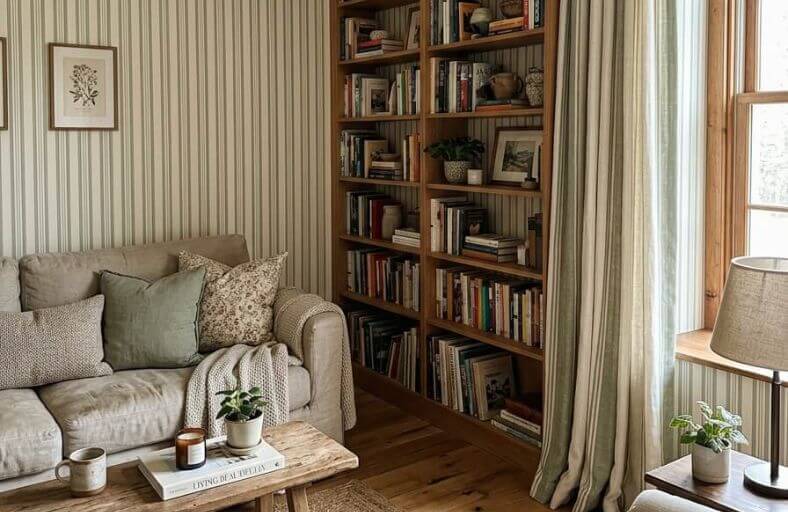
Walking into a living room only to realize the subtle pattern you loved looks like a flat, muddy smudge from the sofa is a true design heartbreak.
This nightmare happens frequently when homeowners select a beautiful, intricate pattern from a small swatch without considering how it behaves on a large scale.
A living room should serve as both a functional communal space and a restorative sanctuary, yet the wrong choice can leave walls feeling like they are encroaching on your space.
Navigating the world of prints and textures requires a strategic eye for architectural flow and visual physics.
This guide provides the essential framework to ensure your walls elevate your home rather than shrinking it.
Evaluating Architectural Context and Existing Decor
Your home possesses a unique personality that should dictate the direction of your wall treatments.
A Georgian-style property with grand proportions naturally calls for the timeless elegance of chinoiserie patterns, while a modern townhouse can easily handle oversized abstract prints that might feel jarring in a historical setting.
Before browsing rolls, assess the fixed elements like flooring, cabinetry, and statement furniture.
The relationship between the wallpaper and your current decor is the first priority for professional designers.
If your sofa features bold upholstery or intricate patterns, your wallpaper should typically act as a supporting character with a more understated design to avoid visual competition.
Conversely, if your furniture is simple or monochromatic, the walls offer a prime opportunity to make a dramatic statement.
Using wallpaper is a powerful tool for adding the specific color and texture that are often missing when a decorating scheme is built solely around paint and hard finishes.
Assessing Dimensions and Volume for Perceptual Management
The physical size of your living room serves as the primary boundary for pattern and color choices. Research indicates that the size of a space is a crucial factor in determining the appropriate scale of a design.
In compact living rooms, the goal is often to create an illusion of openness. Choosing lighter colors and small, neutral patterns helps reflect available light and softens the perceived boundaries of the room, preventing it from feeling cramped.
For expansive living rooms, a lack of pattern can make the space feel uninvitingly cold or sparse.
These larger footprints provide the creative freedom to experiment with deeper, more saturated colors and bolder designs that would overwhelm a smaller area.
Using darker tones like charcoal, dark blue, or forest green in a large room can create a greater sense of comfort and visual balance, making the vast space feel more cohesive and intentional.
Determining Pattern Orientation and Structural Flow
The direction of a pattern is a functional tool used to manipulate the perceived proportions of a room.
Vertical stripes or elongated motifs draw the eye upward toward the ceiling, creating a sense of strength, height, and stability.
This technique is particularly effective for living rooms with low ceilings that might otherwise feel oppressive.
Horizontal patterns encourage the eye to travel laterally across the space. This orientation is ideal for narrow living rooms where you want to create a sense of breadth and openness.
| Orientation | Visual Result | Ideal Use Case |
| Vertical | Increases perceived ceiling height | Low-ceiling rooms; formal settings |
| Horizontal | Increases perceived room width | Narrow living rooms or hallways |
| Diagonal | Evokes movement and energy | Playful spaces; modern accents |
| Curved | Adds grace and femininity | Softening hard architectural edges |
Integrating Pattern Scale and Visual Weight
A common misconception is that small rooms always require small patterns. In reality, large-scale motifs like oversized florals or broad geometric shapes can trick the eye into perceiving more expansive boundaries by providing a bold focal point.
These patterns create a sense of expansiveness that smaller designs might fail to achieve. Conversely, tiny, dense patterns across all four walls can actually make a small room feel cluttered and claustrophobic.
The danger of miniature details in a spacious room is that the design often disappears from a distance, looking like a solid, indistinct color rather than a curated pattern.
Professionals recommend using large motifs sparingly, perhaps on a single feature wall, while keeping the remaining walls in a simpler pattern or texture to ensure the room does not feel “surrounded”.
It is also vital to ensure the pattern repeat aligns perfectly with wall height and furniture placement to avoid awkward cut-offs.
Utilizing Texture and Tactile Depth for Ambiance
Texture is often described as the secret sauce of interior design because it adds depth and visual interest without always requiring a complex pattern.
In a living room, textured wallpapers create a luxurious and inviting ambiance that flat paint simply cannot replicate.
Materials such as grasscloth, paper-backed linen, or vinyl with fabric effects offer a subtle way to add delicate layers of color and shaded interest to a scheme.
Tactile depth is particularly valuable for creating a sense of intimacy and warmth. Luxury options like silk, hemp, or grasscloth wallpapers add a tactile appeal that grounds the room and makes it feel more human-centric.
These textures also serve a practical purpose by helping to bridge small gaps or hide minor imperfections on rough walls.
For those who admire the look of natural fibers but require more durability, faux grasscloth designs made from vinyl offer the same organic appearance with significantly higher resilience.
Engineering the Feature Wall as a Focal Point
The feature wall remains one of the most effective strategies for introducing drama into a living room without overpowering the entire space.
By selecting one wall, usually the one behind a sofa or a fireplace, to be the “superstar” of the room, you can create a centerpiece that defines the theme of the entire area.
This approach allows you to use bold colors or high-contrast patterns that might feel too intense if applied to every surface.
To execute a feature wall successfully, the chosen wallpaper must harmonize with the colors and styles of the remaining walls.
A common professional technique involves matching the background color of the accent wallpaper to the paint or subtle wallpaper on the other walls to maintain visual continuity.
This prevents the accent wall from feeling like an afterthought and instead ensures it feels like a deliberate, integrated element of the room’s architecture.
Navigating Color Theory and Chromotherapy
Color choice is a physiological decision as much as an aesthetic one. Different colors evoke specific emotions through chromotherapy, where specific light wavelengths interact with the human endocrine system.
In a living room, where the goal is a balance of relaxation and social interaction, the palette must be chosen carefully to set the desired mood.
| Color Category | Mood Effect | Living Room Application |
| Restorative (Blues, Greens) | Calming, serene, stable | Ideal for rooms meant for unwinding and tranquility |
| Social Stimulant (Reds, Oranges) | Energizing, warm, vibrant | Best for formal living rooms or social gathering spots |
| Cognitive Catalyst (Yellows) | Optimistic, clear, logical | Useful for dark rooms or areas where focus is needed |
| Authority Neutrals (Grays, Taupes) | Stable, sophisticated | A passive backdrop that allows art and furniture to stand out |
Warm tones like terracotta or deep yellows create a “hearth and home” feeling that fosters conversation.
Meanwhile, blue is not only calming but can physically make a room feel up to 5 degrees cooler, which is a major consideration in warmer climates.
Mastering Light Reflectance Value (LRV) and Reflectivity
The Light Reflectance Value (LRV) of a wallpaper indicates the percentage of light that the surface reflects versus how much it absorbs.
This measurement, which ranges from 0 (absolute black) to 100 (pure white), is a critical tool for ensuring a living room does not become overly glary or oppressive.
A wallpaper with a high LRV, such as light beige or off-white, will reflect more light back into the room, making it feel brighter and more expansive.
In smaller or poorly lit rooms, high-LRV wallpapers are essential for preventing a boxed-in feel. However, you must also consider the finish; glossy or smooth surfaces have higher light reflectance, while matte or heavily textured surfaces absorb more light even if they are light in color.
For a cozy, intimate ambiance, a designer might intentionally choose a wallpaper with a lower LRV to draw the walls in and create a sense of security.
Matching Substrate Material to Lifestyle and Maintenance
The material of your wallpaper determines how it will withstand the daily realities of your home.
While a living room is often a lower-traffic area, factors like children, pets, or high humidity can influence the required durability.
Non-woven wallpaper is currently a professional favorite because it is breathable, reducing mold risk, and is famously easy to install and remove.
For households requiring extreme resilience, vinyl is the industry favorite due to its moisture resistance and scrubbability.
| Material | Durability | Maintenance Level | Best Feature |
| Non-Woven | High | Wipeable | Breathable and easy for DIY installation |
| Vinyl | Superior | Scrubbable | Waterproof and highly resistant to scratches |
| Grasscloth | Low | Dusting only | Organic texture and natural elegance |
| Fabric/Silk | Moderate | Professional only | Luxurious, warm, and highly sophisticated |
Luxury options like grasscloth or silk add unmatched warmth and tactile appeal but are delicate and prone to staining.
These should be reserved for low-touch areas or formal lounges where they can be appreciated without risk of damage.
Optimizing for Environmental Light Temperature
The direction your living room faces dictates the quality of natural light it receives, which can radically alter how your wallpaper color is perceived. North-facing rooms receive cooler, bluish light throughout the day, which can make colors appear flat or gloomy.
To balance this, professionals suggest wallpapers with warmer undertones like soft peach, light brown, or beige to introduce a subtle warmth that offsets the cool daylight.
South-facing rooms benefit from intense, warm light all day, which can make high-LRV whites appear too yellow or washed out. In these spaces, cooler tones or mid-range colors often perform better, retaining their depth even under strong sun.
East and west-facing rooms present a unique challenge as the light shifts from warm to cool throughout the day.
Testing large swatches on multiple walls and observing them at morning, noon, and evening is the only true way to prevent an expensive color mistake.
Implementing Professional Order and Installation Standards
Meticulous planning during the ordering phase is essential to avoid installation nightmares like mismatched seams.
A golden rule of thumb for any wallpaper project is to order 10% to 20% more material than your measurements suggest.
This surplus accounts for mistakes during installation and ensures all rolls come from the same dye lot, preventing slight color variations that become glaringly obvious once applied side-by-side on a wall.
Proper wall preparation is non-negotiable for a professional finish. Walls should be properly primed and allowed to dry for up to four weeks before installation, especially for delicate materials or peel-and-stick options that require a perfectly smooth surface for full adherence.
For DIYers, non-woven “paste-the-wall” papers are recommended for their ease of handling, while complex materials like flocked or silk papers often require professional installation to ensure delicate fibers are not damaged by excess adhesive.
Embracing Biophilic Trends for Long-Term Wellbeing
As homeowners increasingly prioritize mental health, biophilic design has become a cornerstone of modern interior strategy.
Wallpaper featuring botanical prints, scenic murals, or natural textures like wood-grain and hemp helps create a grounding, harmonious effect that can reduce stress and improve overall well-being.
These designs work by blurring the boundaries between indoor and outdoor environments. Using nature-inspired motifs can transform a living room into a restorative retreat.
For example, a room that opens into a garden can be wallpapered with tree motifs or floral patterns that echo the landscape outside, creating a seamless transition that makes the interior feel part of a larger ecosystem.
This connection to nature is not just a passing trend but a deep psychological movement toward creating homes that are restorative and optimistic.