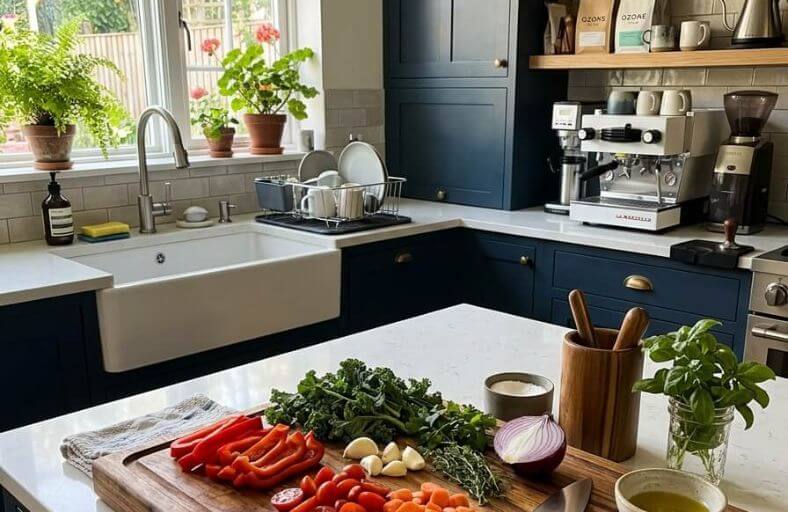
A truly functional kitchen is one where everything you need is within easy reach. The workflow feels natural, and the space supports the way you actually cook rather than working against it.
Achieving that level of functionality requires thinking carefully about layout, storage, lighting, and the relationship between the key working zones of your kitchen before a single cabinet is ordered or a tile is laid.
These tips distill the most important principles of functional kitchen design into clear, actionable guidance that applies to kitchens of every size and layout.
Establish the Golden Work Triangle
The foundation of any high-efficiency kitchen is the Work Triangle, a geometric relationship between your three most-used areas: the sink (cleaning), the refrigerator (storage), and the stove (cooking).
To prevent your cooking routine from feeling like a marathon, each leg of this triangle should be between 4 and 9 feet.
If the points are too close, the kitchen feels cramped; if they are too far apart, you’ll find yourself exhausted by the constant back-and-forth transit.
Most importantly, this path must remain a “no-fly zone”, ensure that no islands, floor cabinets, or major household traffic patterns bisect these lines.
By protecting this flow, you minimize wasted motion and keep the “chef of the house” from colliding with family members passing through.
Transition to Activity-Based Zoning
While the triangle is perfect for a single cook, modern lifestyles often involve multiple people prepping, snacking, and cleaning simultaneously. This is where activity-based zoning becomes a game-changer.
By grouping related tools and appliances into dedicated stations, you eliminate bottlenecks and allow the kitchen to function as a multi-user hub.
| Activity Zone | Core Equipment | Storage Essentials |
| Consumables | Refrigerator, Pantry | Perishables, dry goods, snacks |
| Preparation | Main Countertop | Knives, cutting boards, mixing bowls |
| Cooking | Stove, Oven, Microwave | Pots, pans, oils, spices |
| Cleaning | Sink, Dishwasher | Trash bins, detergents, towels |
| Non-Consumables | Upper/Base Cabinets | Plates, glasses, daily cutlery |
Organizing your kitchen this way ensures that the person unloading the dishwasher isn’t tripping over the person chopping onions, making the space feel twice as large and much more intuitive.
The Elbow Test for Ergonomic Heights
Standard 36-inch countertops are a one-size-fits-al solution that rarely fits anyone perfectly. To prevent chronic backache and shoulder strain, your work surfaces should be tailored to your specific height.
Use the “elbow test”: stand with your arms at a 90-degree angle; your primary prep surface should ideally sit about 4 inches (10 cm) below your elbow height.
This allows you to chop or stir without hunching over or lifting your shoulders into a stress position.
For even better ergonomics, consider a multi-level approach. Raising the sink about 4 to 6 inches higher can prevent you from stooping while washing dishes, while lowering the cooktop area can make it safer and easier to leverage your weight when whisking heavy sauces or kneading dough.
Create Landing Zones for Safety
One of the most dangerous oversights in a kitchen is the lack of landing zones, clear countertop surfaces adjacent to your major appliances.
Without these, you’re forced into a frantic hot-potato dance, desperately searching for a place to set down a searing-hot baking tray while the heat seeps through your oven mitts.
To keep your kitchen safe and functional, ensure you have a minimum of 15 inches of clear space next to your refrigerator (on the handle side) and at least 12 to 15 inches on both sides of your cooktop.
These zones serve as critical staging areas, whether you’re unloading a heavy bag of groceries or sliding a bubbling casserole out of the oven.
For the sink, aim for 24 inches on one side for prep work and 18 inches on the other for drying dishes.
These designated drop spots prevent spills, reduce the risk of burns, and keep your primary work surfaces from becoming a chaotic obstacle course.
Prioritize Deep Drawers Over Base Cabinets
If your kitchen feels like an archaeological dig every time you need a soup pot, your base cabinets are likely the culprit.
Traditional deep cabinets with fixed shelves are essentially black holes where items in the back are forgotten for years.
The functional solution is to swap those swinging doors for full-extension deep drawers.
Drawers bring the entire contents of your storage into the light and within easy reach, eliminating the need to crouch and rummage on your hands and knees.
To maximize their efficiency, use adjustable pegboards or dividers to keep plates and heavy pots from sliding around.
By investing in soft-close hardware, you also reduce the jarring physical impact and noise in the kitchen, creating a more controlled and pleasant environment for cooking.
Master Vertical Storage Logic
A functional kitchen uses every inch of height, but it does so with a plan. Ergonomic storage is based on the frequency of use rule: items you use daily should live in the Prime Zone (between your hips and your eyes), while seasonal or rare items are relegated to the high-reach areas.
| Storage Tier | Item Examples | Reach Strategy |
| High (Above 6ft) | Turkey platters, holiday decor, large vases | Use a step ladder; store rarely |
| Prime (Eye Level) | Spices, daily plates, drinking glasses | Direct reach; no bending required |
| Mid (Counter Level) | Knives, cutting boards, oils | Immediate access for active prep |
| Low (Below Hip) | Heavy cast iron, mixers, baking sheets | Use pull-out drawers for visibility |
Utilizing vertical space prevents countertop creep, where small appliances slowly take over your work surfaces.
Consider adding appliance garages or countertop towers to tuck away the toaster and coffee maker while keeping them plugged in and ready to go.
Respect the Rules of Circulation
Nothing kills the joy of cooking faster than bottlenecking, the moment an open dishwasher or oven door completely traps you in a corner.
To ensure a fluid flow, your work aisles must be wide enough to accommodate human movement even when appliances are in use.
A single-cook kitchen requires a minimum aisle width of 42 inches, while a multi-cook household should aim for at least 48 inches. This allows someone to pass behind the chef without a collision.
Furthermore, pay close attention to door swings. Ensure that your refrigerator and dishwasher doors don’t collide when opened simultaneously and that they don’t block the primary exit path of the room.
If you have a kitchen island, make sure it doesn’t break the work triangle by more than 12 inches, as this forces you to take thousands of unnecessary steps over the course of a year.
Layer Your Lighting for Precision and Mood
Proper lighting is more than just a single bulb in the center of the room. A truly functional kitchen relies on three distinct layers: task, ambient, and accent.
Task lighting is the non-negotiable hero here; under-cabinet LED strips illuminate the exact spot where you are chopping or reading recipes, preventing dangerous shadows cast by your own body.
Ambient lighting provides general warmth for social interaction, while accent lighting, such as toe-kick strips or in-cabinet LEDs, adds depth and makes the space feel significantly larger.
Don’t forget natural light; aim for window space equal to at least 8% of your kitchen’s square footage to keep the mood bright and the environment healthy.
A well-lit kitchen reduces eye strain and makes every culinary task feel easier and more enjoyable.
Integrate a Hidden Waste Management Center
Trash management is often the most overlooked detail in kitchen planning, yet it is vital for a clean-as-you-go workflow.
A standalone bin takes up valuable floor space and can quickly become an eyesore or a source of unpleasant odors.
The professional move is an integrated waste pull-out, ideally located within the cleaning zone right next to the sink or prep area.
This allows you to sweep vegetable peels or scrape plates directly into the bin in one swift motion.
Opt for a multi-compartment system to separate recyclables and compost at the source, making sustainability a built-in part of your daily routine.
Keeping your waste hidden ensures your kitchen always feels reset and ready for guests, even mid-prep.
Reclaim Black Holes with Smart Corner Solutions
Corner cabinets are notorious for becoming black holes where heavy salad spinners and seasonal platters go to be forgotten for years.
To reclaim this dead space, you must move beyond fixed shelves that force you to crawl on the floor to find a lid.
Instead, implement specialized hardware like Magic Corners or articulated caddies that slide and swing the entire contents out of the cabinet and into the light.
Another reliable classic is the Lazy Susan, a rotating shelf system that brings items from the dark back to the bright front with a simple spin.
By making every inch of your cabinetry accessible, you effectively double your usable storage without expanding your kitchen’s footprint.