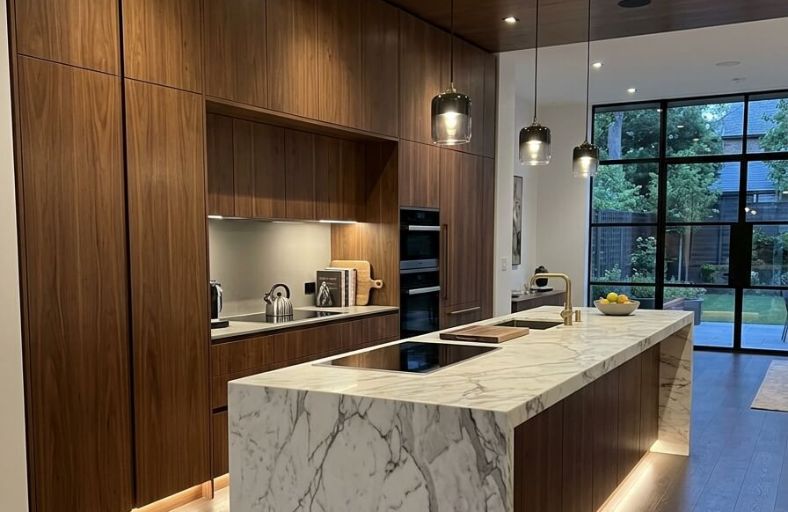
Few questions come up more often during a kitchen renovation than how much cabinets are actually going to cost.
The answer is rarely straightforward because cabinet pricing depends on a wide range of variables that can push the total budget in very different directions.
The type of cabinet construction, the material used, the finish chosen, and whether installation is included all play a significant role in the final number.
In 2026, kitchen cabinets are the single largest investment in a remodel, typically swallowing 29% to 40% of your total budget.
Understanding these numbers is the key to turning that frustration into a functional sanctuary.
Stock Cabinetry: The Budget-Friendly Baseline
Stock cabinetry serves as the essential starting point for many homeowners, offering a predictable cost structure and rapid availability.
These units are mass-produced in standard sizes (typically in three-inch increments) and are ready for immediate installation.
In the 2026 market, you can expect to pay between $100 and $300 per linear foot for stock cabinets including installation.
For a standard ten-by-ten foot kitchen, this usually translates to a total investment of $4,000 to $8,000.
While they are highly affordable, stock cabinets do have limitations. Because they come in fixed sizes, installers often use filler strips to close gaps between the cabinet and the wall, which can result in small pockets of wasted space.
Additionally, entry-level stock options often utilize lower-density particleboard for the box construction, giving them an expected lifespan of about 7 to 12 years.
They are a fantastic choice for rental properties or quick flip projects where speed and initial cost are the primary drivers.
Semi-Custom Systems: The Flexible Middle Ground
Semi-custom cabinetry is the sweet spot for most mid-range renovations. These cabinets use the same basic construction as stock units but allow for specific modifications like changing drawer configurations, adjusting cabinet depths, or choosing from a much wider library of finishes.
For this increased flexibility, the pricing typically ranges from $150 to $650 per linear foot installed.
For a typical medium-sized kitchen, semi-custom systems generally cost between $8,000 and $18,000.
The real value here lies in the upgraded components. Most semi-custom lines in 2026 include plywood boxes and soft-close hardware as standard features rather than expensive add-ons.
This tier also allows you to embrace 2026’s biggest aesthetic trends, such as two-tone designs where you pair a warm wood island with muted green or navy perimeter cabinets.
It provides a tailored look that feels high-end without the staggering price tag of fully bespoke work.
| Cabinet Tier | Cost per Linear Foot (Installed) | Typical 10×10 Total |
| Stock | $100 – $300 | $4,000 – $8,000 |
| Semi-Custom | $150 – $650 | $8,000 – $18,000 |
| Custom | $500 – $1,200+ | $15,000 – $35,000+ |
Fully Custom Cabinetry: The Luxury Investment
Custom cabinetry represents the pinnacle of kitchen design, where every single unit is bench-built to fit the exact dimensions of your home.
This approach eliminates the need for filler strips and allows for seamless integration with architectural features like vaulted ceilings.
In 2026, custom work starts at roughly $500 per linear foot and can easily exceed $1,200 for premium hardwood installations.
A full custom package for a luxury home often ranges from $25,000 to $55,000 or more. This investment is driven by high-end material science and labor.
For example, using species like white oak or walnut, which are currently trending for their Quiet Luxury aesthetic, can push material costs alone to $1,200-$1,500 per linear foot.
Custom shops also provide specialized features like handle-less push-to-open mechanisms and integrated LED lighting.
While expensive, these cabinets can last 30 years or more, often making them the more economical choice when calculated as a cost per year.
Ready-to-Assemble (RTA): The DIY Money-Saver
Ready-to-Assemble (RTA) cabinets have revolutionized the budget-tier market by transferring the labor of assembly from the factory to you.
These cabinets arrive in flat-pack boxes, which reduces shipping and storage costs by 30% to 50%.
For a standard 10×10 kitchen, high-quality plywood RTA cabinets typically cost between $1,200 and $4,400. This represents a significant saving compared to pre-assembled stock cabinets which often run $300 to $1,000 more for the same layout.
The decision to go RTA usually depends on the $128 Breakeven Rule. If your local contractor charges more than $128 per hour for labor, the time they spend assembling the units will likely eat up all your material savings.
However, if you are a confident DIYer, an experienced person can assemble a single cabinet in 15 to 20 minutes.
Modern RTA kits are often indistinguishable from pre-assembled stock options once installed, offering durable plywood construction and stylish shaker or flat-panel designs.
Cabinet Refacing: The High-Impact Transformation
Cabinet refacing is the ultimate strategy for a high-impact aesthetic change without the heavy price tag of a full gut renovation.
If your existing cabinet boxes are structurally sound, you can keep them and simply replace the doors, drawer fronts, and hardware while applying a matching veneer to the frames.
In 2026, refacing typically costs between $4,000 and $13,000, which is roughly 40% to 60% cheaper than a full replacement.
This approach is a favorite for maximizing resale value because it delivers an impressive 75% to 85% ROI.
Since you are not ripping out countertops, backsplashes, or plumbing, the project usually wraps up in just 3 to 5 days.
It allows you to update your kitchen to modern styles, such as slim shaker doors or wood veneers, while your kitchen remains fully functional throughout the process.
Choosing the Right “Bones”
The durability of your cabinets depends entirely on what is inside the box. Homeowners generally choose between three primary materials, each with a different price point and lifespan.
Particleboard is the most affordable at $70 to $150 per linear foot, but it can swell if it encounters moisture.
Medium-Density Fiberboard (MDF) costs between $100 and $250 per linear foot and is the gold standard for painted finishes because it does not expand or contract like solid wood.
For the best balance of cost and long-term durability, plywood remains the preferred choice at $150 to $300 per linear foot.
Plywood provides superior screw-holding strength and is essential for supporting heavy natural stone or quartz countertops.
| Material Type | Cost per Linear Foot | Best Application |
| Particleboard | $70 – $150 | Budget projects / rentals |
| MDF | $100 – $250 | Smooth painted finishes |
| Plywood | $150 – $300 | High-end durability / Heavy counters |
Hardwood Species
If you prefer the look of real wood, the species you select will heavily influence both the cost and the character of your kitchen.
Natural wood grains are having a massive resurgence, with 29% of homeowners now choosing wood over the traditional all-white look.
Workhorse species like Maple and Oak are durable and versatile, typically costing between $500 and $800 per linear foot.
For those seeking a Quiet Luxury aesthetic, premium species like Cherry or Walnut range from $800 to $1,200 per linear foot.
These woods offer rich, organic textures that pair beautifully with earthy color palettes, such as sage green, terracotta, or muted olive.
These materials are prized for their authenticity and craftsmanship, often outlasting cheaper painted alternatives.
Internal Ergonomics: The “More Drawers” Philosophy
Modern kitchen design has shifted toward a “more drawers, fewer doors” philosophy.
While opting for drawer systems over standard cabinets can add between $800 and $2,500 to your total project, the gain in efficiency is substantial.
Drawers allow you to reclaim 30% or more of otherwise unusable space because they bring the contents from the back of the cabinet directly to your fingertips.
Function-first design is a defining trend this year, with 94% of updated kitchens now including specialty storage.
This includes features like pull-out waste and recycling bins (64%), vertical dividers for cookie sheets (55%), and dedicated spice drawers (41%).
These internal upgrades reduce living friction and help maintain clutter-free counters, which is a major priority for today’s homeowners.
Hardware: The Jewelry of Your Kitchen
Cabinet hardware, the knobs, pulls, and hinges, serves as the tactile jewelry of the space. While individual economy knobs can start at $1 to $2, designer handles made from high-end materials like copper or zinc alloy can cost up to $200 per piece.
For an average kitchen with 20 to 40 openings, you should budget between $120 and $2,400 for the hardware and professional installation labor.
In 2026, the trend is shifting toward Minimalist Hardware or completely handleless designs using push-to-open mechanisms.
If you choose traditional hardware, matte finishes like black steel, brushed gold, and satin brass are the dominant choices.
Investing in soft-close hinges is now considered a near-standard requirement, costing between $2 and $6 per pair, ensuring both durability and a premium, quiet feel.
Integrated Utility Lighting: Ambiance and Function
Lighting is no longer just a ceiling fixture; it is increasingly being built directly into the cabinetry to enhance both task work and atmosphere.
Integrated LED systems, including under-cabinet strips, in-drawer lighting, and toe-kick illumination, typically add between $500 and $3,000 to a cabinetry budget.
Under-cabinet lighting, in particular, is noted for its high ROI, often yielding a 70% return as it makes the kitchen feel larger and cleaner.
Beyond aesthetics, smart-integrated lighting has become a functional standard in high-end designs.
Motion-sensing lights that illuminate the interior of a pantry or drawer automatically help users find items quickly without wasting energy.
These systems work harmoniously with modern matte finishes, as the non-reflective surfaces catch the soft glow of LEDs to create a deep, velvety richness in the room.
Labor Economics and Professional Installation
Labor represents a significant portion of your total project cost, often accounting for 20% to 35% of the total budget.
Skilled cabinet installers in 2026 typically charge between $50 and $150 per hour depending on the region and experience.
In high-demand markets like New Jersey, rates are often 20% to 30% higher than the national average, ranging from $45 to $65 per hour for specialized work.
Professional installation for a standard 10×10 kitchen generally costs between $2,000 and $7,500.
While a handyman may offer lower rates, hiring a specialized cabinetmaker ensures that complex features like crown molding, trim, and integrated appliances are perfectly aligned.
It is also important to budget for structural repairs; if walls are uneven or floors need leveling to support new heavy cabinetry, you should plan for an additional $200 to $600 in unexpected labor charges.
Global Trade Policy: The Tariff Impact
One of the most volatile factors influencing kitchen cabinet pricing is the Section 232 tariff policy.
Currently, a 25% tariff is applied to all imported kitchen cabinets and their component parts.
This means that an imported stock cabinet set that wholesale for $3,000 may actually cost the consumer upwards of $3,750 after the tariff pass-through.
Although a planned increase to 50% was delayed until 2027, the current 25% rate remains a major driver of cost for non-domestic products.
Homeowners can mitigate these costs by choosing domestic “U.S. Made” cabinetry, which is largely insulated from these specific tariff-driven price spikes.
However, even domestic manufacturers are facing rising prices due to general inflation and the high cost of locally sourced lumber.
When budgeting, it is essential to ask your supplier about the origin of their materials to understand if your quote is subject to sudden tariff adjustments or international shipping delays.
| Upgrade Category | Average Cost Range | ROI Impact |
| Designer Hardware | $300 – $2,400 | Moderate |
| Integrated LEDs | $500 – $3,000 | 70% |
| Labor (Installation) | $2,000 – $7,500 | High (Standard) |
Colors, Textures, and Forms
The visual language of 2026 has moved away from stark minimalism toward spaces that feel layered and expressive.
The Green Anchor is the most significant trend, with moss, sage, and eucalyptus greens serving as the new neutral foundations for the home.
This nature-inspired palette is often executed through a Multi-Chromatic Narrative, pairing warm wood base cabinets with dark, grounding upper colors like “beet burgundy” or “ink blue”.
Texture and form have also evolved, with curved edges on cabinet ends and kitchen islands becoming a hallmark of sophisticated design.
Sharp angles are being replaced by softened, organic shapes that create a more fluid and approachable workspace.
Homeowners are increasingly embracing matte finishes, which offer a deep, velvety richness that hides fingerprints while celebrating the authenticity of materials like white oak and walnut.
Smart Cabinetry: Integrating Technology
In 2026, technology is no longer an afterthought but is integrated directly into the cabinetry “bones.”
Smart features like the InFocus Drawer now allow for wireless charging directly through the wood surface of the drawer, eliminating countertop cord clutter.
High-end kitchens are also incorporating motorized pull-out shelves that extend automatically, making heavy appliances or deep pantry items accessible at the touch of a button.
Furthermore, smart inventory tracking systems are emerging in custom designs to help manage kitchen essentials and reduce food waste.
While these features significantly improve efficiency, they add a layer of complexity to the budget.
Integrating smart hardware and the necessary electrical work can add between $500 and $3,000 to the cabinetry portion of your remodel.
For many, however, the reduction in “living friction” makes this a worthwhile investment for a high-performance home.
Fiscal Analysis: ROI and Valuation Metrics
From a financial perspective, the scope of your cabinet project determines its ultimate return on investment.
Minor kitchen remodels, focused on cabinet refacing, updated countertops, and modern hardware, deliver a remarkable 113% ROI.
In contrast, major upscale gut renovations often only return 30% to 38% of their cost. This makes strategic refresh projects the smartest financial move for homeowners looking to sell in the near future.
Updated cabinetry is the primary signal to buyers that a home has been well-maintained. By focusing on high-ROI upgrades like soft-close hinges, quartz countertops (70-80% ROI), and neutral, durable materials, you can maximize your property value without over-capitalizing.
| Project Scope | Average Cost | Resale Value Added | ROI Percentage |
| Minor Remodel (Refacing) | $28,458 | $32,141 | 112.9% |
| Mid-Range Major Remodel | $82,793 | $42,156 | 50.9% |
| Upscale Major Remodel | $164,104 | $58,592 | 35.7% |
Ultimately, a well-planned cabinet upgrade recover 60% to 85% of its cost across all project types, confirming that the “heart of the home” remains the best place to invest your remodeling dollars.