Choosing a trim color for white walls might seem like a minor decision, but it has a surprisingly powerful impact on the overall feel of a room.
The right trim color can add definition, warmth, depth, or a touch of drama that makes white walls look intentional and polished rather than plain.
From crisp bright whites that create a seamless look to bold contrasting colors that make architectural details pop, the options are far more varied and exciting than most people initially realize.
The Monochromatic “Sheen Break”
For a modern, seamless look that makes any room feel exponentially larger, painting your trim the exact same color as your walls is the gold standard.
This strategy, often called color drenching, removes the visual stutter that happens when your eye hits a contrasting baseboard. Instead of using different colors, you create depth through a sheen break.
Professionals typically apply a flat or matte finish to the walls to hide imperfections, then use a satin or semi-gloss version of that same white on the trim to catch the light.
This creates a sophisticated, architectural shadow rather than a jarring color change, making it perfect for small spaces or rooms with complex angles.
It allows your furniture and art to be the true focal points while the architecture provides a clean, unified envelope.
High-Contrast Graphic Definition
If you want to anchor your space with a sense of permanence and drama, black trim acts like a sharp graphic outline for your home.
Much like a frame on a photograph, dark moldings draw the eye to the room’s structure and can even make ceilings appear higher by emphasizing vertical lines.
This look works beautifully in high-energy spaces like dining rooms but should be approached with caution in spa-like areas like bathrooms where high contrast might feel too intense.
To avoid a look that feels off, match the temperature of your black to your white wall. For instance, a cool white pairs best with a blue-toned black.
| Paint Color | Brand | Tone & Characteristic |
| Tricorn Black | Sherwin-Williams | True, neutral black |
| Black Beauty | Benjamin Moore | Sophisticated, warm lean |
| Iron Ore | Sherwin-Williams | Warm, deep charcoal |
| Off-Black | Farrow & Ball | Soft, muted black |
Soft Neutral Warmth
Moving away from clinical whites, pairing white walls with beige, taupe, or greige trim creates a welcoming atmosphere that is far easier on the eye.
This low-contrast approach is a staple of the upcoming warm minimalism movement, providing just enough definition to highlight millwork without the aggression of black.
Using a slightly darker neutral on the trim, such as a mushroom or clay tone, adds a layer of organic sophistication that feels grounded and timeless.
It is also a practical choice for high-traffic homes, as these muddier tones are much more forgiving when it comes to hiding the inevitable scuffs and dust that show up on pure white baseboards. This combination substitutes harsh lines for a soft transition, creating a homely feel.
Atmospheric Blue and Green Tones
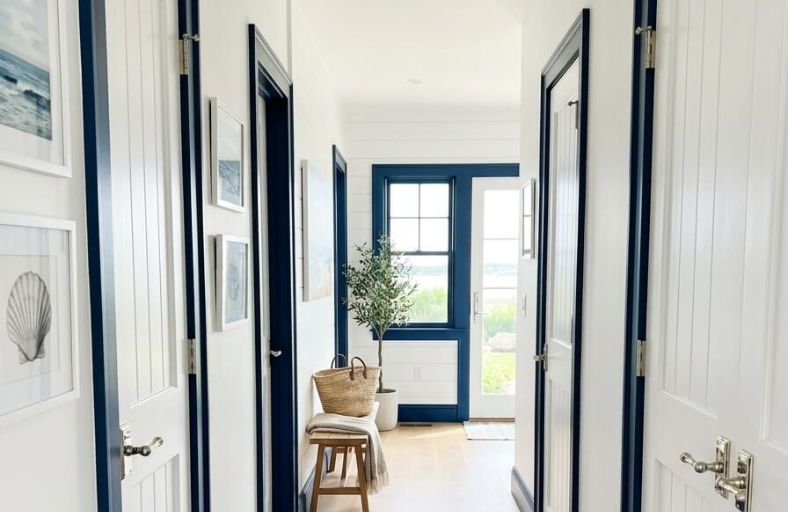
Using a soft blue or muted green on your trim can transform a plain white room into a curated sanctuary.
Navy blues provide a tailored, coastal look that feels both classic and fresh, especially when applied to doors or staircase balusters.
Alternatively, recent trends point toward biophilic shades like sage, eucalyptus, and dusty mint to bring a sense of the outdoors inside.
These botanical tones work exceptionally well in kitchens and bathrooms, where they balance the starkness of white tiles with a soothing, wellness-oriented energy.
Even a small pop of color on a window frame or a focal point on baseboards can enliven a scheme without the commitment of a full accent wall. It adds a level of character and hopeful optimism to the space.
Preserving the Soul of Natural Wood
If you are lucky enough to have original Mid-Century Modern or Craftsman wood trim, the best color might actually be no color at all.
High-quality wood is a non-renewable resource that provides a biophilic warmth white paint simply cannot replicate.
The key to making heritage wood feel intentional rather than dated lies in the specific white you choose for the walls.
For honey-toned oak or pine, use a cool or neutral white to counteract the orange lean of the wood.
If your trim is a dark walnut or mahogany, a warm white provides a rich, classic backdrop without feeling clinical.
| Wood Tone | Recommended Wall White | Why It Works |
| Warm Oak / Pine | Cool or Neutral White (e.g., BM Chantilly Lace) | Balances out yellow or orange undertones. |
| Dark Walnut / Mahogany | Warm White (e.g., SW Alabaster) | Complements the richness and depth of the wood. |
| Pale Maple / Ash | Crisp, Pure White (e.g., SW Extra White) | Enhances a clean, Scandinavian aesthetic. |
Updating the surrounding elements, like swapping builder-grade hardware for matte black or brushed brass, instantly modernizes the space while letting the natural grain shine.
Light Orientation
One of the most common mistakes is ignoring how your windows affect color. Natural light is not constant, it shifts in temperature depending on which direction your room faces. In a north-facing room, the light is consistently cool and blue-tinted.
This can make a crisp white trim look icy or even dirty if the wall undertones don’t match. To fix this, pair your white walls with trim in a warm neutral like Sherwin-Williams Antique White to inject a cozy glow.
Conversely, south-facing rooms are flooded with warm, golden light all day. This environment is the most forgiving, but it can make creamy whites look overtly yellow.
To maintain a fresh look, choose a cool-toned white for your trim to knock back the golden intensity and keep the space feeling balanced.
High-Impact Statement Accents
For the adventurous homeowner, using a bold, unexpected color on the trim creates a high-fashion pop that turns architectural details into art.
This technique is perfect for small zones like a powder room or a reading nook where you want to inject personality without overwhelming the entire house.
Vibrant shades like periwinkle, coral, or even an electric orange on a window frame can enliven a neutral scheme and create a hopeful optimism in the home.
The beauty of this approach is that it requires very little paint, often just one gallon, to completely transform a room’s energy.
Whether you choose a jewel-toned teal for your built-ins or a dusty mint for your baseboards, these colorful frames act as a counter-neutral that draws the eye to your home’s most interesting features.