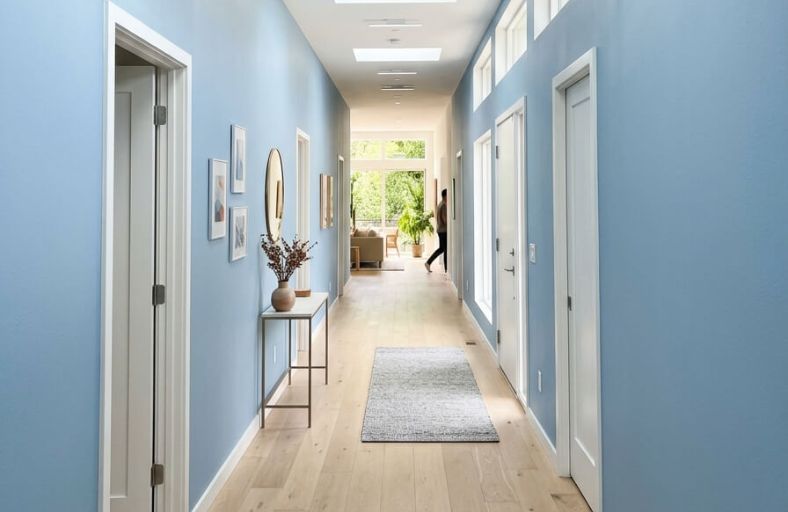
Stepping into a windowless hallway feels like entering a pressurized architectural vacuum where the home’s energy suddenly dissipates into a stagnant pocket of shadows.
This common domestic scenario is an aesthetic nightmare for homeowners who find their transition zones feeling more like subterranean tunnels than welcoming corridors.
Without the dynamic influence of natural sunlight, wall pigments are left to fend for themselves against the static wavelengths of artificial bulbs.
Darkness does more than just hide color; it fundamentally alters the molecular perception of paint. A crisp white can turn into a muddy gray, while a cheerful pastel becomes a dreary reminder of a space that lacks life.
Warm Whites (Alabaster and White Dove)
Choosing the right white is the first step toward reclaiming your hallway. Many homeowners reach for the brightest, most pure white they can find, but in a windowless space, this often backfires.
Without natural light, pure white can appear clinical, cold, or even slightly blue-gray in the corners. Instead, expert designers recommend warm whites like Sherwin-Williams Alabaster or Benjamin Moore White Dove.
These shades have high Light Reflectance Values (LRV) of 82 and 83, respectively, meaning they bounce a significant amount of light back into the room.
Because they contain tiny amounts of yellow or gray pigment, they fill the shadows with warmth, preventing the space from feeling like a sterile hospital corridor.
When applied in an eggshell or satin finish and paired with 3000K LED bulbs, these whites create a soft, inviting glow that visually pushes the walls outward, effectively curing that tunnel sensation.
The Greige Paradigm (Accessible Beige and Edgecomb Gray)
If white feels a bit too plain for your taste, greige (a sophisticated blend of gray and beige) is the industry standard for windowless transition zones.
Pure grays often look muddy or dingy in the absence of blue-spectrum natural light to lift them.
By opting for a greige like Sherwin-Williams Accessible Beige or Benjamin Moore Edgecomb Gray, you bring in the modern edge of gray with the light-reflecting warmth of beige.
Greige is exceptionally practical for high-traffic areas because it is much better at hiding the scuff marks and fingerprints that inevitably accumulate in narrow corridors.
These tones remain stable under various artificial light temperatures, providing a grounding neutral that makes the hallway feel like an intentional part of your home’s design rather than just a dark void between rooms. This balance of warmth and brightness ensures the space feels cozy yet open.
Pale Oak and Light Warm Grays
For those who want a true gray aesthetic without the risk of a “dingy basement” feel, Benjamin Moore Pale Oak (LRV 70) is a top-tier choice.
It sits perfectly between a light gray and a warm cream, offering a luminous quality that reacts beautifully to layered lighting schemes.
Unlike cooler grays that can take on a sickly violet or blue cast under standard hallway bulbs, Pale Oak maintains its neutral integrity.
This color acts as a chameleon. In the morning, it looks like a soft, airy off-white, while in the evening, it takes on a more sophisticated taupe-like depth under artificial light.
For a sharp architectural look, pair these light warm grays with a high-gloss white trim.
This contrast draws the eye upward and forward, creating a sense of luxury and expansion that makes the hallway feel twice as large as its actual dimensions.
Soft Butter Yellows and Sunlight Simulation
When a hallway feels particularly claustrophobic or subterranean, pale, creamy yellows can psychologically simulate the presence of sunlight.
Yellow is cognitively linked to happiness and energy, making it a powerful tool for lifting the “mood” of a light-starved corridor.
However, the key to success is subtlety; a saturated or neon yellow will quickly become overwhelming in a narrow space, creating an environment that feels agitated rather than bright.
A buttery, off-white yellow like Benjamin Moore Aura (LRV 77.46) provides the perfect balance.
It introduces enough pigment to give the space a distinctive personality while maintaining a high enough LRV to ensure that limited light from fixtures is effectively redistributed.
| Color Name | Manufacturer | LRV | Best Performance Attribute |
| Alabaster | Sherwin-Williams | 82 | Provides a cozy, warm glow |
| White Dove | Benjamin Moore | 83 | Maximum expansiveness without being sterile |
| Accessible Beige | Sherwin-Williams | 58 | Hiding scuffs in high-traffic zones |
| Pale Oak | Benjamin Moore | 70 | Maintaining gray tones without looking “muddy” |
This approach is especially effective in traditional homes where the warmth of the yellow complements natural wood flooring and brass hardware, creating a sun-drenched feel even in the middle of the house.
Powder Blues and the Sky Effect
Using light blue is a classic design trick to deceive the brain into perceiving an outdoor connection.
In the world of color psychology, blue is known as a receding color. This means that unlike aggressive warm tones, blue appears to move away from the observer.
By painting a narrow, windowless hallway in a quiet blue like Sherwin-Williams Blue Horizon or Upward, you can physically make the walls seem like they are pushing outward.
This sky effect is incredibly powerful in light-starved corridors because it counteracts the suffocating tunneling sensation.
To keep the look sophisticated rather than resembling a nursery, professional designers recommend blues with a slight gray undertone.
When paired with a bright white ceiling and crisp trim, a soft blue hallway feels remarkably airy. It creates the illusion that the space is an open-air passage rather than a dark interior artery of the home.
Sage Greens and Biophilic Harmony
For those who prefer an organic and grounded feel, soft sage greens offer a beautiful biophilic connection to nature.
Green is the most restful color for the human eye, which makes it an ideal choice for a hallway that connects high-energy living areas to quiet bedrooms.
Shades like Benjamin Moore Soft Fern or Sherwin-Williams Sprout provide a sense of freshness that can immediately alleviate the stagnant feeling of a windowless zone.
While darker greens are popular for their moody vibe, they can sometimes feel heavy without adequate lighting.
For a windowless space, a delicate green like Sprout is highly recommended because it has a noticeable vibrancy that reacts well to artificial LED spotlights.
This color family is especially effective when paired with natural materials like jute rugs or wood accents. It reinforces the feeling that your hallway is alive and connected to the outdoors despite its structural limitations.
Luminous Blush and Dusty Pinks
Pink has officially graduated from kids’ bedrooms to become a versatile modern neutral. In a windowless hallway, a luminous blush or dusty pink acts as a vibrant alternative to basic beige.
Colors like Benjamin Moore Aphrodite Pink introduce a layer of warmth that beige simply cannot achieve.
They reflect light in a way that creates an inviting glow and is famously flattering to all skin tones.
This design approach is often called the jewelry box effect. By treating a small, enclosed space with a warm, precious-feeling color, you turn the hallway into a special destination rather than just a pass-through.
A dusty pink or coral-toned blush is also quite strategic for neutralizing the harsh, blueish tint found in some older LED or fluorescent hallway lighting.
Combined with gold or brass hardware, a blush hallway takes on a high-end, boutique hotel aesthetic that feels intentionally curated and incredibly cozy.
Lavender and Pale Violet for Artistic Depth
Lavender is a unique and often overlooked choice that perfectly balances the cool spatial expansion of blue with the cozy warmth of red.
In a hallway with no windows, a pale violet can provide a sense of cheer and subtle personality without the overwhelming energy of a bright yellow.
Because lavender is a more unconventional choice, it signals to guests that the hallway was a carefully planned part of your home’s design.
These violet tones are remarkably effective at making a space feel clean and airy. They pair beautifully with white-framed photography and silver-toned light fixtures, creating a modern and whimsical atmosphere.
For homeowners who find whites too boring and grays too depressing, a soft lavender-gray hybrid provides the perfect middle ground.
It reflects enough light to be practical for safety while offering enough pigment to be interesting and spunky.
| Atmospheric Hue | Recommended Shade | Psychological Effect | Best Pairing |
| Powder Blue | SW Upward | Receding and Expansion | Crisp White Trim |
| Sage Green | SW Sprout | Freshness and Restorative | Wood Accents |
| Dusty Pink | BM Aphrodite Pink | Jewelry Box Warmth | Brass Hardware |
| Pale Violet | Lavender Tones | Modern and Artistic Depth | Silver Fixtures |
Embracing the Dark (The “Jewel Box” Effect)
Contrary to the conventional wisdom of painting dark spaces white, some designers suggest embracing the darkness by using deep, saturated jewel tones like navy, forest green, or charcoal.
This strategy, known as the jewel box effect, works by leaning into the lack of light rather than fighting it.
In a narrow hallway, a dark color like Sherwin-Williams Still Water or Benjamin Moore Hale Navy creates a dramatic, moody atmosphere that makes the transition into the next (presumably lighter) room feel even more expansive.
The success of this approach hinges entirely on the quality of your lighting. For a dark hallway to work, it must be punctuated by brilliant pools of light from wall sconces, spotlights, or a central chandelier.
These light sources highlight the richness of the paint and prevent the space from feeling like a black hole.
Darker colors are also highly practical for high-traffic entryways where dirt and scuffs are common, as they hide imperfections far better than light whites.
Color Drenching for Uninterrupted Flow
Color drenching is the practice of painting the walls, trim, baseboards, and even the ceiling in the exact same color.
In a windowless hallway, this technique is transformative because it eliminates the visual stutter caused by white trim against a colored wall.
When the eye isn’t interrupted by a change in color at every door frame and baseboard, the boundaries of the hallway blur, making the space feel significantly larger and more cohesive.
To make color drenching effective in a dark space, experts recommend using different paint finishes to create subtle depth.
For example, you can paint the walls in a soft eggshell finish to minimize the appearance of drywall imperfections, while using a semi-gloss or high-gloss version of the same color for the doors and trim.
This contrast in sheen creates a sophisticated architectural look that catches and reflects light in different ways, adding layers of interest to an otherwise monochromatic space.
Two-Toned Design and Architectural Wainscoting
Creating a two-toned wall is a classic method for adding visual interest and correcting the proportions of a long, narrow hallway.
By painting the lower third of the wall a darker or more saturated color and the top two-thirds a lighter, high-LRV hue, you can ground the space and make the ceiling appear higher.
This horizontal division draws the eye forward, guiding guests through the home and making the journey through the hallway feel more dynamic.
Wainscoting or paneling adds a physical texture to this two-toned approach. Painting the lower panels and trim in a consistent white or cream provides a solid reflective base that helps bounce light from floor-level shadows upward.
Above the wainscoting, a soft neutral like greige or a pale blue can be used to add character without overwhelming the space.
This is also a highly practical solution for families, as the lower portion of the wall (where most damage occurs) can be painted in a more durable, darker, and high-gloss finish that is easy to scrub.
High-Sheen and Reflective Finishes
The finish, or sheen, of the paint is just as critical as the color in a windowless environment. While matte finishes are popular for hiding imperfections, they absorb light, making a dark hallway feel even gloomier.
To maximize brightness, designers often move toward satin or eggshell finishes for walls, and semi-gloss or even full-gloss for trim and doors.
A high-sheen finish acts essentially like a subtle mirror, catching and amplifying every bit of light that hits the wall.
In some luxury designs, hallways are treated with a lacquer look or a full-gloss paint on the ceiling to create a sense of infinite height.
However, a word of caution: high-sheen paints highlight every bump or uneven patch of drywall.
Proper surface preparation, including sanding and priming, is essential before applying a reflective finish in a windowless space where artificial lighting will cast long, revealing shadows.
| Solution Style | Key Advantage | Best Finish |
| Jewel Box | Adds drama and hides scuffs | High-Gloss for drama |
| Color Drenching | Blurs boundaries and looks modern | Mix of Eggshell and Semi-Gloss |
| Two-Toned | Corrects narrow proportions | Satin on bottom, Eggshell on top |
| High-Sheen | Maximizes light reflection | Semi-Gloss or Full Gloss |
Light Temperature (Kelvin) and Color Coordination
No paint color exists in a vacuum. Its appearance is a direct result of the color temperature of the bulbs illuminating it.
Color temperature is measured in Kelvins (K) and usually ranges from the warm candlelight glow of 2700K to the bright daylight of 6500K.
In a windowless hallway, the choice of bulb can make a perfect paint color look either inviting or clinical.
For most hallways, a True White range between 3100K and 4500K is the ideal sweet spot.
These bulbs allow colors like greige and sage green to show their true undertones without leaning too yellow or blue.
If you prefer a cozy vibe with warm whites or yellows, 2700K to 3000K bulbs are appropriate.
However, avoid Daylight bulbs above 5000K unless you have a very modern space, as they can feel harsh and commercial in tight corridors where there is no natural light to balance them out.
Strategic Mirror Placement and Light Multiplication
Mirrors are the single most effective tool for multiplying available light in a windowless space.
A well-placed mirror does more than just reflect your hallway color: it catches artificial light and bounces it into the darkest corners of the corridor.
The key to success is positioning. Mirrors should be hung close to light sources or directly opposite a light-colored wall to capture as much brightness as possible.
Beyond light reflection, mirrors create a simulated window effect. By reflecting the opposite side of the hall, they break up the visual solidity of the walls and create an illusion of depth. This makes a narrow passage feel significantly wider.
Consider using an oversized mirror at the end of a long hallway to visually double the space, or a cluster of mirrors to add architectural interest while creating multiple points of light reflection.
The “Borrowed Light” Architectural Trick
If paint and lighting are not enough, you can use the “borrowed light” trick to introduce actual natural light. This technique involves replacing solid doors with glass-paneled versions.
Glazed doors allow sunlight from a bright adjacent room to spill into the windowless hallway, providing a dynamic light source that changes throughout the day.
For areas where you need privacy, you don’t have to sacrifice light. You can use reeded, fluted, or frosted glass to transmit light while obscuring the view.
For a more significant impact, some homeowners install internal windows or Crittall-style partitions between the hallway and a sunlit living area.
| Lighting & Decor Hack | Key Benefit | Expert Placement Tip |
| 3500K LED Bulbs | True color representation | Use in all recessed fixtures |
| Strategic Mirrors | Light multiplication | Position opposite light walls |
| Glazed Doors | Borrowed natural light | Use reeded glass for privacy |
These features not only brighten the hallway but also create a visual connection that makes the entire home feel more spacious and integrated.