Your pristine hardwood floors are the crown jewel of your home, reflecting light and adding organic warmth to every room.
Yet, the moment a loose area rug begins to “creep” across that polished surface, your sophisticated sanctuary feels more like a hazardous obstacle course.
Displacement isn’t just a minor annoyance that ruins your room’s symmetry; it is a leading cause of household slips and a silent assassin for your floor’s finish.
Grit trapped under a shifting rug acts like sandpaper, grinding away at your expensive polyurethane coating with every single step. Securing your textiles is about protecting your investment and your family.
Premium Felt and Natural Rubber Hybrid Pads
A high-quality hybrid pad is widely considered the gold standard for stabilizing rugs on hardwood.
These pads feature a needle-punched felt top layer designed to physically interlock with the rug’s backing, preventing the textile from bunching or rippling.
Beneath the felt, a layer of natural rubber provides the necessary grip to anchor the entire assembly to the floor.
Unlike cheap synthetic alternatives, natural rubber uses surface tension rather than sticky adhesives to stay in place, making it safe for all hardwood finishes without leaving a gummy residue.
Beyond safety, the density of the felt provides excellent sound absorption and protects the wood from pressure imprinting caused by heavy furniture.
For the best results, always cut the pad approximately one to two inches smaller than the rug on all sides to keep it completely invisible.
Natural Rubber Waffle Grippers
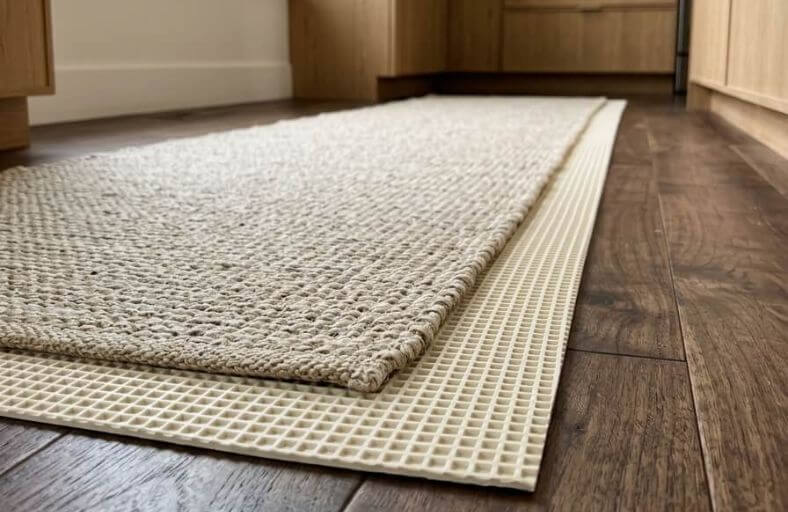
If you are dealing with a thin rug in a high-traffic entryway or beneath a swinging door, a thick felt pad might be too bulky. In these scenarios, a natural rubber waffle or mesh gripper is the perfect low-profile alternative.
These thin liners create grip through thousands of tiny contact points that maximize friction without the use of harmful chemicals.
A major technical advantage of the waffle design is its breathability; the open-mesh structure allows air to circulate freely beneath the rug.
This airflow is critical for preventing moisture entrapment, which can lead to clouding of the floor’s finish or even wood warping in humid environments.
While they offer less cushioning than felt, they are incredibly effective at stopping lateral sliding in zones like kitchens or hallways where safety is the top priority.
Furniture Anchoring
Sometimes the most effective stabilization tool is already sitting in your room. Strategically placing heavy furniture on the edges of a rug provides a mechanical anchor that essentially locks the textile into the floor plan.
In a living room, for example, having at least the front legs of your sofa and armchairs resting on the rug creates enough downward pressure to resist most sliding forces.
This method is particularly successful for large, heavy rugs made of wool or hand-knotted fibers that have enough internal weight to lay flat.
However, keep in mind that furniture only secures the perimeter. In a very large space, the center of the rug can still pool or bunch up if it isn’t supported by a thin non-slip underlay.
Combining a few furniture legs with a lightweight gripper pad is the ultimate covert solution for a perfectly styled home.
Hardwood-Safe Double-Sided Carpet Tape
For lightweight runners or flat-woven rugs that tend to “walk” across the hallway, double-sided carpet tape is a powerful, budget-friendly ally.
Unlike industrial tapes, hardwood-safe versions like XFasten use a specific adhesive designed for clean removal without stripping the floor’s sealer.
You simply apply the tape along the perimeter and corners of the rug backing to create a strong, immediate bond with the floor. However, caution is key. Some older floor finishes can be extremely sensitive to adhesives, potentially leading to delamination or sticky residue if left for years.
To avoid a sticky disaster, always perform a small “patch test” in a hidden corner before committing to the full rug.
This method is exceptionally effective in high-traffic zones where you need the rug to stay “rock solid” even through heavy foot traffic or vigorous vacuuming.
Specialized Corner Grippers
Sometimes the entire rug isn’t the problem, just those stubborn, curling corners that seem to hunt for passing toes.
Corner grippers are small, L-shaped or triangular adhesive pads that focus exclusively on these problem spots.
Many modern versions utilize a “suction” or “vacuum” technology that mimics a gecko’s foot, allowing them to grip the hardwood firmly without any permanent glue.
They are a dream for kitchen mats or bathroom accents because they can often be peeled up, rinsed under water to restore their “tackiness,” and repositioned indefinitely.
While they don’t provide the full-surface protection of a rug pad, they are the best “invisible” fix for preventing “corner curl,” which is the most frequent cause of tripping in busy households.
The DIY Silicone Caulk Hack
If you are looking for a customizable, long-term solution for an inexpensive synthetic rug, look no further than your toolbox.
Applying 100% silicone caulk to the back of a rug is a favorite trick of professional organizers and DIY experts alike. Using a caulk gun, you simply flip the rug over and apply thin, even lines or dots across the backing.
Once the silicone cures completely (which takes about 24 hours), it turns into a permanent, rubbery grip that acts as a built-in non-slip barrier.
This creates a high-friction surface that handles jumping or sudden movement with ease. However, remember that this is a permanent modification to the rug.
Avoid this method for high-value antique or hand-knotted Oriental rugs, as the silicone can entangle with the delicate fibers and lower the rug’s value.
To help you choose between these adhesive-based options, here is a quick comparison:
| Method | Best For | Risk to Floor Finish | Ease of Removal |
| Carpet Tape | High-traffic runners | Medium (test first) | Harder (may need heat) |
| Corner Grippers | Small mats / Curling edges | Low | Very Easy (peel and wash) |
| Silicone Caulk | DIY / Synthetic rugs | High (long-term) | Permanent to rug |
Liquid Latex and Fiber-Lock Treatments
For a truly professional, built-in solution that doesn’t involve separate pads or sticky tapes, you can apply a liquid non-skid backing directly to your rug.
Products like Fiber-Lok or InPlais use natural latex rubber to create a flexible, permanent grip on the rug’s underside.
To apply it, you simply vacuum the rug backing, brush on a thin, even coat, and let it dry overnight. This “hack” essentially transforms a slippery textile into a high-friction, floor-safe masterpiece. It is particularly useful for handmade rugs or thin cotton pieces that lack their own structure.
Because the latex is breathable once cured, it avoids the moisture-trapping risks associated with solid PVC mats.
Just ensure you are using organic or natural latex to avoid the chemical migration issues common with synthetic blends that can stain your beautiful hardwood.