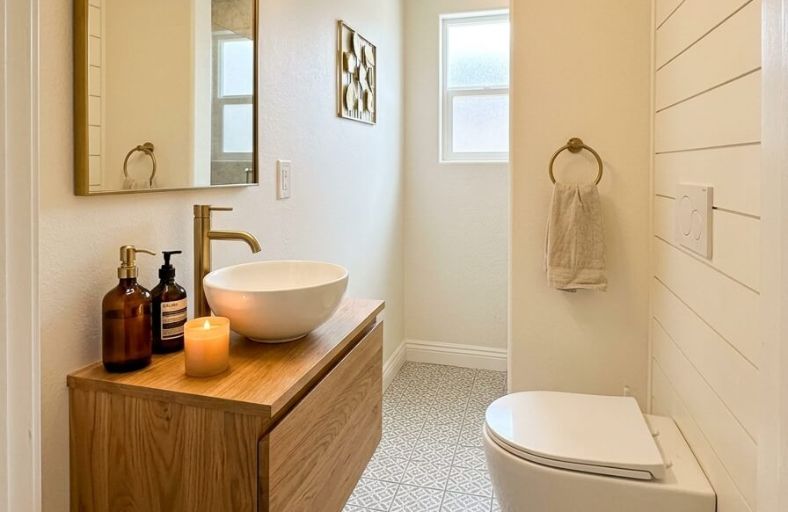
Morning routines in a single-bathroom household often look like a synchronized high-stakes race, complete with cold coffee, locked doors, and a frantic queue lining up in the hallway.
Adding another bathroom is the ultimate dream for restoration and domestic harmony, yet the mere thought of massive construction bills can instantly stall that dream.
In 2026, the national average for a bathroom addition typically hovers between $21,000 and $49,000, which can easily scare away even the most eager home decorators.
Fortunately, achieving that stress-free morning doesn’t require breaking the bank. By making several clever structural, planning, and design choices, you can add a beautiful new bath while keeping your hard-earned savings completely intact.
Leverage Existing Footprints
Building a brand-new bump-out addition forces you to deal with site grading, concrete foundations, framing, and roofing integration.
Instead, look closely inside your home. Transforming existing spaces like a large closet, a section of a bedroom, a finished attic, or a laundry room is an absolute game-changer for your budget.
By keeping the work inside your home’s current footprint, you completely bypass the need to pour a new foundation or alter your roofline. This single design choice can slice your structural expenses in half.
While a ground-up addition can easily run $400 to $550 per square foot, a clever interior conversion averages only $200 to $250 per square foot. Here is a quick look at the math:
| Build Type | Average Cost Per Square Foot |
|---|---|
| Conversion | $200 – $250 |
| Addition | $400 – $550 |
You can take that saved cash and put it toward beautiful, high-quality finishes instead.
Prioritize Plumbing Proximity
Plumbing is notoriously one of the most volatile and expensive phases of building a new bathroom.
Running entirely new supply, drain, waste, and vent lines from scratch can cost anywhere from $1,000 to $10,000, and these prices climb rapidly the further your new bathroom sits from existing plumbing.
The easiest trick to keeping these mechanical costs down is to share a wet wall.
This means placing your new bath back-to-back or directly above an existing bathroom, kitchen, or laundry room.
When your pipes can easily hook into a nearby existing main waste stack, your plumber won’t have to tear open massive sections of your walls and floors.
In fact, keeping your plumbing layout straightforward and close to existing lines can save you between $3,000 and $10,000 in heavy labor and rough-in work.
It keeps the hard-earned money in your pocket while making your home’s system highly efficient.
Utilize Upflush Maceration Systems
If you dream of adding a half-bath in the basement or garage, you might have recoiled at quotes involving heavy jackhammers breaking through concrete slabs.
Traditional below-grade plumbing trenching is incredibly labor-intensive, often costing between $6,000 and $15,000.
Fortunately, you can skip the concrete dust and the astronomical bills by choosing an upflush macerating toilet system.
These systems sit right on top of your existing floor and use a powerful grinder pump to process waste, sending it vertically to your main sewer line through small pipes.
Brands like Saniflo or Zoeller offer pre-assembled systems that can also connect to your sink and shower.
Going the upflush route cuts your plumbing installation costs to a manageable $1,500 to $3,500, securing a net savings of up to $12,000.
Select Mid-Range Materials with Timeless Appeal
When designing your new space, it is incredibly easy to get swept away by high-end marble tiles and custom designer vanities.
However, those luxury materials will quickly destroy your budget and offer a very poor return on investment (ROI) at resale.
While an upscale bathroom addition recoup only about 36.4% of its cost , a mid-range bathroom remodel recovers an outstanding 79.9% to 80%.
Opting for durable, gorgeous mid-range selections like porcelain tiles, quartz countertops, and quality pre-made vanities keeps your budget hovering in a comfortable $16,000 to $28,000 range.
Porcelain tile offers the elegant look of natural stone with much higher water resistance and far lower maintenance costs.
By choosing classic, durable, and highly functional mid-range fixtures, you will build a gorgeous space that future home buyers will absolutely love while keeping your equity perfectly safe.
Enforce a Strict Design Freeze Before Demolition
Labor is the single largest expense of any bathroom construction project, typically devouring 40% to 65% of your total budget.
This concentration of cost happens because bathrooms require multiple highly specialized, licensed trades like plumbers, electricians, and tile setters to work sequentially inside a very tight physical space.
The absolute best way to keep your labor costs under control is to issue a strict design freeze before any tool touches your walls.
This means choosing every single tile, faucet, and lighting fixture, and locking in your layout completely.
Changing your mind mid-construction (such as moving a toilet even just a few feet) requires tearing out completed drywall, adjusting studs, and rerouting heavy drain lines, which can instantly add $1,000 to $3,000 or more in plumber fees.
Planning ahead keeps the workflow smooth and prevents expensive delay penalties.