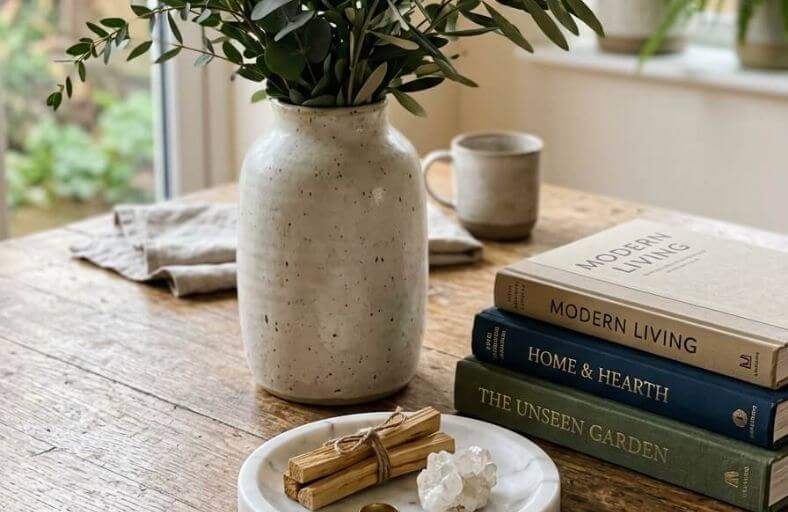
A stunning living room design often loses its impact right at the center, where a bare or cluttered coffee table sits like an island of aesthetic neglect.
This central surface is far more than a simple place to rest a drink; it is the geometric anchor and the most visible narrative canvas in your home.
When left to accumulate a chaotic pile of remotes and half-empty mugs, it creates a sense of visual friction that makes the entire room feel unpolished.
Mastering this small space requires a blend of spatial psychology and creative layering to transform a basic utility into a sophisticated, professional focal point.
Scale and Spacing Metrics
Before selecting a single candle or vase, you must address the physical relationship between your table and the surrounding furniture.
A common professional error is choosing a coffee table based solely on style while ignoring the vital measurement intervals that dictate comfort.
Designers aim for a “sweet spot” where the surface is perfectly accessible but does not impede the natural flow of traffic through the space.
| Metric Category | Standard Guideline | Functional Impact |
| Placement Gap | 14 to 18 inches from sofa | Balances legroom with ease of reach. |
| Table Length | ~2/3 of sofa length | Keeps the table from looking “lost” or undersized. |
| Table Height | Within 1-2 inches of seat height | Maintains comfortable sightlines and reach. |
| Walkway Width | 30 to 36 inches around the grouping | Ensures smooth circulation in the room. |
Ensuring these proportions are correct creates an architectural foundation that makes the subsequent styling steps feel intentional rather than forced.
A table that is properly scaled grounds the seating area, turning it into a cohesive conversation zone.
Using Trays
The most effective way to organize a surface is through the use of a decorative tray. On a large tabletop, individual objects can easily appear scattered or disjointed, contributing to a sense of visual noise.
A tray serves as a visual boundary that “contains the chaos” by grouping smaller items into a single, cohesive unit.
This foundation provides a clearly defined stage for your decor, making remotes, coasters, and matches feel like part of a curated vignette rather than clutter.
For oversized or rectangular tables, designers often suggest using two smaller trays to define separate zones for beauty and utility.
Using a tray also facilitates a quick cleanup, as the entire arrangement can be moved in seconds when the table is needed for other activities.
Artful Book Stacking
Coffee table books are the secret weapon of professional interior styling. They offer an easy way to introduce color, texture, and personality while serving a critical structural purpose.
By stacking two or three high-quality volumes, you create a pedestal that adds much-needed height and dimension to the arrangement.
When building your stack, always place the largest and heaviest book at the bottom to ensure visual stability.
These stacks allow you to layer smaller, more delicate objects on top, such as a sculptural piece or a small candle.
This layering technique prevents the tabletop from looking flat and uninteresting, while the subjects of the books themselves, whether travel, fashion, or art, serve as great conversation starters for guests.
The Vertical Rule of Three
The Rule of Three is a classic design principle based on the human brain’s natural affinity for odd-numbered patterns.
Groupings of three feel more energetic and balanced than pairs, which can often appear too static or formal.
To execute this, you should create a visual triangle by varying the heights of your three items: a high element like a tall vase, a medium element like a stack of books, and a low element like a small bowl or dish.
This vertical variation draws the eye upward and ensures that your arrangement remains visually interesting from every angle of the room.
Mixing materials within this trio, such as pairing a smooth ceramic vase with a textured stone bowl, further enhances the curated, designer feel.
Living Elements
Adding a living element is the fastest way to breathe life into your living room and soften the straight lines of your furniture.
Whether it is a vase of fresh peonies, a few clipped branches from the garden, or a small potted succulent, greenery provides an instant mood boost and a necessary organic contrast to hard surfaces like marble or glass.
For those who prefer a low-maintenance approach, you can opt for high-quality artificial plants or “moss balls” tucked into a decorative wooden bowl.
The goal is to introduce natural, irregular shapes that break the “static” feel of inanimate objects.
If your table is large, a tall vase with long branches can serve as your “high” element in the Rule of Three, drawing the eye upward and creating a sense of drama.
Decorative Box
A common “aesthetic nightmare” in many homes is the accumulation of remote controls, charging cables, and loose matches scattered across the coffee table.
To maintain a professional, curated look, you should utilize decorative lidded boxes to hide these functional but unsightly essentials.
A beautiful box made of burl wood, bone inlay, or sleek marble serves a dual purpose: it acts as a sculptural piece of art while keeping your surface organized and stress-free.
By tucking away the “stuff” of daily life, you allow the eye to rest on your more beautiful decor items.
These boxes can also be used as a “medium” height element when placed on top of a book stack, adding further dimension to your arrangement.
Objects of Interest
To move your table from “staged” to “curated,” you need to include items that serve no purpose other than to be beautiful or meaningful.
Sculptural objects, such as brass chain links, stone orbs, or vintage figurines, add an artistic flair and serve as great “story starters” for your guests.
These pieces are often where your personal narrative shines through. Perhaps it is a unique stone found on a favorite beach or a vintage tea caddy inherited from a relative.
Because these items often have irregular or “bumpy” textures, they provide a wonderful sensory contrast to the smooth surface of the table or the paper pages of your books.
Mixing Materials
A table that features only one type of material, such as all shiny metal or all dark wood, can feel sterile and flat.
Professional designers avoid the “showroom” look by mixing at least three different textural categories to create what is known as “sensory depth”.
| Texture Category | Example Materials | Visual/Tactile Impact |
| Natural | Wood, stone, rattan, or bone | Adds warmth, organic irregularity, and a grounded feel. |
| Man-Made | Glass, polished metal, or glazed ceramic | Provides structure, reflection, and a modern “edge.” |
| Soft | Paper (books), linen (trays), or moss | Introduces “touchability” and softens hard corners. |
By layering a smooth ceramic vase (Man-made) next to a stack of linen-bound books (Soft) on a burl wood table (Natural), you create a rich, multi-dimensional vignette that feels expensive and intentional.
Lighting and Candles
Lighting is the final layer that transforms a coffee table from a static display into a warm, inviting focal point.
Candles are the most traditional choice, offering a flickering glow that creates an immediate sense of comfort and intimacy.
To make them look intentional, pair a single candle with a matchbox cloche or place it atop a stack of books to vary its height and ensure it does not look “lost” on the surface.
In the contemporary design landscape, we are also seeing the rise of modular and hybrid lighting solutions.
Small, rechargeable LED lamps are becoming a staple for coffee tables, providing a focused glow without the need for unsightly cords.
Whether you choose a scented candle to add a sensory layer of citrus or florals, or a sleek metallic lamp, these light sources draw the eye and make the living room feel much more welcoming during evening hours.
The 50% Negative Space Rule
One of the most common mistakes in home styling is overcrowding the surface, which leads to a state of aesthetic frustration where the eye finds no place to rest.
Professional designers adhere to a “Less is More” principle, ensuring that at least 50% of the tabletop remains entirely empty. This negative space is not merely for visual balance; it is a functional requirement for daily life.
A coffee table must remain a supportive surface where you can comfortably set down a laptop, a coffee mug, or a shared platter when entertaining guests.
If every inch of the table is covered in decor, the styling has failed its primary purpose.
By leaving open areas, you allow the individual pieces you have selected to “breathe” and stand out, ensuring the arrangement feels intentional and curated rather than cluttered.
Seasonal Thematic Resets
A well-styled coffee table should reflect the passing of the seasons to keep the living room feeling fresh and dynamic. This “ritual of the reset” allows you to refresh the entire room without a full redecoration.
During the spring and summer, swap out dark elements for lighter materials such as clear glass, white ceramics, and airy textures like rattan or linen.
As the year moves into the cooler months, shift your palette toward Cremèle Neutrals including mocha, caramel, and clay.
You can introduce “heavier” textures such as chunky brass candleholders, darker-toned book covers, and wooden bead garlands.
These small, thoughtful swaps ensure that your home always feels in harmony with the environment outside, transitioning from the breezy openness of summer to the grounded coziness required for winter.
Tray-Based Reset Ritual
Maintaining a professionally styled look in a busy, lived-in home requires a strategy for flexibility. The “Tray-Based Reset” is the ultimate secret for high-traffic living rooms.
By grouping your main decorative elements on one sturdy, portable tray, you gain the ability to clear the surface in seconds.
| Reset Step | Action | Benefit |
| Clear | Lift the tray and move it to a sideboard or console. | Instantly creates space for puzzles, games, or meals. |
| Clean | Wipe down the table surface. | Maintains the longevity and hygiene of the furniture. |
| Restore | Place the tray back in the center. | Returns the room to its polished, “ready-for-photos” state. |
This ritual ensures that your styling never gets in the way of your lifestyle. It allows the coffee table to function as a “Game Room” or a workspace when needed, while still being able to return to its role as a beautiful focal point in an instant.