The sun streams through the window, hitting a tangled heap of wrinkled sheets and a lonely, flat pillow that looks more like a pancake than a place to rest.
We spend nearly a third of our lives in this space, yet it often becomes the most neglected architectural anchor in our homes.
Transforming your bed into a designer sanctuary is not about chasing perfection; it is about creating a multi-sensory retreat that whispers “relax” the moment you walk through the door.
Building a “Cloud-Like” Foundation
Professional bed styling starts with the invisible layers that provide volume and hygiene. A high-quality mattress protector is essential to shield your investment from allergens and moisture while providing a smooth surface for your fitted sheets.
However, the real secret to that five-star “sink-in” feeling is the mattress topper.
Adding a topper made of memory foam or high-loft down alternative provides an extra 2 to 3 inches of physical depth. This extra height transforms the silhouette of the bed, making it look substantially more plush and inviting.
In a designer setup, this structural base ensures that the subsequent layers of fabric drape beautifully rather than falling flat against a thin mattress.
Mastering the Technical Base Layer
High-quality natural fibers are the “backbone” of professional bedding. For a luxury feel, designers prioritize long-staple cotton, such as Egyptian or Pima, which offers superior breathability and a soft hand-feel.
To achieve a crisp, tailored look, utilize the “hospital corner” technique when tucking in your top sheet. This method creates a firm, non-slip fit that prevents the bed from looking messy after a night’s sleep.
The choice of weave also dictates the room’s aesthetic. A sateen weave offers a subtle sheen and silky drape that reflects light beautifully, while a percale weave provides a cool, matte finish that feels like a freshly pressed hotel sheet.
Ensuring your fitted sheets are deep enough for your mattress and topper is a critical step to avoid the “crunchy” or loose appearance of ill-fitting linens.
The “Turn-Back” Technique
The “turn-back” is the quintessential designer secret that creates an instant visual hierarchy on the bed. Instead of pulling your covers all the way to the headboard, fold the top sheet and any mid-layers back by approximately 1/3 of the bed’s length.
This simple adjustment creates a balanced proportion and invites the eye to explore the different textures underneath.
To execute this properly, place your top sheet with the finished side facing down. This way, when you fold it back over your quilt or duvet, the decorative hem or embroidered border is visible to the observer.
This technique not only makes the bed look more inviting but also serves as a practical way to manage temperature throughout the night.
Adding a Structural Mid-Layer
To prevent your bed from looking “flat” and one-dimensional, you must introduce a mid-layer between your sheets and the primary duvet. This is where the quilt or coverlet comes into play.
A coverlet is a lightweight, decorative layer that adds a touch of elegance, while a quilt offers a more textured, homey feel with its three-layer construction.
In professional staging, this layer is often tucked in tightly at the foot and sides to create a structured, tailored silhouette.
Beyond the aesthetic appeal, this mid-layer is functionally brilliant for temperature regulation, allowing you to peel back the heavy duvet on warmer nights while still feeling “tucked in” and secure.
The “Double-Stuffing” Secret for Cloud-Like Loft
If you have ever wondered why hotel beds look so much more voluminous than ours at home, the secret is often “double-stuffing.” This involves placing two separate inserts inside a single duvet cover to create unparalleled loft and plushness.
If using two inserts feels too heavy, stylists recommend choosing a single high-tog insert, such as 13.5 tog , to achieve that coveted “cloud” effect.
When placing your duvet, try tri-folding it at the foot of the bed. This creates a voluminous “nest” that looks incredibly inviting in photos and keeps the bed from feeling top-heavy.
This technique emphasizes the height of the bed and provides a beautiful contrast to the flatter layers beneath it.
Architecture of the “2-2-1” Pillow Rule
Pillows are the most expressive part of bed styling, and the “2-2-1 rule” is the gold-standard formula for a balanced, professional look.
This arrangement uses five pillows to create a sense of symmetry and depth without overwhelming the sleep surface. By using odd numbers at the very front, you create a natural focal point for the eye to land on.
| Layer | Pillow Type | Role |
| Back Layer | Two Euro Shams (26×26 inches) | Provides essential height and acts as a headboard backdrop. |
| Middle Layer | Two Standard or Medium Decorative | Adds a secondary texture or a subtle pattern for depth. |
| Front Layer | One Central Lumbar or Accent | Anchors the arrangement and serves as the “personality” piece. |
This formula works because it transitions the viewer’s eye from the largest elements at the back to the smallest, most detailed elements at the front.
The Rule of Five
Modern bed styling has moved beyond visual appeal to focus on “sense-scaping” the practice of creating a multi-sensory environment that supports psychological well-being. To achieve this, designers apply the “Rule of Five,” which suggests that a well-styled bed should incorporate at least five distinct tactile elements.
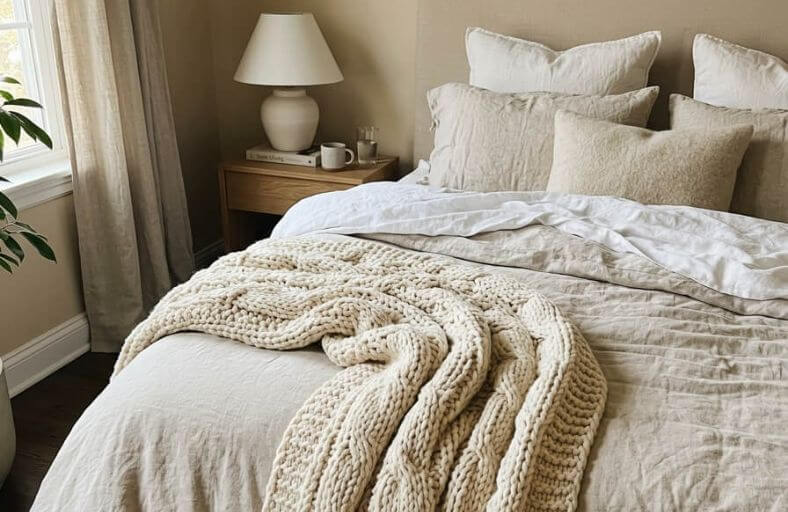
By mixing contrasting materials such as pairing a smooth sateen duvet with a rough-hewn linen throw you create a rich sensory experience that feels grounded and organic.
| Texture Type | Example Material | Sensory Impact |
| Smooth | Cotton Sateen / Silk | Provides a cool, orderly, and luxurious feel. |
| Organic | Linen | Highly breathable and introduces a relaxed texture. |
| Rich/Plush | Velvet / Quilted Batiste | Adds opulence, warmth, and visual weight. |
| Heavy Knit | Chunky Wool | Creates a sense of security and grounding. |
| Sculptural | Bouclé / Faux Fur | Offers a soft, modern aesthetic for accent pieces. |
Embracing the “New Neutrals”
The era of the “stark white box” is officially over. Nowadays, the trend shifts toward “The New Neutrals” earthy, warm, and grounding tones that provide a cocooning effect. Colors such as mocha, caramel, and “Cloud Dancer” (an ethereal, warm off-white) are replacing clinical grays.
These tones amplify natural light without feeling sterile, creating a restorative atmosphere that feels both sophisticated and intimate.
Using these grounded neutrals as your primary palette allows your bed to act as a peaceful anchor in the room.
Grounding the Foot of the Bed
The foot of the bed offers a critical opportunity for visual anchoring and functional elegance. A wooden or upholstered bench helps define the bed as a distinct zone and adds a “collected” feel to the bedroom.
For a more streamlined look, a bed runner is a powerful tool to introduce color and pattern.
To maintain professional proportions, ensure your runner is between 50 and 70 cm wide for King or Super King beds, allowing it to drape gracefully over the sides to convey a luxurious, considered feel.
The Artistic Throw
The “accent throw” is the final element that breaks up the large, flat surface of the duvet, adding a sense of “lived-in” charm.
While folding a blanket neatly in thirds at the foot of the bed conveys order, designers are leaning toward the “S” drape for a more effortless vibe.
Loosely draping a chunky knit or faux fur throw diagonally over one corner suggests an inviting, “jump right in” feel.
This intentional looseness brings character and warmth, moving the aesthetic away from a stiff showroom toward a true personal sanctuary.