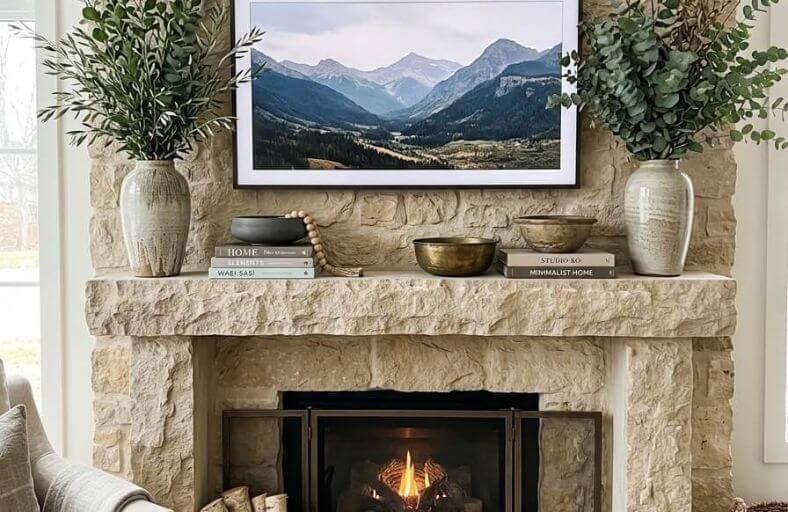
A bare fireplace mantel is the architectural equivalent of a blank stare in a room meant for storytelling.
It is the visual heartbeat of your home, yet so many of us leave it cluttered or, even worse, completely empty.
Transforming this narrow sliver of space into a curated masterpiece doesn’t require a professional degree in design.
By understanding how to play with height, texture, and light, you can turn a simple shelf into a captivating focal point that grounds the entire living area.
Establish a Strong Anchor
Every successful mantel design begins with a “heavy lifter”, a primary anchor that commands attention. This is usually a large piece of artwork or a mirror centered above the firebox.
Mirrors are particularly effective in smaller rooms because they bounce light and create an illusion of depth.
If you prefer a more relaxed, modern vibe, try leaning the artwork against the wall instead of mounting it. This “leaner” technique adds instant character and makes it easier to swap pieces out later.
Remember, this anchor acts as the visual center of gravity; everything else you add will be built around this single, dominant element to provide authority to the entire arrangement.
Master the Two-Thirds Ratio
Scale is often where most DIY decorators feel “off-kilter” without knowing why. The professional secret lies in the two-thirds ratio: your anchor piece should span roughly two-thirds of the total width of the mantel shelf.
If the artwork is too small, it appears “unmoored” and loses its impact. Conversely, a piece that stretches edge-to-edge leaves no “breathing room” for other decorative accents.
Getting this proportion right establishes a visual cushion that allows the eye to rest and prevents the composition from feeling cramped.
For rooms with vaulted ceilings, you may need to go even larger or more vertical to prevent the fireplace from looking disproportionately small.
| Dimensional Element | Recommended Ratio | Why It Works |
| Anchor Width | approx 2/3 of Mantel Width | Balances visual weight without crowding. |
| Height Clearance | 10-30 cm above shelf | Creates a clean separation for layering. |
| Negative Space | approx 66% of wall above | Prevents the display from looking cluttered. |
Harness the Power of Odd Numbers
Human psychology is naturally wired to find odd-numbered groupings more appealing and less stagnant than even ones.
The Rule of Threes is your best friend here: grouping three items of varying heights (tall, medium, and small) creates a natural visual triangle that leads the eye through the display.
You might pair a tall ceramic vase with a medium-sized frame and a small metallic object.
This variation in height and texture ensures the arrangement feels alive rather than like a flat lineup.
For longer mantels, you can repeat this rhythm by placing a trio on each end, leaving intentional negative space in the middle to allow each collection to shine.
Build Depth Through Layering
A professional-looking mantel isn’t a straight line of objects; it’s a tiered composition with a foreground, middle ground, and background.
Start with your background (the anchor), then overlap secondary items in the mid-ground.
This is where you introduce different textures, such as a matte stoneware vase in front of a shiny mirror. Finally, place small “accent” pieces, like a tiny bowl or a single branch, in the foreground near the front edge.
This layering prevents the display from looking staged and creates “visual interest” by allowing the eyes to travel through multiple depths of field.
Using the full depth of the shelf, rather than just the back edge, makes the scene feel rich and personal.
Navigate the TV Dilemma
A television above the mantel is a common design challenge that often creates a visual “black hole” in the room.
To harmonize technology with style, your goal is to make the screen feel like an intentional part of the architecture.
If you do not have a “Frame TV” to display art, focus on low-profile styling to avoid obstructing the view. Use shallow trays, horizontal book stacks, or small bowls directly beneath the screen.
To frame the TV and prevent it from appearing to float, place taller items on the far ends of the mantel shelf.
A pair of elegant candlesticks or a tall vase with sweeping greenery on the periphery can draw the eye out and around the screen.
This side-flanking strategy provides the necessary height without competing with your favorite shows.
Illuminate the Focal Point
Lighting is the invisible layer that transforms your mantel from a simple shelf into a glowing centerpiece after sunset.
Effective mantel illumination requires a layered approach to avoid flat, uninspired shadows.
Wall sconces are a classic choice for framing an anchor piece and are best installed at about 66 inches from the floor, which is natural eye level.
For a softer, more magical feel, incorporate “ambient glow” elements like fairy lights tucked into a garland or battery-operated LED pillar candles.
These flicker like real flames without the safety hazards of an open fire. If your fireplace has architectural relief like brick or stone, consider hidden LED tape lighting under the mantel lip to emphasize the texture and depth of the material.
Master the Seasonal Micro-Swap
A professionally styled mantel should evolve with the calendar, but that does not mean you need a complete overhaul every few months.
The secret is the “micro-swap” method: maintaining a neutral, high-quality base of foundation elements while updating only about 20% of your accents.
Start with a transitional foundation of warm whites or soft wood tones that play well with any color palette.
As the seasons shift, you only change the “jewelry” of the mantel to reflect the world outside.
| Season | Recommended Micro-Swaps | Natural Elements |
| Spring | Airy Glass, Pastel Ceramics | Flowering Quince, Tulips |
| Fall | Stoneware, Earthy Textures | Wheat, Dried Pinecones |
| Winter | Metallics, Velvet Accents | Evergreen, Fir Branches |
This principle of restraint ensures your home feels fresh and current without looking like a seasonal showroom.
Style for Your Specific Material
The physical material of your fireplace dictates the “vibe” of your decor and how light interacts with the space.
High-end materials like polished marble or smooth stone demand a formal approach with high-contrast accents like brass or glass to highlight their inherent luxury.
Conversely, if you have a dark or visually “heavy” brick fireplace, you should lean into lighter-colored decor, think white ceramics or cream-toned frames, to provide a necessary visual lift and prevent the hearth from looking like a dark hole in the room.
For rustic wood beams, organic textures like eucalyptus or stoneware are essential to match the “honesty” of the material.
| Mantel Material | Recommended Elements | Aesthetic Goal |
| Marble / Stone | Brass, Glass, Polished Ceramics | Formal Elegance / High Contrast |
| Dark Brick | White Vessels, Cream Frames | Visual Lightness / Balance |
| Reclaimed Wood | Iron Lanterns, Stoneware, Greenery | Textural Harmony / Warmth |
The Step-Back and the Rule of Editing
The final and most crucial phase of styling is the curatorial edit. It is often the process of removing the unnecessary that allows the essential pieces to shine.
Professional stylists use the Squint Test: stand back and squint at your mantel until the details blur, leaving only the “visual weight” visible. If one side feels heavier or darker than the other, the balance must be adjusted.
Before you finalize the display, try the “One Item” rule, remove one object, usually the smallest or most “fussy” one.
This creates more negative space, giving your high-value items the “breathing room” they need to be noticed. A mantel that feels calm rather than cluttered is the hallmark of a truly expert design.