Pet hair on the couch is one of those daily realities that every dog and cat owner knows all too well.
It embeds itself into fabric fibers, clings stubbornly to cushions, and seems to reappear minutes after you have just cleaned the whole sofa.
The frustrating part is that a standard vacuum often does not do the job on its own. Different couch fabrics hold onto pet hair in different ways, which means the most effective removal method varies depending on what your sofa is made from.
These tips cover every proven technique for getting pet hair off a couch quickly and thoroughly, so your sofa looks genuinely clean rather than just slightly less furry.
Damp Rubber Glove Magnet Technique
The humble rubber glove, typically reserved for dishwashing, is actually your most potent weapon against shedding. This method works through simple physics: friction and moisture.
When you rub a rubber or nitrile glove over fabric, it generates a localized static charge that attracts negatively charged pet hair like a magnet.
To execute this perfectly, put on a clean glove and lightly dampen it under a faucet. The moisture adds surface tension, causing the hair to clump together and stick directly to the glove.
Use firm, circular motions across the sofa cushions. You will find that the hair rolls into manageable “tumbleweeds” that you can easily peel off and toss.
This is particularly effective for delicate fabrics like performance velvet or microfiber, where traditional brushes might be too abrasive.
Window Squeegee Raking Method
If you have a large sectional covered in Golden Retriever glitter, a handheld tool can feel inefficient.
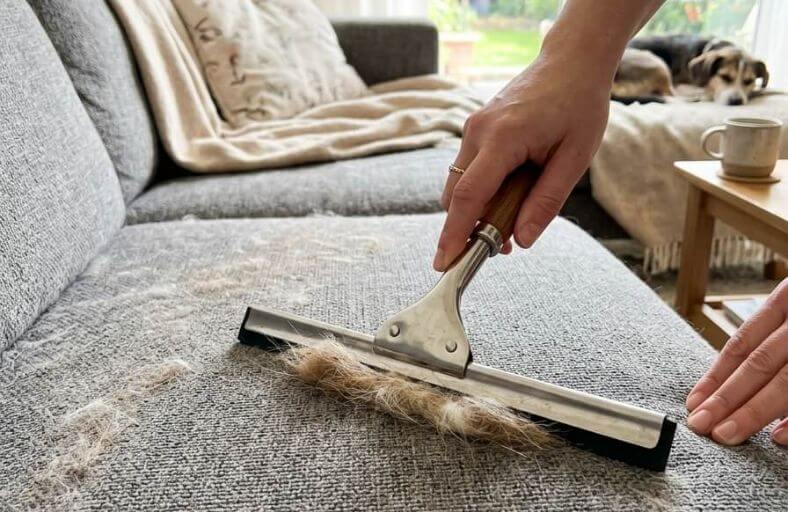
This is where the window squeegee shines. Its firm, flat rubber edge is designed to provide uniform pressure across a wide area, making it ideal for raking fur out of the fabric weave.
By dragging the squeegee toward your body in short, overlapping strokes, you physically dislodge hair that has woven itself into the textile.
The rubber edge grabs the fur and pulls it into neat lines for easy collection. This technique is a secret weapon for textured fabrics like corduroy or heavy polyester blends where hair tends to hide in the recesses.
Always ensure the squeegee is clean and dry before starting to avoid transferring any residue to your upholstery.
Anti-Static Neutralization
Sometimes, the electrostatic bond between hair and fabric is so strong that mechanical force alone fails. You must neutralize the charge at a molecular level.
A simple DIY solution of equal parts white vinegar and water acts as a natural anti-static agent.
The acetic acid in vinegar dissolves the biological oils (sebum) that glue hair to the fabric while simultaneously softening the fibers.
Lightly mist your sofa with the solution, being careful not to soak the material. Once the static is neutralized, the hair slides out of the weave, making it significantly easier to gather with a cloth or vacuum.
If you prefer a store-bought scent, a light spritz of fabric softener mixed with water offers a similar effect, leaving your living room smelling like fresh laundry.
Specialized Reusable Rollers
While adhesive lint rollers are convenient for a quick swipe before guests arrive, they are often wasteful and struggle with deeply embedded fur.
The modern gold standard for pet owners is the reusable roller, such as the famous ChomChom.
These devices utilize a unique back-and-forth motion that triggers a rubber squeegee and a specialized fabric brush simultaneously.
| Feature | Reusable Roller (e.g., ChomChom) | Traditional Sticky Roller |
| Waste Level | Zero (No refills needed) | High (Disposable sheets) |
| Mechanism | Back-and-forth friction | Surface-level adhesion |
| Collection | Internal catchment chamber | Adhesive surface only |
| Best For | Large furniture panels | Decorative pillows/clothing |
The rapid movement creates a static charge that lifts hair and traps it in an internal collection compartment.
It is a highly efficient, eco-friendly way to maintain a hair-free sanctuary without burning through dozens of adhesive sheets daily.
Deep Extraction with Motorized Upholstery Tools
When hair is deeply embedded, suction alone is rarely enough. To truly clean your sofa, you need mechanical agitation. This is where motorized upholstery tools come into play.
Unlike a standard vacuum head, these specialized attachments feature a rotating brush roll, often called a beater bar, that vibrates the fabric, shaking loose the hair and dander trapped deep within the foam and fibers.
For the best results, use a vacuum equipped with HEPA filtration. This ensures that while you are pulling up fur, you aren’t blowing microscopic dander and allergens back into your living room .
Move the tool slowly in a crosshatch pattern: first vertically, then horizontally. This pump and release action helps extract bio-composite residue (a mix of hair, skin flakes, and oils) that standard tools leave behind.
Air Fluff Laundry Pre-treatment
If your couch has removable covers, your first instinct might be to toss them straight into the wash. However, adding water to pet hair often causes it to mat and weave even tighter into the fabric.
The expert secret is the Air Fluff pre-wash strategy. Before the covers get wet, place them in the dryer on a No Heat or Air Fluff setting for 10 to 15 minutes with a couple of dryer sheets .
The tumbling action combined with the anti-static agents in the dryer sheets loosens the hair, sending it straight into the dryer’s lint trap .
This significantly reduces the amount of fur that enters your washing machine, preventing fur clogs and ensuring your covers come out truly clean.
Fabric Pumice Stones for Heavy-Duty Textiles
For sturdy, non-knit fabrics like heavy canvas, denim, or even automotive-grade upholstery, the fabric pumice stone is a secret weapon used by professional detailers.
These stones are made of porous volcanic glass that acts as a series of microscopic hooks, grabbing onto fine hairs that other tools miss.
| Fabric Type | Safety Level | Technique |
| Heavy Canvas | Safe | Firm, one-way strokes |
| Denim / Twill | Safe | Light pressure; follow the grain |
| Synthetic Velvet | Caution | Test on hidden area; very light touch |
| Silk / Fine Knits | Unsafe | Do not use; will snag fibers |
When using a pumice stone, always work in a single direction to ball up the fur. Because the stone is sacrificial and wears down during use, follow up with a quick vacuum pass to remove any residual “pumice dust”.