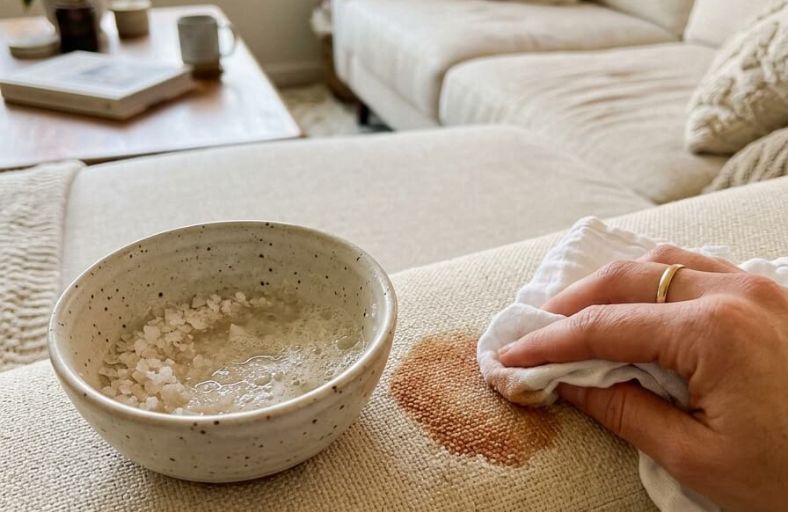
Blood stains on upholstery can feel alarming, but they are among the most treatable fabric stains when approached correctly and quickly.
The golden rule is always cold water, never hot. Heat bonds blood proteins to fabric fibers permanently, turning a treatable stain into a lasting one. Beyond that, the right cleaning agent makes all the difference.
Enzyme-based cleaners, hydrogen peroxide on light fabrics, and salt paste on fresh stains are all effective options depending on your couch material and how long the stain has been there.
These practical tips give you a clear, step-by-step removal guide that works safely on every common couch fabric without causing secondary damage or discoloration.
Immediate Capillary Extraction
The most critical factor in successful blood removal is speed. When blood is fresh, it is still in a soluble state.
You must utilize the principle of capillary action to draw the fluid out before it cross-links with the textile fibers.
Using a clean, white, absorbent cloth, apply firm vertical pressure to the spot. It is vital to avoid any horizontal scrubbing or rubbing, as this mechanical friction drives the hemoglobin deeper into the internal foam padding, where it becomes nearly impossible to extract without professional machinery.
Always use cold water for this process. Heat causes the proteins in blood to denature and set, creating a permanent covalent bond with the fabric.
Continue the cycle of dampening the cloth with cold water and blotting until no more color transfers to the rag. This method is safest for “W” (Water-based) or “WS” coded fabrics.
The Saline Osmosis Protocol
When a stain has already begun to settle into the weave, you can create a concentration gradient to pull the proteins out using salt.
Salt is naturally hygroscopic, meaning it attracts water and dissolved organic matter.
By mixing one tablespoon of salt with one cup of cold water and a teaspoon of mild dish soap, you create a powerful surfactant-based solution.
The soap reduces the surface tension of the water, allowing it to penetrate the fibers, while the salt initiates an osmotic draw that “locks” the hemoglobin into the liquid for extraction.
Apply this mixture sparingly to the edges of the stain and work toward the center to prevent spreading.
Once the area is damp, blot firmly with a dry towel. This technique is particularly effective for durable natural fibers like cotton or linen .
Effervescent Mechanical Lifting
For textured fabrics like bouclé or chenille, blood can hide deep within the valleys of the weave.
Seltzer or club soda provides a gentle mechanical agitation that manual blotting cannot achieve .
The carbonation creates microscopic bubbles that physically lift blood particles to the surface of the fabric .
| Feature | Seltzer Protocol Details |
| Mechanism | Carbonic acid bubbles lift organic matter . |
| Safety | pH-neutral and safe for most water-tolerant fabrics. |
| Technique | Pour directly, let fizz for 30 seconds, then blot . |
When applying seltzer, the effervescence works best on fresh or slightly damp stains . For a boost in cleaning power, sprinkle a small amount of salt onto the fizzing area.
The combination of mechanical lifting from the bubbles and the osmotic draw of the salt makes this a highly effective first-response treatment for high-end, textured upholstery .
Adsorbent Desiccation
For blood that has already seeped deep into the upholstery, baking soda acts as a powerful adsorbent.
Unlike cleaners that simply wet the fabric, this method uses desiccation to pull moisture and pigment out of the fibers.
To start, mix two tablespoons of baking soda with one tablespoon of cold water to create a thick, uniform paste.
Spread this paste generously over the stained area and let it sit for at least 30 to 60 minutes. As the paste dries, it draws the blood residue into the sodium bicarbonate crystals.
Once it is completely dry and crumbly, use a vacuum with a brush attachment to remove the residue. A word of caution: baking soda has a pH of approximately 9.
On natural fibers like cotton or linen, this alkalinity can cause “cellulosic browning” if left for too long, so always perform a quick spot test first.
Oxidative Decomposition
Hydrogen peroxide is a biological game-changer for light-colored or white sofas. When a 3% solution of H₂O₂ touches the catalase enzymes in blood, it triggers an immediate chemical reaction that decomposes the hemoglobin.
You will see a characteristic bubbling or fizzing, which indicates the oxygen is physically rupturing the blood cell membranes and bleaching the iron-rich pigment.
To apply, dampen a clean white cloth with the peroxide and gently dab the stain. Let it bubble for about 30 seconds, then blot the area with a dry towel to lift the loosened particles.
Because peroxide is a mild bleaching agent, it should only be used on very light fabrics and never on silk or wool, as it can weaken natural fibers over time.
Humectant Rehydration
If the period blood has dried into a hard, crusty blemish, standard cleaners often fail because the proteins have cross-linked and become insoluble. To fix this, you need a humectant like glycerin.
Glycerin penetrates the dried protein shell, rehydrating the stain and making it flexible enough to be washed away.
Create a specialized spray by mixing 8 parts cold water, 1 part glycerin, and 1 part mild laundry detergent. Spray the solution directly onto the dried spot and allow it to dwell for 5 to 10 minutes.
This dwell time is essential, as it allows the glycerin to lubricate the fibers while the detergent emulsifies the organic matter. Finish by blotting with a damp sponge and cold water until the fabric feels clean.
Protease Enzymatic Digestion
Enzymatic cleaners are the most advanced DIY solution because they don’t just clean the stain; they biologically eat it.
These cleaners contain proteases, which are specific enzymes designed to break the peptide bonds of proteins like hemoglobin and fibrin.
| Recommended Enzyme Cleaners | Best Use Case | Key Features |
| Puracy Natural Stain Remover | All-purpose safe cleaning. | Uses 6 plant-based enzymes. |
| Biokleen Bac-Out | Eco-conscious households. | Biodegradable and citrus-scented. |
| Nature’s Miracle | Stubborn, set-in odors. | Powerful for both stains and smells. |
Spray the enzyme cleaner onto the couch and let it sit for 15 to 30 minutes. To keep the enzymes active, cover the area with a damp white cloth to prevent the solution from evaporating too quickly.
This allows the biological catalysts to penetrate deep into the weave for a thorough clean.
The Proteolytic Meat Tenderizer Hack
Meat tenderizer is a surprisingly effective tool for blood remediation because it contains natural proteolytic enzymes: bromelain (from pineapples) or papain (from papayas).
These enzymes are specifically designed to break down the tough protein chains in muscle tissue, and they perform an identical function on the hemoglobin and fibrin in a blood stain.
To execute this method, create a thick paste using unseasoned meat tenderizer and a small amount of cold water. Apply the paste directly to the stain and let it sit for 30 to 60 minutes.
The enzymes work at a molecular level, cleaving the protein chains and making them easy to rinse away with a damp cloth.
Be careful to only use unseasoned powder to avoid staining the fabric with spices, and avoid this method on protein-based fabrics like silk or wool.
Acetylsalicylic Acid (Aspirin) Breakdown
Aspirin, known chemically as acetylsalicylic acid, can act as a targeted chemical decomposer for stubborn blood residues.
The acid helps to break the bonds between the iron in the hemoglobin and the textile fibers, which is often what causes that lingering brownish tint.
| Step | Action | Dwell Time |
| Preparation | Crush 2 to 3 uncoated aspirin tablets into a fine powder. | |
| Application | Mix with a few drops of cold water to form a paste and apply. | 30 minutes |
| Removal | Blot with a cold, damp cloth to rinse the fibers. |
This method is particularly useful for light-colored cotton or polyester blends. However, because aspirin has mild bleaching properties, always perform a spot test on colored upholstery to ensure it doesn’t cause a light spot.
Anhydrous Solvent Cleaning (For S-Coded Fabrics)
When dealing with a sofa made of velvet, mohair, or certain microfibers that carry an “S” cleaning code, water is your primary enemy.
Using water on these materials can cause permanent rings, fiber shrinkage, or dye migration.
For these delicate surfaces, you must use an anhydrous (water-free) solvent like isopropyl alcohol.
Alcohol acts as a solvent that dissolves the organic matter of the blood without causing the fiber swelling associated with water. Apply the alcohol to a clean white cloth and blot the stain gently from the outside in.
Since alcohol evaporates quickly, it leaves no moisture behind to damage the cushion’s internal padding. Once dry, use a soft brush to restore the visual texture or “nap” of the fabric.