If you frequently wake up with a stuffy nose, itchy eyes, or a scratchy throat, the dust levels in your bedroom could be a major contributing factor.
Bedrooms tend to accumulate dust more rapidly than other areas of the home because they’re filled with fabric surfaces that trap particles and aren’t always cleaned as regularly as they should be.
The good news is that reducing dust doesn’t require a complete bedroom overhaul or an expensive air purification system.
A few targeted changes to your cleaning routine and bedroom setup can produce a noticeable difference surprisingly quickly.
Top-to-Bottom Cleaning with Microfiber Technology
The secret to long-term dust management lies in the physics of how particles settle. Because dust is subject to gravity, any cleaning activity on upper surfaces will cause particles to drift downward.
A professional cleaning sequence always starts with ceiling fans and light fixtures before moving to dressers and finally the floor.
Using traditional feather dusters or dry cotton rags is often counterproductive because they simply relocate dust into the air rather than removing it.
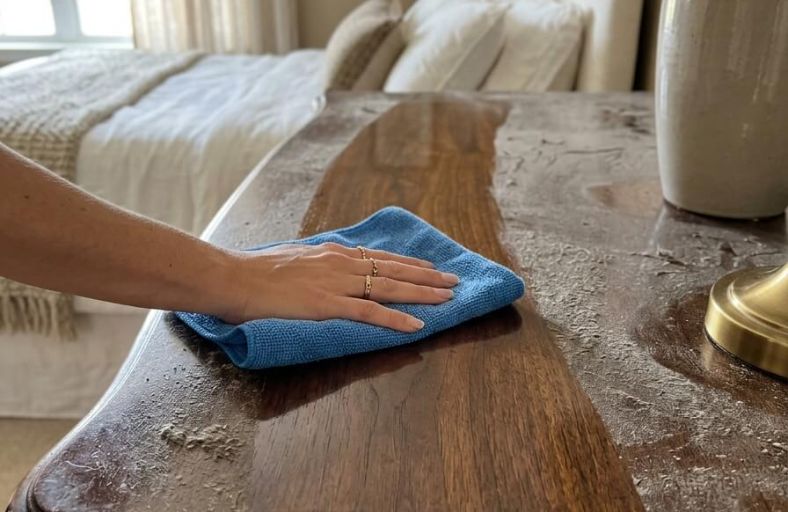
Microfiber cloths represent a significant technological upgrade for your cleaning routine. These cloths feature split fibers that create a massive surface area and a natural static charge to attract and grip dust.
| Feature | Microfiber Cloth | Traditional Duster |
| Mechanism | Static charge & split fibers | Surface displacement |
| Dust Retention | Traps and holds particles | Relocates particles to air |
| Cleaning Method | Best when slightly damp | Usually used dry |
For the best results, use a lightly dampened microfiber cloth to trap particles effectively, preventing them from becoming airborne.
High-Temperature Weekly Bedding Laundering
Your bed is the primary reservoir for biological particulates. An average person sheds approximately 1.5 grams of skin flakes every day, which is enough to feed one million dust mites.
These microscopic pests thrive in the warmth and humidity of your sheets. To effectively manage this organic load, a strict weekly laundering schedule is essential for all linens, including sheets and pillowcases.
Temperature is the critical factor in this process. Research indicates that washing bedding in water that reaches at least 60°C (140°F) is necessary to kill dust mites on contact.
While cold water might remove surface dirt, it fails to eliminate the mite population or denature the allergenic proteins found in their waste.
After washing, drying on high heat further ensures that any remaining moisture is removed, making the environment inhospitable for mites.
Implementation of Allergen-Proof Encasements
For many, the mattress itself is the largest source of dust exposure. Mattress and pillow encasements provide a physical barrier method that seals existing allergens inside while preventing new skin cells from entering the core of your bedding.
Unlike standard fitted protectors, a true allergen-proof solution is a full six-sided zippered encasement that completely surrounds the mattress.
The efficacy of these covers depends entirely on the pore size of the fabric. To block dust mite fecal particles, which average between 10m and 40m in diameter, the fabric pore size must be significantly smaller.
| Protection Level | Pore Size | Target |
| Standard Protector | > 10m | Spills and large debris |
| Dust Mite Barrier | 6-10m | Dust mite waste pellets |
| Medical Grade | < 6m | Dander and mold spores |
Medical research recommends encasements with a certified pore size of 6m or less to effectively block allergens while still allowing the fabric to remain breathable for a comfortable night’s sleep.
Investment in HEPA Filtration Technology
While mechanical cleaning removes settled dust, air purifiers and advanced vacuums address the airborne and embedded fractions of particulates.
A standard vacuum cleaner often lacks the seal integrity to prevent fine dust from being exhausted back into the room.
In contrast, a High-Efficiency Particulate Air (HEPA) filter is engineered to capture 99.97% of particles as small as 0.3m.
This level of filtration ensures that allergens like dust mite waste and pet dander are trapped within the machine rather than being aerosolized.
Continuous air purification is equally vital. Running a True HEPA air purifier 24/7 in the bedroom can trap dust before it ever settles on your furniture or floors.
These units should be placed where air can circulate freely, ensuring they cycle the room’s air several times per hour.
Using a vacuum with HEPA filtration at least once or twice a week completes this high-tech defense against microscopic invaders.
Precise Humidity Regulation and Static Control
The environmental conditions in your bedroom dictate the behavior of dust and the survival of biological allergens. Dust mites do not drink water; they absorb moisture from the air.
Because of this, maintaining a relative humidity below 50% is one of the most effective ways to inhibit their growth and reproduction. However, dropping humidity too low (below $30) can be counterproductive, as extremely dry air increases static electricity.
High static levels cause dust particles to repel from one another and loft into the air more easily, making them harder to capture. The ideal range for a bedroom is between 40% and $50 humidity.
Using a simple hygrometer to monitor these levels allows you to adjust a humidifier or dehumidifier as needed.
This balance keeps dust heavy enough to settle where it can be wiped away while keeping the mite population in check.
Strategic Transition to Hard Flooring
Carpeting is arguably the most significant dust reservoir in any home. The deep fibers trap soil, hair, and skin cells, creating a permanent habitat for dust mites that even high-powered vacuums cannot fully clear.
If your goal is a truly dust-free bedroom, replacing wall-to-wall carpet with hard flooring like wood, tile, or luxury vinyl is the most impactful structural change you can make. Hard surfaces allow for total particulate removal through daily damp mopping.
For those who still want a soft touch underfoot, small, machine-washable area rugs are an excellent alternative.
These rugs can be taken outdoors and shaken monthly to remove stubborn debris, and they can be laundered regularly in hot water to kill any residing mites.
Avoiding thick, shaggy rugs in favor of low-pile options also makes it much easier for vacuum suction to reach deep into the base of the textile.
The No-Shoes Protocol and Perimeter Sealing
A staggering two-thirds of house dust originates from the outdoors, carried in on footwear or drifting through gaps in your home’s structure.
Establishing a strict no-shoes policy is a simple yet powerful preventive measure that keeps soil, lead, and pesticides out of your sleeping area.
Placing high-quality mats at all entryways further reduces the amount of debris tracked into the home.
Beyond footwear, you must seal the bedroom’s perimeter to block atmospheric dust. Examining windows and doors for drafts and applying weatherstripping or caulk creates a tighter seal against outdoor pollutants.
This not only keeps the room cleaner but also improves energy efficiency. On windy days or during high pollen seasons, keeping windows closed is essential to prevent a sudden influx of external particulates from overwhelming your indoor air quality.
Decluttering and Hidden Storage Solutions
Every object in a bedroom provides a surface where dust can settle, and the more complex the object, the harder it is to clean.
Decluttering is fundamental because it minimizes “dust catchment zones” and simplifies your maintenance routine.
Removing unnecessary knick-knacks, piles of magazines, and open baskets of toys reduces the overall surface area where particles can accumulate.
For essential items, hidden storage is the preferred solution. Storing seasonal clothing and extra linens in sealed plastic bins prevents them from shedding fibers and protects them from settling skin cells.
Using under-bed drawers or closed wardrobes instead of open shelving creates a streamlined aesthetic and makes it much easier to vacuum thoroughly without moving dozens of small objects.
Choosing Easy-to-Clean Window Treatments
Window treatments are notorious for trapping dust, yet they are frequently overlooked. Heavy, non-washable drapes or ornate velvet curtains can harbor massive amounts of particulates that release into the air every time you pull them closed.
For a lower-dust bedroom, prioritize tightly woven, washable fabric panels that can be laundered seasonally in hot water.
Alternative options like roller shades or vertical blinds are often easier to maintain than horizontal blinds, which have numerous flat surfaces for dust to settle upon.
If you prefer horizontal blinds, using a vacuum tool with soft bristles allows you to dust them without causing damage. Regularly vacuuming your curtains with a brush attachment can also keep buildup at bay between major washes.
Phytoremediation via NASA-Approved Indoor Plants
Indoor plants can contribute to a healthier bedroom by filtering certain chemical pollutants from the air.
The famous NASA Clean Air Study identified several species that are particularly effective at removing toxins like formaldehyde and benzene, which can shed from furniture foam and adhesives.
While plants do not “eat” dust, they improve overall air quality and help balance local humidity levels.
| Plant Species | Target Chemicals Removed | Sleep Benefit |
| Snake Plant | Formaldehyde, Benzene, Xylene | Produces oxygen at night |
| Peace Lily | Ammonia, Trichloroethylene | Increases local humidity |
| Spider Plant | Formaldehyde, Xylene | High purification rate |
To keep plants effective, you must wipe their leaves regularly with a damp cloth to remove settled dust that blocks their pores.
Be sure to choose pet-safe varieties like the Spider Plant if you have furry friends, as species like the Peace Lily can be toxic if ingested.