A tiny, tickling sensation on your arm at 2 AM often reveals a nightmare scenario: a line of ants marching across your pristine duvet.
This aesthetic disaster quickly turns your peaceful bedroom into a source of skin-crawling stress.
Ants are opportunistic scouts, and their presence in your sleeping area usually signals that they have discovered a reliable path to moisture or microscopic crumbs. Reclaiming your bed requires more than just a quick wipe down.
It demands a strategic, science-backed approach to disrupt their chemical maps and fortify your furniture.
Immediate High-Heat Sanitization
The first step to stopping an active invasion is to remove every soft surface from your bed frame immediately. This includes sheets, pillowcases, duvet covers, and even the mattress protector.
Ants at all life stages, including eggs that might be tucked into folds, cannot survive extreme temperatures. You should wash all bedding in hot water at a minimum of 130°F (54°C) to ensure total eradication.
This process does more than just kill the insects; high heat is highly effective at causing the lipids in ant pheromones to evaporate, effectively “bleaching” the chemical history of the infestation from your fabrics.
After washing, dry the items on the highest heat setting your fabric allows for at least 30 minutes.
While your laundry is running, keep the mattress bare to prepare for a deep structural cleaning. This immediate action prevents any lingering ants from relocated to other parts of your room.
Deep Precision Vacuuming
Once the bed is stripped, you must address the ants and debris hiding in the mattress itself. Using a vacuum equipped with a HEPA filter is essential to ensure that microscopic particles and small insects are trapped securely inside the machine.
Focus your efforts specifically on the “hiding zones” where ants often congregate.
| Area to Focus | Reason for Attention |
| Mattress Seams | Ants hide in the tight piping and folds. |
| Bed Frame Crevices | Small gaps in wood or metal house scouts. |
| Under the Bed | Crumbs and dust bunnies provide food and cover. |
| Tufting Buttons | These deep recesses trap moisture and skin cells. |
Slowly move the upholstery attachment in overlapping rows to extract every possible intruder. Most importantly, you must empty the vacuum canister or bag into an outdoor bin immediately after finishing.
Leaving the debris inside the vacuum allows ants to simply crawl back out and re-infest your room within hours.
Disrupting the Chemical Pheromone Trails
Killing the ants you see is only half the battle. Ants navigate using invisible chemical “highways” called pheromone trails.
If you do not erase these instructions, new ants from the colony will follow the same path back to your bed tomorrow.
A simple 50/50 mixture of white vinegar and water is one of the most effective ways to neutralize these scent markers.
The acetic acid in vinegar disrupts the chemical bonds of the pheromones, making it impossible for the colony to communicate. Spray this solution generously along the baseboards, the floor around the bed, and any visible trails leading to the bed legs.
If the smell of vinegar is too strong for your bedroom, a mixture of warm water and dish soap works similarly by breaking down the pheromone molecules on contact.
Wipe the surfaces clean after spraying to remove both the scent and the physical residue of the trail.
Sanitizing with Baking Soda and Essential Oils
After erasing the trails, you need to treat the mattress surface to remove attractants like moisture and odors. Lightly sprinkle a thin layer of baking soda across the entire mattress.
This natural mineral absorbs the sweat and humidity that attract moisture-seeking ants. For an added layer of protection, you can mix a few drops of peppermint or tea tree essential oil into the baking soda before sprinkling.
Peppermint oil contains menthol, which acts as a powerful natural repellent that ants find overwhelming.
Tea tree oil also offers antimicrobial properties, though you must use it with caution if you have pets, as it can be toxic to cats and dogs.
Let the powder sit for at least an hour to “pull” moisture from the fabric, then vacuum it up thoroughly. This leaves your bed dry, fresh, and smelling like a botanical barrier that discouraged ants from returning.
The “Island Bed” Moat Strategy
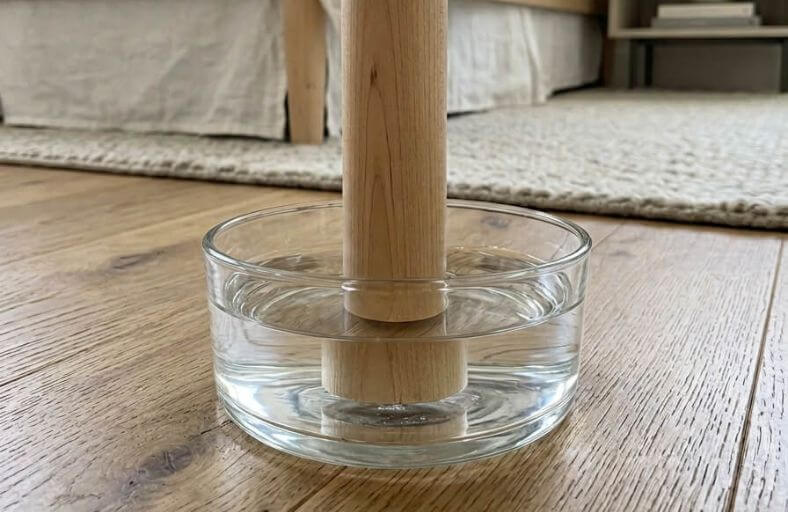
If ants continue to climb your bed despite your best cleaning efforts, you can use a physical barrier technique known as a “moat.” This method effectively turns your bed into an island that ground-based pests cannot reach.
By placing each leg of your bed frame into a small plastic container filled with a specific liquid, you create an impassable gap.
Ants are small enough to walk across the surface tension of plain water, so the choice of liquid is critical.
You should use water mixed with a few drops of dish soap, which breaks the surface tension and causes ants to sink, or a small amount of vegetable oil, which creates a sticky, viscous barrier.
Ensure the bed legs are centered in the containers so they do not touch the sides, as even a tiny point of contact can act as a “bridge” for the colony.
This is a non-toxic, highly effective mechanical solution, though you must ensure your bedding does not hang down and touch the floor, which would bypass the moats entirely.
Strategic Colony Baiting
To stop the infestation permanently, you must target the queen hidden inside the walls or outside the house. Killing the scouts on your bed is only a temporary fix; you need a “Trojan Horse” strategy using slow-acting baits.
These baits combine a sweet or protein-based attractant with a slow-acting metabolic inhibitor like Borax or Hydramethylnon.
| Bait Type | Best For | Active Ingredient Example |
| Liquid Bait | Sugar/Sweet-seeking ants | Borax (e.g., Terro) |
| Gel Bait | Hard-to-reach cracks/crevices | Indoxocarb (e.g., Advion) |
| Granular Bait | Protein/Grease-seeking ants | Avermectin |
Place these bait stations along the baseboards or near entry points on the floor, but never directly on your bed. It is vital that you do not kill the ants you see interacting with the bait.
They must survive long enough to carry the poison back to the nest and share it with the queen through a process called trophallaxis. Within a few days to a week, the entire colony will collapse from the inside out.
Fortifying the Perimeter and Controlling Moisture
Ants do not enter your bedroom by accident; they are often seeking refuge from extreme weather or searching for a steady water source.
Long-term prevention requires you to “fortify” your room by sealing entry points and managing the microclimate.
Use a silicone-based caulk to plug every tiny gap around window frames, baseboards, and electrical outlets, which are common “highways” for species like Pharaoh ants.
Furthermore, moisture control is a powerful deterrent. Many ants are explicitly drawn to humidity and sweating pipes. If your bedroom feels damp, use a dehumidifier to keep the humidity level below 50%.
Ensure there are no slow leaks in nearby walls or windowsills, as damp wood is an invitation for Carpenter ants to nest.
By maintaining a dry, sealed environment and removing the “bridge” of overgrown plants touching your exterior walls, you make your home a hostile environment for any future scouts.