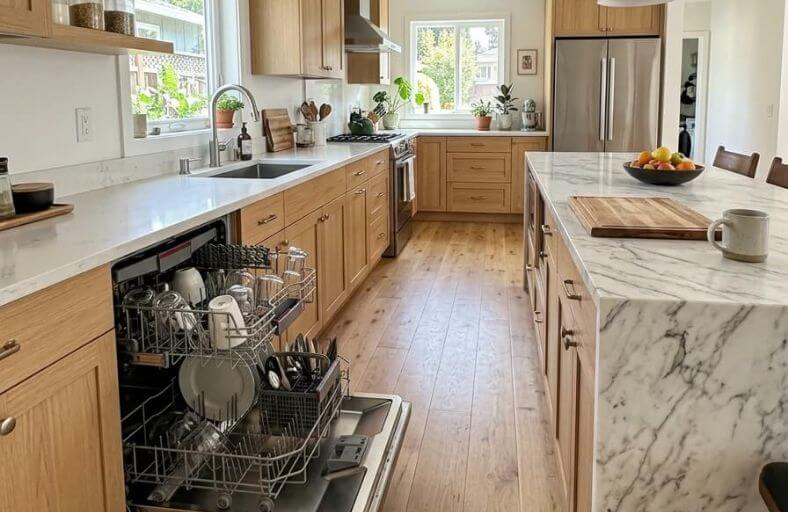
A massive kitchen island looks stunning in a glossy magazine, but in a real-life Tuesday morning rush, an oversized block can turn into a frustrating obstacle course.
The difference between a dream kitchen and a spatial nightmare often comes down to just a few inches of clearance.
Finding the perfect scale is a mathematical dance between the square footage you have and the functions you need.
Whether you want a cozy breakfast spot or a professional chef’s prep station, understanding the architectural standards ensures your kitchen remains the heart of the home rather than a crowded bottleneck.
Respect the Ten Percent Rule
The first step in sizing your island is looking at the room’s total footprint. Architectural harmony relies on the ten percent rule, which suggests that your island should not occupy more than 10% of the kitchen’s total square footage.
For instance, in a 160-square-foot kitchen, the island should ideally stay under 16 square feet to prevent the room from feeling cramped.
Additionally, many designers use the Golden Ratio, aiming for an island length that is roughly two-thirds the length of your main countertop to maintain visual balance and prevent the unit from overwhelming the space.
| Kitchen Size | Typical Island Width | Typical Island Length |
| Small | 24″ – 36″ | 36″ – 60″ |
| Medium | 36″ – 48″ | 60″ – 84″ |
| Large | 48″ – 72″ | 84″ – 108″+ |
Prioritize Clear Floor Space
The efficacy of your kitchen layout is determined by the air around the island rather than the island itself.
National Kitchen and Bath Association (NKBA) guidelines specify a minimum work aisle of 42 inches for a single cook and 48 inches if multiple people are routinely working together.
If your kitchen is less than 13 feet wide, a fixed island may actually hinder your movement and reduce overall functionality.
These clearances are critical because they allow cabinet doors, dishwashers, and ovens to swing open fully without causing a traffic jam.
In high-traffic zones, stretching the aisle to 54 inches can transform the space into a truly comfortable workflow.
Choose Heights Based on Tasks
Vertical ergonomics dictate how your body feels after an hour of meal prep. The standard counter height is 36 inches, which aligns with most perimeter cabinets and is optimized for chopping and mixing without straining your shoulders.
However, multi-level designs are becoming popular for their versatility. A 42-inch bar height section is ideal for social gatherings, as it places seated guests at eye level with the standing cook.
| Task Type | Optimal Height |
| Baking Center | 32″ – 34″ |
| Standard Prep | 36″ |
| Social/Bar Height | 42″ |
For heavy-duty baking, a lower 32-inch surface provides better leverage for kneading dough or rolling pastry.
Budget for Personal Space and Seating
When an island transitions from a prep zone to a dining zone, you must account for human shoulder width.
To avoid elbow-clashing, budget at least 24 inches of linear width per person along the seating edge.
A three-seat configuration, for example, requires at least a 72-inch island edge to remain comfortable. Equally important is the knee depth, which changes based on the height of the surface.
A standard 36-inch counter requires a 15-inch overhang to ensure legs don’t hit the cabinetry.
If you prefer a 42-inch bar height, the required knee depth drops to 12 inches since legs dangle more vertically.
Plan for Appliance Landing Zones
If you intend to integrate a sink or cooktop, your island dimensions must grow to include mandatory landing zones. These are critical safety buffers for staging ingredients or resting hot pans.
For a primary sink, NKBA standards require a minimum of 24 inches of countertop on one side and 18 inches on the other.
Cooktops demand 12 inches on one side and 15 inches on the other to prevent grease splatters or accidental contact with hot burners.
| Appliance Type | Primary Landing Side | Secondary Landing Side |
| Sink | 24 inches | 18 inches |
| Cooktop | 15 inches | 12 inches |
| Refrigerator (Adjacent) | 15 inches | N/A |
Furthermore, if your island is a single-level surface, you must maintain at least 9 inches of space behind the cooktop for safety.
Update for Modern Electrical Codes
Electrical planning for islands has changed significantly with the National Electrical Code (NEC).
Traditional side-mounted outlets under a countertop overhang are no longer permitted to serve the work surface because dangling cords create a major hazard for children.
Modern designs now favor pop-up outlets that remain flush with the countertop when not in use.
Even if you choose not to install an outlet immediately, current codes require a provision for future use, such as a junction box, so one can be added later without a full renovation. Always ensure every island outlet is GFCI-protected for water safety.
Perfect the Visual Balance of Lighting
The size of your island directly dictates your lighting layout to avoid a dark zone in the center of your workspace.
Pendant lights should be hung 30 to 36 inches above the countertop to provide focused task lighting while keeping sightlines clear for conversation.
To preserve architectural rhythm, maintain at least 6 inches of space between the edge of the island and the center of the first pendant fixture. Pendants are typically spaced 24 to 30 inches apart, measured from center to center.
Generally, a 6-foot island accommodates two medium pendants, while an 8-foot island requires three for even light distribution.
Opt for Mobile Units in Compact Spaces
If your kitchen width is less than 13 feet, a permanent island may become a frustrating obstacle rather than a helper.
In these scenarios, a mobile island or kitchen cart on casters is a smarter architectural choice.
These units should still meet a functional minimum of 24 inches by 48 inches to be useful for food prep.
| Island Type | Best For | Main Advantage |
| Fixed | Large Kitchens | Integrated Utilities/Stability |
| Rolling/Mobile | Small/Galley Kitchens | Flexible Traffic Flow |
The primary advantage of a rolling island is flexibility; you can lock the wheels for extra counter space during meal prep and then tuck it against a wall to restore a clear thoroughfare for guests.
Incorporate Universal Design for All Generations
Standard aisles are functional for most, but universal design ensures your kitchen remains accessible as your family’s needs change.
To accommodate a wheelchair or mobility aid, the absolute minimum turning radius is 60 inches.
This often requires expanding your walkways from the standard 42 inches to a more generous 48 or 60 inches. Beyond width, accessibility is about safety details.
Choose clipped or rounded countertop corners instead of sharp 90-degree angles to prevent injuries from accidental collisions.
Additionally, integrating a lower 30-inch-high counter section allows tasks like chopping or mixing to be performed comfortably from a seated position.
Avoid Blocking the Kitchen Work Triangle
Your island should act as a bridge, not a barrier, between your primary work centers: the sink, refrigerator, and stove.
The work triangle rule suggests the total distance between these three points should be between 12 and 26 feet.
Crucially, an island must not block any leg of this triangle by more than 12 inches. If you find yourself constantly walking around a massive island just to get from the fridge to the sink, the unit is likely too long or poorly positioned.
Maintaining a clear path prevents traffic jams and ensures a high-efficiency workflow during complex meal preparation.
Leverage the Social Triangle for Connection
Psychology is a key component of a dream kitchen that feels right. Designers often reference the social triangle, which ensures the primary cook can maintain eye contact with guests or family members while working.
By positioning the main prep area to face the living space, you transform cooking from a solitary chore into a democratic, social activity.
To make this successful, respect the territory effect by providing enough buffer space between the prep zone and the seating area.
If guests feel they are too close to a hot stove or a splashing sink, they will subconsciously feel uncomfortable and avoid the space.
Master Proportions with the Golden Ratio
Aesthetically, a kitchen island should look anchored in the room, not floating aimlessly.
The Golden Ratio in design suggests that your island length should be approximately two-thirds the length of your main countertop run to feel balanced to the human eye.
While oversized islands are a major trend, anything exceeding 10 feet in length is often considered impractical; it becomes a massive obstacle that disrupts kitchen fluidity and makes cleaning the center of the surface nearly impossible.
| Layout Feature | Standard Recommendation |
| Max Island Footprint | 10% of total kitchen square footage |
| Work Triangle Sum | 12 – 26 feet |
| ADA Turning Radius | 60 inches |
For most medium-to-large homes, a 7-foot island is the sweet spot for accommodating three seats and a prep sink without overwhelming the floor plan.