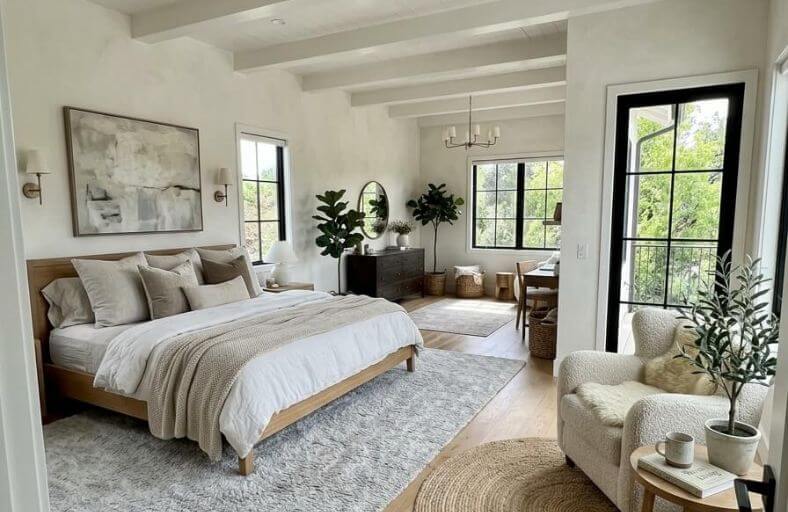
A large bedroom might sound like every homeowner’s dream, but decorating one well presents its own unique set of challenges.
Without thoughtful planning, a spacious bedroom can easily feel cold, cavernous, and lacking the warmth and coziness that a bedroom should naturally provide.
Simply filling the space with furniture isn’t enough. The key lies in creating distinct zones, choosing appropriately scaled pieces, and layering textures and colors in a way that makes the room feel full of personality rather than just full of stuff.
Master the Golden Ratio for Spatial Balance
The foundation of a balanced large bedroom lies in the Golden Ratio, a mathematical constant (approx 1.618) found throughout nature and architecture.
Applying this ratio helps prevent the floating furniture syndrome common in oversized rooms.
Instead of centering your bed in the exact geometric middle of the floor, use the ratio to split the space into two primary zones: a sleeping sanctuary and a secondary lifestyle area.
Typically, the bed area should occupy approximately 62% of the room’s total width, leaving the remaining 38% for functional additions like a reading nook or a vanity.
This division provides an architectural anchor that makes the room feel organized and intentional rather than empty.
By respecting these proportions, you ensure that the furniture mass is distributed logically, creating a sense of visual stability that immediately calms the mind.
Choose Furniture with Visual Gravity
Standard-sized furniture often disappears in a large room, looking unmoored and diminutive. To bridge the gap between a high ceiling and the floor, you must choose pieces with significant gravitas.
A grand canopy frame or an oversized, tall headboard acts as a vertical bridge, effectively shrinking the room’s perceived height to a more human scale.
Pairing a massive bed with equally large nightstands is essential to maintain symmetry and prevent the central furniture cluster from being overwhelmed by negative space.
| Furniture Element | Recommended Feature for Large Rooms | Design Purpose |
| Bed Frame | Canopy or Four-poster | Creates an intimate “room within a room”. |
| Headboard | Tall, upholstered or floor-to-ceiling | Provides visual weight and vertical balance. |
| Nightstands | Oversized or generous width | Prevents the bed from looking isolated. |
| Foot of Bed | Upholstered bench or ottoman | Acts as a visual anchor and functional landing spot. |
Implement Functional Zoning
Professional designers approach a vast bedroom as a multi-functional suite rather than just a place to sleep.
This suite methodology involves carving out specialized areas that serve different parts of your daily ritual.
A secondary zone positioned near a window, for example, can become a dedicated lounge area with a pair of sculptural armchairs and a small side table.
Using rugs is the most effective way to define these boundaries without building actual walls.
A large rug should anchor the bed, while a separate, smaller rug defines the lounge or vanity zone.
This creates invisible rooms that guide your movement and provide a sense of structure. For 2026, consider a dedicated reading nook or even a vanity moment to add a layer of personalized luxury to the layout.
Embrace Monochromatic Cocooning
In a large space, light colors often recede, making the walls feel even further away and the atmosphere colder.
The trend of Monochromatic Cocooning solves this by saturating the room in deep, grounded earth tones like mocha or warm chocolate brown.
Painting the walls, ceilings, and millwork in the same rich hue creates a sensual, cave-like atmosphere that feels incredibly secure.
These muddied colors have a psychological weight that whites and light grays lack. By eliminating high-contrast lines between the walls and the ceiling, the room feels both unified and snug.
If you aren’t ready for a full-room treatment, consider a bold accent wall in dark cherry red to add depth and a pop of personality.
Prioritize Acoustic Softening
Large rooms with hard surfaces like wood floors and expansive glass often suffer from a sterile, echoey atmosphere. To transform this into a sanctuary, you must employ acoustic engineering through heavy textiles.
Think of your fabrics as a sponge for sound. High-density materials, particularly velvet, are significantly more effective than lightweight synthetics at trapping sound waves.
For maximum comfort, install floor-to-ceiling drapery that is at least double the width of your window, this fullness creates irregular surfaces that diffuse sound waves.
| Material | Acoustic Benefit | Technical Specification |
| Heavy Velvet | Absorbs mid-range frequencies | 300–500 GSM weight |
| Multi-layer Rugs | Dampens impact and floor echo | 0.5+ NRC Rating |
| Upholstered Panels | Reduces wall-to-wall “slap echo” | ≥4mm thickness |
Laboratory tests show that well-fitted, heavy curtains can reduce perceived noise by up to 10 decibels, effectively halving the loudness of external sounds.
Command Verticality with Wall Treatments
Empty walls in a large bedroom can feel cold and sterile, creating a sense of visual drift. To counteract this, leverage the verticality of the space with tall features that draw the eye upward.
Tall headboards, floor-to-ceiling drapes, or vertical wood paneling bridge the gap between the floor and high ceilings, making the room feel snug rather than cavernous.
Consider pattern drenching or applying wall treatments like classic wainscoting or modern board-and-batten.
These architectural details add depth and texture, preventing the walls from looking like flat, white voids.
Large-scale art installations that occupy 60-75% of the wall space above furniture also help anchor the room’s proportions, ensuring every element feels intentional.
Sculpt the Space with Layered Lighting
A single overhead light is a design mistake in large rooms because it flattens the space and leaves corners in shadow. Instead, implement layered illumination to create a dynamic and flexible atmosphere.
By mixing ambient, task, and accent lighting, you can shrink the psychological scale of the room, making specific zones like the bed or a lounge nook feel like intimate pockets of warmth.
Use warm-toned LEDs (around 2700K) to signal your body to relax and prepare for sleep. Position dimmable floor lamps in your seating area and sleek task lamps on oversized nightstands.
This strategy doesn’t just illuminate the room; it sculpts the architectural features and enhances the tactile richness of your materials, making the entire suite feel balanced and inviting at night.