Walking into a living room with soaring ceilings should feel like stepping into a sanctuary, yet many homeowners find themselves staring at a vast, white void that feels more like a cold gallery than a cozy home.
This “tiny art syndrome”, where a single small frame gets lost on a twenty foot surface, is the ultimate aesthetic nightmare that leaves a space feeling unfinished and echoey.
Masterfully decorating a large wall is about more than just filling space: it is about establishing a visual anchor that grounds the entire room .
By understanding scale and psychological comfort, we can transform these daunting vertical expanses into meaningful design statements that reflect a unique personal identity.
Oversized Statement Art and Massive Canvases
Oversized wall art is a dominant trend because it solves the problem of expansive space with a singular, high impact focus.
A substantial framed print or massive canvas anchors the room without the visual complexity of a gallery arrangement.
The rule of thumb is to let the artwork occupy 50% to 75% of the primary wall area for a single focal piece.
If placing art above a sofa or console, aim for the piece to span 60% to 70% of the furniture’s width to ensure it feels grounded rather than like a floating outlier.
To maintain a human-centric perspective on tall walls, designers suggest hanging these pieces so the center is approximately 57 to 60 inches from the floor.
“Soft Surrealism” and “Dreamscapes” are rising in popularity, offering a poetic character that adds emotional depth to a room without feeling like a literal theme.
Choosing matte or low-sheen finishes is also essential to reduce glare from windows, ensuring the art remains visible and calming throughout the day.
Coordinated Multi-Panel Sets
For those who find a single massive canvas logistically difficult, coordinated sets like diptychs (two panels) or triptychs (three panels) offer a polished, professional solution.
This approach removes the guesswork of scaling because the set is designed to work in a specific visual rhythm.
“Soft Landscape Triptychs” featuring misty mountains or organic botanicals are favored for bringing a quiet, meditative energy to the home.
To execute this correctly, panels must be hung with consistent spacing, typically 2 to 4 inches apart, which allows the eye to bridge the gap and perceive the collection as a single unified gesture. This technique is particularly effective above long sectionals where a single frame might feel insufficient.
Multi-panel sets provide the necessary scale to fill a large wall while feeling lighter and less “heavy” than a single giant frame.
They bridge the gap between architectural structure and personal decor, creating a “Modern Heritage” feel that is both balanced and intentional.
The Symmetrical Grid Gallery Wall
While eclectic gallery walls have their place, the “Personal Gallery Wall” trend leans toward symmetry and order.
A grid of six to nine identical frames creates a moment that feels organized and calm, effectively reducing the cognitive load that a chaotic arrangement might trigger.
Using uniform frame colors such as clean black or natural wood gives the collection a designer-grade finish that acts as a structural anchor for the room.
| Grid Element | Recommendation | Visual Impact |
| Frame Style | Uniform colors (Black/Oak) | Professional, polished look |
| Spacing | 2-inch uniform gaps | Organized and architectural |
| Content | Black & white photography | Timeless, low visual noise |
| Lighting | Dedicated picture lights | Gallery-like “designer touch” |
To achieve a professional look, designers often use laser levels to ensure the grid is perfectly aligned.
Adding slim brass picture lights above each column of frames can elevate the display from a simple photo wall to a sophisticated architectural feature.
This method is ideal for showcasing travel memories or family moments while maintaining a disciplined, high-end aesthetic.
Architectural Picture Frame Molding and Wainscoting
Architectural molding or millwork is a powerful tool for adding Modern Heritage character to newer homes that may feel flat.
Picture frame molding involves creating repeating rectangular “boxes” on the wall, which instantly raises the elegance factor and adds value to the property.
For large walls, using narrow vertical boxes can create an optical illusion of heightened ceilings, making the space feel more grand.
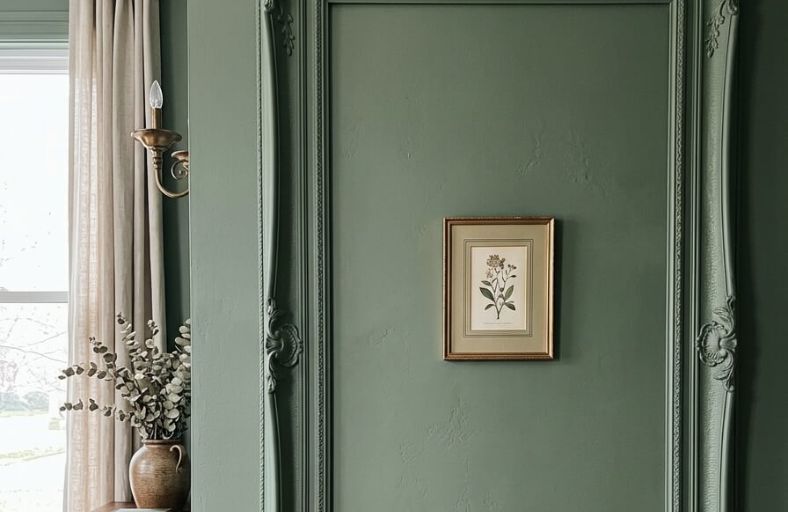
The trend of color drenching, these moldings, painting the walls, trim, and baseboards in a single, saturated hue like sage green or warm taupe, is highly popular.
This technique emphasizes the shadows and texture of the wood without creating the visual “noise” of contrasting colors. Using wainscoting on the lower third of the wall helps ground a massive space and provides a sturdy backdrop for furniture.
It acts as “architectural punctuation”, providing an intentional pause that makes a large room feel more intimate and human-scaled.
Modern Vertical Wood Slat Walls
Vertical wood slat panels, often called “slat walls”, have evolved from a passing trend into a core architectural feature.
These panels provide a rhythmic, linear texture that anchors a room without the need for traditional artwork.
The design world is shifting toward deeper wood tones such as walnut and smoked oak to add a sense of grounded sophistication.
Beyond aesthetics, slat walls serve a vital functional purpose by improving room acoustics.
The vertical slats help diffuse sound waves and reduce echoes, which is especially important in large rooms with high ceilings and hard flooring.
For a “show-stopping” result, designers suggest pairing these wood panels with integrated LED strip lights that catch the edges of the wood, emphasizing the three-dimensional profile of the wall.
Biophilic Living Walls and Preserved Moss Installations
As wellness becomes a primary design goal, “Living Architecture” is moving from commercial spaces into residential living rooms. A large wall provides the perfect canvas for a preserved moss installation.
These “green walls” offer the authentic texture of nature without the maintenance or water requirements of living plants.
Research into biophilic design shows that interacting with these natural patterns can reduce stress levels by up to 37%.
The human brain is naturally calmed by “fractal fluencies”, patterns like moss or wood grain that repeat at different scales.
By installing a large-scale moss feature, you create a state of “soft fascination” that allows your mind to recharge from daily digital fatigue.
These installations are frequently framed in organic wood or bronze, merging biological beauty with high-end architectural precision.
Strategic Layered Lighting
One of the most common design mistakes is relying solely on overhead lighting, which can leave a large wall feeling flat and sterile.
Lighting is treated as “emotional luxury”, using sculptural fixtures to define the atmosphere.
Adding oversized brass sconces or slim picture lights creates a “warm ambient” effect that makes an expansive wall feel intimate and inviting.
| Lighting Type | Best Use Case | Visual Benefit |
| Picture Lights | Above large canvases or grids | Highlights texture and creates focus |
| Sculptural Sconces | Flanking a mirror or fireplace | Adds “architectural jewelry” to the wall |
| Integrated LEDs | Tucked behind slats or shelves | Adds depth and dramatic shadows |
| Amber-Toned Bulbs | Across the entire feature wall | Evokes a sense of calm and luxury |
Designers recommend layering at least two to four additional light sources in a living room to create a welcoming ambiance.
This mid-level lighting wraps the room in a “golden glow”, shifting the wall from a simple surface to a curated stage.
Oversized Floor and Wall Mirrors
Mirrors are no longer just for checking your reflection: they are “layout decisions” used to stretch space and double natural light.
A massive, arched floor mirror leaning against a wall can echo architectural features like windows or doorways, making a room feel significantly taller.
This “leaner” style is increasingly popular because it feels relaxed and adaptable compared to permanent wall-mounted options.
| Mirror Shape | Style Influence | Architectural Effect |
| Arched / Curved | Soft Minimalism | Heightens the room and adds flow |
| Geometric Grid | Neo Deco / Industrial | Adds rhythm and structural drama |
| Irregular / Fluid | Modern Organic | Breaks up rigid, square layouts |
| Round / Circular | Contemporary Neutral | Softens heavy furniture and adds balance |
Strategically placing a mirror opposite a window brings the outdoors deeper into the home, a key element of biophilic light amplification.
When choosing a mirror for a large wall, scale matters more than ever: a piece that is too small will look lost, so aim for a size that anchors the surrounding furniture.
Floor-to-Ceiling Built-In Shelving and Library Walls
For a truly massive wall, custom built-in shelving is a high-value investment that combines storage with a permanent sense of intellectual warmth.
The styling of these units has moved toward “intentional maximalism”, where books, sculptures, and personal heirlooms are grouped by material or color to tell a story without feeling cluttered.
By extending the shelving from floor to ceiling, you emphasize the height of the room and create a “built-in display wall” that functions as a piece of functional furniture and a structural anchor.
Integrating LED lighting within the shelves is a signature move, turning the unit into a sophisticated light feature that highlights your favorite ceramics or leather-bound collections.
To keep the look modern, many designers now use “color drenching” for the shelving, painting the entire unit the same color as the walls to let the curated objects take center stage.
This creates a seamless, designer-grade finish that makes the room feel more organized and expansive.
Immersive Color Drenching and “Color Capping”
Color drenching involves painting every surface in a room, including walls, ceiling, trim, and doors, in a single, unified hue.
This creates a cocoon-like environment that eliminates the high-contrast interruptions of white trim, making a large wall feel less daunting and more purposeful.
The most popular shades for this technique include “Jade” for serenity and “Plum Noir” for dramatic intimacy.
| Color Strategy | Best Use Case | Psychological Effect |
| Color Drenching | Open-concept or large walls | Enveloping, calming, reduces stress |
| Color Capping | Living rooms with high ceilings | Visually lowers ceiling, adds intimacy |
| Double Drenching | Rooms with architectural details | Adds depth using two tones from one family |
A more targeted variation is “Color Capping”, where an intense color is applied to the ceiling and the top portion of the wall. This creates a “warm envelope” effect that visually lowers a soaring ceiling, making a double-height living room feel more human-scaled and inviting.
By mixing paint sheens, such as a matte wall with satin trim, you can add subtle layers of depth without disrupting the monochromatic calm.
Textural and 3D Wallpapers or Large-Scale Murals
Wallpaper has evolved from repetitive patterns into immersive art environments.
Large-scale abstract murals or “biophilic mega-florals” can transform a blank surface into a window into another world, adding atmospheric depth that “pushes the wall back” and makes the room feel more connected to nature.
Texture is the priority this year, with tactile wallpapers like grasscloth, linen weaves, or even 3D raised finishes that invite the touch.
| Wallpaper Style | Trend Feature | Best Pairing |
| Textured Grasscloth | Organic, woven fiber | Mid-century modern furniture |
| Abstract Murals | Misty, watercolor washes | Minimalist, clean-lined sofas |
| 3D Sculptural | Raised plaster or stone effects | Directional art lighting |
| AI-Generated | Custom-designed patterns | High-tech, personalized spaces |
For renters or those who want flexibility, peel-and-stick murals have become incredibly high-quality, allowing for bold experimentation with moody forests or celestial night skies.
These installations often serve as the primary “artwork” for the room, requiring very little additional decor to feel complete.
Plaster, Limewash, and Raw Masonry Finishes
Flat, white walls are being replaced by “Tactile Design”, where the wall surface itself is the star of the room.
Finishes like plaster, limewash, and raw masonry provide a sense of “material honesty” and a handcrafted feel that brings warmth to large spaces.
Limewash is particularly favored due to its eco-friendly, non-toxic properties and its soft, mottled texture that interacts beautifully with changing daylight.
These soulful finishes add a layer of “patina”, the beautiful way that authentic materials age over time, which makes a new home feel lived-in and storied.
For a more modern edge, designers are using “shadow painting”, where alcoves or niches are painted a slightly darker shade to emphasize the room’s architectural lines.
When paired with directional lighting, these textures cast soft shadows that create a rich, layered look that standard paint simply cannot achieve.
Textile Hangings and Global Fiber Art
Softening a large room is often best achieved through “Textile and Fabric Hangings”, which provide sensory richness while significantly improving acoustics.
The Afrohemian Fusion trend is dominating Pinterest, featuring hand-dyed mudcloths, Ethiopian wall art, and handwoven baskets.
These materials absorb sound in noisy, high-ceilinged rooms, making the space feel like a restorative sanctuary rather than an echo chamber.
Secure these soft materials with simple brass art rails or wooden rods to turn a casual textile into a formal design statement. This approach allows for seasonal swaps, providing a “layered and lived-in” look that hard frames cannot replicate.
Beyond the visual appeal, the presence of natural fibers like wool and linen connects inhabitants to the natural world, a core requirement for wellness-focused interiors.
Functional Furniture Vignettes
Sometimes the most effective way to decorate a wall is to move furniture “off the walls” or use low-profile pieces to create “momentary pauses” for the eye.
A long console table or a low bench placed in front of a massive wall provides a functional base for layering art and lighting.
This creates a furniture “vignette” that breaks up the vertical expanse and adds much-needed depth to the room layout.
| Vignette Component | Function | Psychological Effect |
| Console Table | Storage and display surface | Adds structure and stability |
| Low Bench | Seating and visual rest | Creates a “refuge” pause point |
| Pedestal + Vase | Vertical accent | Draws the eye up gracefully |
| Symmetrical Lamps | Secondary lighting | Promotes “cognitive calm” |
Designers suggest the “2/3 width rule”, where the decor above a piece of furniture should span at least 60% to 70% of its width to maintain proper proportion.
This zoning strategy helps massive rooms feel like a collection of intimate, intentional spaces rather than one giant, overwhelming void.
Advanced Shadow Gap and Floating Trim Details
The Shadow Gap is a sophisticated architectural detail that makes ceilings or walls appear as if they are “floating” by leaving a small 10 to 20mm recess between planes. This technique represents the pinnacle of the “quiet luxury” aesthetic.
While traditionally a structural renovation, a popular DIY hack involves painting a thin, dark line at the top of the wall where it meets the ceiling to mimic the effect.
This faux recess creates a sense of contrast that makes ceilings feel disconnected from the walls, giving them a weightless, floating quality that makes the room feel taller. In practice, the precision of the line is critical for the illusion to work.
Beyond the ceiling, shadow gaps can be implemented at the baseboard level to create a clean, minimalist finish that avoids bulky, traditional trim.
It is an “architectural punctuation” that signals a home rooted in quality and thoughtful development.