A movie night snack takes a tragic turn when a melting piece of dark chocolate finds its way onto your pristine beige upholstery. Before you panic and start scrubbing frantically, take a deep breath.
Chocolate is what experts call a combination stain, meaning it is a tricky cocktail of fats, proteins, and dark tannins that bond to fabric fibers.
Handling this without a plan often leads to a permanent smudge that stares at you every time you sit down.
Fortunately, with the right science-backed strategy and a bit of patience, you can restore your sofa to its pre-chocolate glory.
The Scrape and Freeze Strategy
The golden rule of chocolate spills is to never wipe a soft mess. If the chocolate is still gooey, you will only push it deeper into the weave.
Instead, grab a plastic bag filled with ice cubes and rest it directly on the spot for about ten minutes.
This process, known as cryogenic hardening, turns the flexible cocoa butter into a brittle solid.
Once it is hard, use the blunt edge of a spoon or a credit card to gently fracture and lift the pieces away.
Always scrape from the outside of the stain toward the center to prevent the debris from spreading.
Follow up with a quick vacuum using a brush attachment to remove any tiny, pulverized chocolate dust before it has a chance to melt again into the textile fibers.
Decoding Your Upholstery Care Label
Before applying any liquid, you must play detective with your couch’s care label.
Upholstery fabrics are not created equal, and using the wrong cleaner can result in permanent water rings or fiber shrinkage.
Look for the small tag, usually tucked under the cushions or on the bottom of the frame, to find your cleaning code.
| Code | Cleaning Method | Safe Agents |
| W | Water-based | Mild detergent or upholstery foam |
| S | Solvent-based | Dry-cleaning solvents only (no water) |
| WS | Dual-compatible | Both water and solvent-based methods |
| X | Vacuum-only | Professional cleaning required |
If your tag says “S,” put the water away immediately and stick to specialized dry solvents to protect the fabric’s structural integrity.
Cold Soap Emulsification
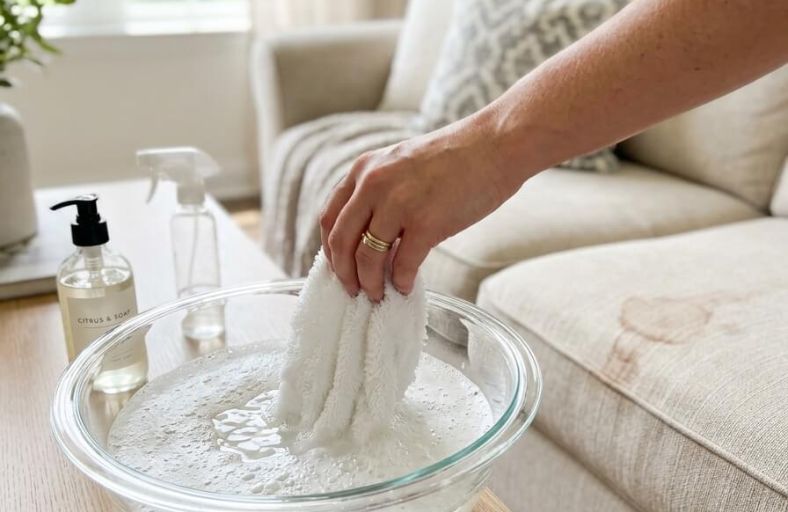
For fabrics with a “W” or “WS” code, a simple grease-fighting dish soap is your most effective tool. Mix one tablespoon of clear dish soap with two cups of cold water.
It is vital to use cold water because heat denatures the milk proteins found in chocolate, essentially cooking them into the fibers and making the stain permanent. Dip a clean white cloth into the solution and gently blot the area.
The soap molecules act as surfactants, forming structures called micelles around the oils in the cocoa butter to lift them away from the fabric.
Avoid scrubbing vigorously, as mechanical friction can generate localized heat and fray delicate upholstery fibers.
Neutralizing Tannins with Vinegar
If a brownish shadow remains after the soap treatment, you are likely dealing with tannins, the plant compounds that give cocoa its deep pigment.
Distilled white vinegar is a fantastic natural acid that breaks down these pigments and helps dissolve leftover sugars.
Create a 1:1 mixture of white vinegar and lukewarm water. Lightly dampen a cloth and blot from the outer edges in toward the center.
The natural acetic acid in the vinegar provides a one-two punch by cutting through any lingering grease while neutralizing the dark pigments.
As a bonus, vinegar acts as a rinse agent, ensuring that no sticky soap residue is left behind to attract future dirt.
Advanced Enzymatic Power
For stubborn or set-in chocolate marks, reach for a professional-grade enzymatic cleaner. Unlike regular soap, these cleaners contain biological catalysts specifically designed to “digest” the different parts of a chocolate stain.
| Enzyme Type | Target Component |
| Lipase | Breaks down cocoa butter and fats |
| Protease | Dissolves milk proteins and dairy |
| Amylase | Targets starches and sugars |
To use these effectively, spray the solution and allow for dwell time, usually 10 to 30 minutes.
This period allows the enzymes to chemically break the bonds between the stain and the fabric.
If you are dealing with a deep mess, cover the treated area with a damp utility towel overnight to prevent evaporation, allowing the enzymes to keep working into the morning.
Special Care for Leather and Suede
Leather and suede require a specialized touch to avoid ruining their natural texture. If chocolate lands on a leather sofa, your priority is to preserve the hide’s essential oils while removing the contaminant.
For smooth leather, use a mild, pH-neutral leather cleaner or a damp cloth with a tiny bit of soap, then follow up immediately with a leather conditioner to prevent the material from cracking.
Suede and nubuck are far more sensitive, as water often causes permanent spotting. Instead, use a specialized degreaser spray that dries into a fine powder, pulling the grease out as it sets.
Once the powder is dry, simply vacuum it away and use a suede brush to restore the soft nap of the fabric.
Final Polish with Absorbents
Once you have finished the liquid cleaning phase, the final step is to ensure no hidden oils “wick” back to the surface as the fabric dries.
This phenomenon happens when deep-seated oils travel up the fibers and reappear as the moisture evaporates.
To prevent this, sprinkle a generous layer of cornstarch or baking soda over the damp area.
These powders act like tiny sponges, drawing out residual moisture and microscopic chocolate lipids from the deepest layers of the upholstery.
Let the powder sit for at least 45 minutes, though leaving it overnight is best for heavy spills.
Finally, vacuum the area with a brush attachment to lift the powder and fluff the fabric back to its original state.