Walking into a room only to stub your toe on a defiant rug edge is a quick way to ruin a peaceful morning. This common household annoyance is actually a significant safety risk.
Statistics show that thousands of adults visit emergency rooms every year due to falls involving loose rugs or curled edges. Beyond the danger, these stubborn corners disrupt the clean lines and cozy aesthetic of your home.
Whether it is caused by tight storage or changes in humidity, the “fiber memory” of your rug needs a little coaxing to lay flat again. Let us explore the best expert methods to restore your floor covering to its intended beauty.
Reverse Rolling and Mechanical Counter-Stress
The most common reason for a curling corner is simply how the rug was packaged. Most manufacturers roll rugs tightly for shipping, which creates a “set” in the backing material. To fix this, you should perform a reverse roll.
This technique involves rolling the rug in the exact opposite direction of the curl. If the corners are lifting upward, flip the rug over and roll it tightly with the pile facing outward.
For the best results, leave the rug in this counter-rolled state for 24 to 72 hours to allow the fibers and backing to relax. For particularly stubborn natural fibers like jute, you can use a “30-second twist” method.
Simply manually roll the corner downward and stretch the backing material to help it adapt to its new, flat shape.
This mechanical stress neutralizes the memory of the original roll without requiring any extra tools.
Thermal Fiber Manipulation via Controlled Steam
Steam is a professional secret for relaxing both natural and synthetic rug fibers. The combination of heat and moisture softens the adhesive or latex in the rug’s backing, allowing the pile to reset into a flat position.
Using a handheld garment steamer on the underside of the rug is the most efficient approach.
If you do not own a steamer, a standard iron can work, provided you follow strict safety protocols to avoid scorching the fibers. You must place a damp, clean towel over the curled area to act as a thermal buffer.
Move the iron continuously on a low to medium setting for short intervals. This method is especially effective for wool rugs, as the animal protein fibers respond beautifully to gentle heat and hydration, locking into a flat state as they dry.
Localized Hygroscopic Relaxation with Ice Cubes
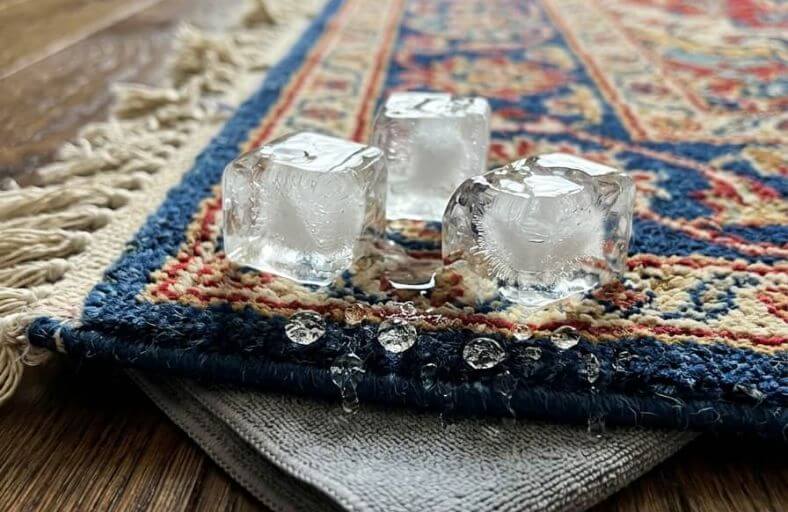
An ingenious and low-cost DIY hack for persistent curling involves using the simple ice cube. This method relies on a slow, controlled release of moisture that penetrates deep into the rug’s core.
Place a few ice cubes along the margin of the curl, leaving the very edge exposed. As the ice melts, the water saturates the stiff fibers, making them pliable and ready to be reshaped.
To ensure success, you must place a heavy object over the corner while it is still damp and leave it to dry overnight. This “wet-set” technique is highly effective for natural materials like cotton or wool.
However, you must always place a thin towel underneath the rug corner during this process to protect your hardwood or laminate floors from potential moisture damage. Once the rug is completely dry, the corner should remain perfectly flush with the floor.
Static Loading and Weighted Compression
Weighted compression, often called “training” the rug, is a passive but highly effective strategy that uses gravity to overcome internal tension.
By placing heavy, flat objects on the corners, you force the rug to settle into a planar state over time. This method is ideal for new rugs that just need a bit of time to acclimate to their new environment.
The duration of this treatment is vital for permanent results. While some minor curls might resolve in a few hours, stubborn edges usually require several days or even up to two weeks of consistent pressure.
| Recommended Weights | Ideal Duration | Best For |
| Stacks of heavy books (3-5 tomes) | 48 hours | Lightweight rugs |
| Small furniture (coffee table legs) | 1 week | Large area rugs |
| Kettlebells or heavy platters | 2-3 days | High-tension backings |
| Specialized rug weights | Permanent | Formal galleries |
This method is safe for almost all materials, though you should avoid using extremely heavy furniture on delicate silk or antique pieces to prevent crushing the pile.
Polymeric Adhesive Stabilization
When mechanical training is not enough, chemical stabilization through specialized adhesives is often the most effective “quick fix.”
Double-sided carpet tape provides an immediate, strong bond between the rug backing and the floor surface.
High-quality brands such as YYXLIFE or XFasten are specifically engineered to be residue-free, ensuring they do not pull up your hardwood finish or leave sticky marks when removed.
To apply this successfully, you must ensure the floor is thoroughly cleaned and free of dust, as any debris will compromise the adhesive bond. Simply apply the tape to the underside of the rug corner and press firmly into the floor.
This method is particularly useful for high-traffic entryways where the rug is frequently subjected to the lateral forces of people wiping their feet, which is a primary cause of marginal lifting.
Vacuum-Tech Suction Stabilization
A modern and highly popular alternative to traditional glue-based adhesives is “Vacuum Tech” or suction-based grippers.
Products like those from Home Techpro use a proprietary material that functions like thousands of microscopic suction cups.
Because they rely on physics rather than glue, these grippers do not harden or damage floor finishes over time, making them exceptionally “renter-friendly.”
These grippers are often reusable and washable; if they collect dust and lose their “stick,” a simple wipe with a damp cloth restores their full suction power.
They are virtually invisible once applied and work best on smooth surfaces like tile, laminate, or hardwood. This technology is ideal for those who want a permanent-feeling hold without the commitment of permanent adhesives.
Strategic Furniture Anchoring and Kinetic Load Distribution
Sometimes the best solution is to let your existing decor do the heavy lifting. By positioning the legs of sofas, heavy chairs, or coffee tables directly on the corners of a rug, you create a permanent mechanical anchor that prevents curling from ever starting.
This method effectively removes the “free edge” of the rug, which is the area most susceptible to lifting and tripping.
If you cannot place furniture directly on a corner, you can use heavy houseplants as functional decor to serve as a weight. However, you should be careful with delicate rugs made of silk or antique materials.
Placing extreme weight directly on these fibers can leave permanent crush marks, so using protective furniture cups is highly recommended to distribute the pressure evenly.
Comprehensive Hybrid Underlayment Systems
Investing in a high-quality rug pad is perhaps the most comprehensive step for long-term stability.
A rug pad provides the necessary friction to prevent the rug from shifting, which is a major contributor to corner bunching.
Research suggests that hybrid pads, those combining a felt top with a natural rubber bottom, offer the best performance for stabilizing rug margins. The felt layer “grabs” the rug’s backing, while the rubber provides a high coefficient of friction against the subfloor.
| Top Rated Rug Pads | Material | Best For |
| Mohawk Home Dual Surface | Felt and Natural Rubber | All Hard Floors & Carpet |
| Durahold Plus | Felt and Rubber | Maximum Grip on Hard Surfaces |
| RugPadUSA Cloud Comfort | Memory Foam | Cushioning and Comfort |
| Veken Non-Slip | PVC / Waffle Design | Budget-friendly for small rugs |
A proper pad also adds a layer of support that prevents the rug’s backing from breaking down due to repeated compression against a hard subfloor, extending the life of your investment while keeping it flat.
Atmospheric Humidity and Psychrometric Regulation
If you notice your natural fiber rugs, like wool, jute, or cotton, behaving differently as the seasons change, the culprit is likely humidity.
These materials are hygroscopic, meaning they absorb water molecules from the air, causing fibers to swell and edges to lift.
This is a common phenomenon in coastal or humid southern areas where moisture levels fluctuate significantly.
To maintain a flat rug, you should aim to keep your indoor humidity between 30% and 50%. Using a dehumidifier in the room where your natural fiber rugs are placed can prevent the fibers from dampening and drying in a curled position.
Conversely, in extremely dry environments, fibers can become brittle and hold a “set” curl more stubbornly.
Keeping a stable temperature and moisture level ensures the rug stays in a state of physical equilibrium, protecting the structural integrity of the backing.
Perimeter Reinforcement and Structural Binding
The way a rug’s edge is finished plays a massive role in its long-term stability. Rugs with “serged” or hand-stitched edges are tightly bound with thread, providing a rigid structure that naturally resists curling better than unbound or loosely finished edges.
If a rug persistently curls, it may be due to a lack of tension in this perimeter binding.
| Edge Type | Description | Curling Risk |
| Serged Edges | Tightly bound with reinforcing thread | Low |
| Hand-stitched | Reinforced manually for durability | Low |
| Unbound Edges | Lacks structural reinforcement | High |
For a DIY fix, you can apply a thin bead of rug-safe glue or silicone along the underside of the edge to provide a localized area of stiffness. This helps the margin “remember” its flat orientation.
If the problem is severe, a professional can re-bind the edges or add a heavy-duty “serge” that pulls the margins into a more grounded state, ensuring the rug stays flush with the floor for years to come.
Specialized Corner Bracing and Weight Inserts
For formal spaces like dining rooms or galleries where you want an invisible solution, specialized corner products are the way to go. “Rug corner weights” are small, dense discs or triangles made of metal or polymers that adhere to the underside of the corner.
These weights provide just enough downward force to counteract the internal tension of the fibers without being visible to guests.
Another high-tech option is the “corner brace” or products like the Curl Stop system. These are rigid L-shaped attachments that affix only to the rug itself (not the floor) to physically prevent the corner from bending upward.
These systems are ideal because they do not use adhesives on your subfloor, making them perfect for high-value hardwood or antique flooring. They offer a permanent, set-it-and-forget-it fix that maintains the clean, professional aesthetic of your interior design.
Professional Re-blocking and Restoration Services
Sometimes, a curled corner is more than just a surface issue; it could indicate a failing latex backing or deep structural “set” that home remedies cannot fix.
In cases of severe deformation, especially with expensive Persian or antique Oriental rugs, the safest route is professional re-blocking.
This process involves cleaning the rug and then stretching it while damp onto a specialized frame to “reset” the fiber alignment.
You should consider professional help if you notice the backing is crumbling or if deep creases remain after trying heat and weight methods.
Experts can also replace a worn-out support layer or apply professional-grade rug adhesives to restore flexibility to the backing. While this carries a higher cost, it is a necessary investment for preserving the value and safety of a high-end textile piece.