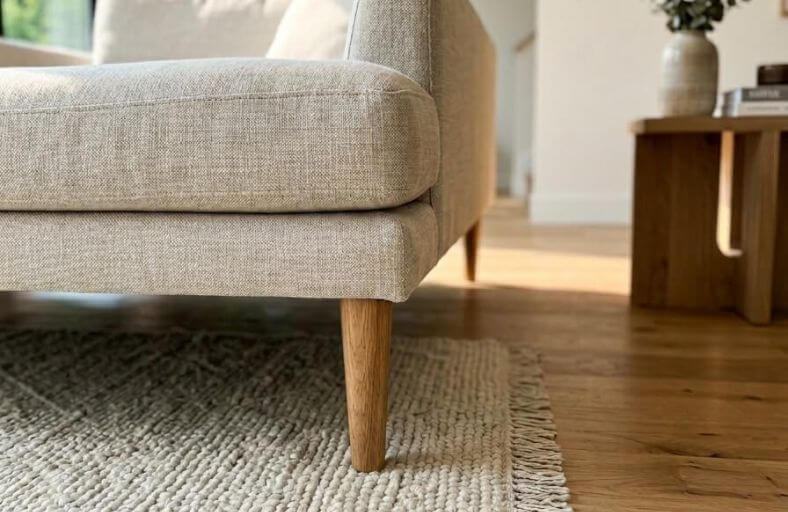
A lonely sofa drifting across a sea of bare hardwood floor is a classic interior design nightmare that makes even the most expensive furniture look accidental.
This visual disconnect, where pieces feel like they are floating without a purpose, often stems from a single misunderstood element: the area rug.
Rather than being a simple accessory, a rug serves as the architectural foundation of your living space. It defines the conversation zone, absorbs echoes, and dictates the room’s perceived size.
Choosing the right dimensions is a balancing act of geometry and comfort that transforms a scattered room into a unified sanctuary.
Banishing the Postage Stamp Effect
The most frequent mistake in living room design is selecting a rug that is far too small, a phenomenon professionals call the postage stamp effect.
This happens when a rug covers only the area beneath the coffee table, leaving the surrounding sofas and armchairs to sit entirely on the bare floor.
This lack of physical connection creates a visual “island” that makes the room feel segmented and much smaller than its actual footprint.
To fix this, your rug must act as a unifying anchor. Instead of looking at the coffee table as the center, look at your seating arrangement as a whole.
A rug that is properly sized will touch or sit beneath the furniture, pulling the pieces inward and creating a defined, cozy conversation zone.
By expanding the rug size, you eliminate visual breaks on the floor, which psychologically opens up the room and makes the entire layout feel intentional and high-end.
Master the Front-Legs-Only Rule
If you are looking for a layout that feels professional but remains versatile, the “front-legs-only” methodology is your best friend.
This approach involves placing the front two legs of your sofa and accent chairs on the rug while the back legs rest on the floor.
This creates a physical link between the furniture and the rug, grounding the pieces without requiring a massive, room-sized investment.
This technique is particularly effective for standard-sized living rooms where you still want to showcase beautiful hardwood or tile flooring.
For this look to remain successful, the rug should extend at least 18 inches in front of the sofa’s legs to provide enough visual weight. It creates a virtual stage that keeps the furniture from feeling like it is sliding off the edge.
It is the perfect middle ground between a floating rug and a wall-to-wall look, offering a polished aesthetic that works in almost any home.
Elevate with the All-Furniture-On Layout
For those with a larger living room or an open-concept Great Room, the “all-legs-on” layout is the gold standard for luxury.
In this configuration, the rug is large enough so that every single leg of every piece of furniture, sofas, end tables, and accent chairs, sits fully on the rug’s surface.
This approach creates a defined island of comfort that feels incredibly grounded and cohesive.
This layout is especially effective when using high-quality, hand-knotted rugs because it allows the craftsmanship to be a centerpiece of the room’s architecture.
To avoid a cramped look, designers recommend leaving at least 6 to 8 inches of rug visible behind the furniture pieces.
This extra breathing room ensures the furniture does not appear to be falling off the back, providing a generous foundation that invites people into the space.
Size by the Sofa
A rug should never be the exact same width as your sofa, as this creates a narrow, cramped look. To ensure spatial harmony, your rug must be wider than the primary seating it supports.
The general rule of thumb is that a rug should extend at least 6 to 12 inches beyond each side of the sofa.
This prevents the furniture from looking like it is “falling off” the rug and makes the seating area feel more inviting and expansive.
When you maintain this extension, you create a balanced frame that anchors the entire room. Below is a quick guide to matching your rug size to your sofa length:
| Sofa Length (Inches) | Description | Minimum Rug Size (Feet) | Preferred Rug Size (Feet) |
| 60-72 | Loveseat | 5×8 | 6×9 |
| 72-84 | Standard Sofa | 6×9 | 8×10 |
| 84-96 | Large Sofa | 8×10 | 9×12 |
| 96+ | Oversized Sofa | 9×12 | 10×14 |
Using these ratios ensures that your furniture layout feels proportionate to the rug’s footprint, avoiding the awkwardness of a sofa that outgrows its foundation.
The Perimeter Standard
A rug’s relationship to your walls is just as vital as its relationship to your furniture. If a rug is too large and extends nearly wall-to-wall without a visible border, it can overwhelm the space and make it feel claustrophobic, resembling an unintentional wall-to-wall carpet.
Professional designers follow the 18-inch rule, which suggests leaving about 18 inches of bare floor exposed around the perimeter of the rug.
This creates a natural frame that enhances the room’s proportions and highlights the beauty of your primary flooring.
In smaller or more compact living rooms, you can bend this rule to ensure the rug is still large enough to anchor the furniture.
Reducing the clearance to 8–12 inches prevents the rug from looking like a postage stamp while still providing that necessary visual border.
| Room Scale | Recommended Wall Clearance | Rationale |
| Small / Compact | 8 – 12 inches | Maximizes rug surface while maintaining a distinct border. |
| Average / Standard | 12 – 18 inches | Provides a balanced “frame” for the furniture grouping. |
| Large / Open Plan | 18 – 24 inches | Prevents the rug from feeling like wall-to-wall carpet. |
This gap also serves a practical purpose by allowing floor vents to remain clear and preventing the rug from bunching up against baseboards.
Mastering the Sectional Puzzle
Sectional sofas present a unique sizing challenge because of their irregular, L-shaped or U-shaped footprints.
Unlike a standard rectangular sofa, a sectional requires a rug that can accommodate both the main seating branch and the chaise extension.
If the rug is too small, the chaise often looks like it is falling off the edge, which disrupts the flow of the room.
For most L-shaped sectionals, a 9×12 rug is the most effective choice. This size typically allows the entire sectional to sit comfortably on the rug or, at minimum, ensures the front legs and the entire chaise are fully grounded.
If you have a massive U-shaped sectional in a Great Room, you may need to scale up to a 10×14 or even a 12×15 footprint.
In these expansive environments, the rug acts as a virtual wall, clearly delineating the lounge area from walkways or dining zones without the need for physical barriers.
The Science of Optical Illusions
The size and color of your rug can be manipulated to change the perceived dimensions of your living room. Large rugs expand a room by drawing the eye outward toward the edges of the space.
By covering more floor area and eliminating visual breaks, a generous rug creates a continuous flow that suggests expansiveness.
Color trend-forward palettes also play a significant role in this perception. Lighter rugs, in shades like Cool Blue, Jade, or sun-baked sand, reflect light and create an airy atmosphere, making a space feel larger and more inviting.
Conversely, deep, saturated tones like Plum Noir or charcoal add weight and grounding. While these darker colors create a cozy, intimate sanctuary, they are best used in well-lit areas to avoid making a small room feel visually compressed.
Choosing a rug with a subtle, repeating pattern can also add depth without cluttering the visual field.
Strategic Layering
Layering rugs is a sophisticated technique that solves both sizing and aesthetic problems simultaneously.
It involves placing a smaller, more decorative rug (like a vintage Persian or a bold pattern) on top of a larger, neutral base rug made of jute, sisal, or low-pile wool.
This is a lifesaver when you fall in love with a high-end rug that is unfortunately too small for your room.
By placing that smaller jewel rug over a larger 9×12 jute base, you ensure your furniture is properly anchored while still showcasing the color and personality of the decorative piece.
For a successful layered look, the base rug should be flat-woven to prevent the top layer from rippling or becoming a trip hazard.
Ideally, the top rug should cover about two-thirds of the bottom one to maintain a perfect visual balance that feels intentional rather than cluttered.
Creating Virtual Walls
In modern open-plan homes, a rug serves a purpose far greater than just comfort; it acts as a virtual wall.
When your living, dining, and kitchen areas share one large architectural space, a rug is the primary tool used to delineate functional zones without the need for physical barriers.
Without a properly sized rug, your furniture groupings can appear lost or scattered across a vast expanse of flooring, making the room feel cold and undefined.
By using a large rug, such as a 9×12 or 10×14, to anchor the seating arrangement, you carve out a distinct identity for the lounge area.
This creates a sense of order and purpose, psychologically signaling to guests where the conversation zone begins and ends.
For a truly professional look, ensure the rug is large enough to encompass the entire furniture grouping, which reinforces the feeling of a room within a room and provides the necessary visual weight to balance a large open-concept floor plan.
Navigating Environmental and Technical Logistics
Before you fall in love with a plush, high-pile rug, you must account for the physical realities of your space. One of the most common logistical oversights is failing to check door clearance.
Before purchasing, measure the gap between the bottom of your doors and the floor to ensure a rug will not obstruct the door’s swing.
A rug that is too thick will catch on the door edge, leading to frustrating jams and damage to the rug fibers over time.
Additionally, pay close attention to the placement of floor vents and electrical outlets. A rug should never be positioned in a way that completely covers a vent, as this can disrupt your home’s airflow and potentially damage your HVAC system.
Similarly, ensure that rug edges do not overlap with busy walkways or create trip hazards near doorways.
By auditing these small technical details before you buy, you ensure that your beautiful new foundation is as practical as it is stylish.
Precision Prototyping with the Painter’s Tape Trick
To avoid the pain of “buyer’s remorse,” professional designers rely on a simple prototyping technique: the painter’s tape trick.
Before committing to a specific rug size, use blue painter’s tape to outline the dimensions directly on your floor around your current furniture.
This allows you to visualize the exact footprint the rug will occupy, helping you test whether a 8×10 or a 9×12 feels more appropriate for the scale of the room.
Leave the tape outline on the floor for at least 24 hours to see how it interacts with your daily traffic patterns and furniture movement.
If you find it difficult to visualize a flat tape line, you can use folded bed sheets to mimic the rug’s dimensions.
This three-dimensional approach gives you a better sense of how the rug’s presence will influence the room’s flow and whether it provides enough breathing room against your walls. It is the ultimate insurance policy for your interior design budget.
Organic Forms and Performance Luxury
Rug trends are shifting away from rigid rectangles toward organic forms and high-performance materials.
Soft ovals, abstract silhouettes, and gently irregular outlines are becoming the preferred choice for high-end interiors.
These organic shapes help soften the sharp lines of modern furniture and make a space feel more human and less clinical.
An abstract-shaped rug can act as a standalone piece of floor art, adding movement and energy to a minimalist room.
Furthermore, performance luxury is redefining how we choose rug materials. Modern polyester and synthetic blends can now mimic the look and feel of expensive wool while offering incredible durability against pets, spills, and heavy foot traffic.
This shift means you no longer have to choose between a “gallery-worthy” aesthetic and a rug that can survive real life.
By choosing a trend-forward piece, you are investing in a foundation that balances sensory-rich textures with the practical demands of a busy home.