Building a 4 bedroom house is one of the biggest financial decisions most homeowners will ever make, and the total cost can vary dramatically depending on a wide range of factors.
Location, materials, labor costs, and the level of finish you choose all play a significant role in the final price tag.
Many people are surprised to learn just how much these elements can shift a budget, sometimes by tens of thousands of dollars.
Understanding what drives these costs upfront can help you plan more accurately and avoid unpleasant surprises along the way.
Architectural Configuration and Gross Floor Area Optimization
Designing a four-bedroom home requires a delicate balance between individual privacy and communal warmth.
For most American families, a functional layout with four distinct sleeping quarters typically demands a Gross Floor Area ranging from 2,000 to 2,500 square feet (approx. 185 – 230 m²).
In the 2026 market, building a standard 4-bedroom home within this size range is projected to cost between $300,000 and $600,000 for construction alone, depending heavily on the complexity of the design, location, and material quality.
Opting for a compact 2,000-square-foot footprint allows for highly efficient room placement but requires smart architectural zoning to prevent a crowded feel.
Expanding to 2,500 square feet or more grants the luxury of larger master suites, walk-in closets, and guest rooms, though it naturally increases the initial investment.
Foundation Engineering and Highland Topography Stabilization
Site topography and local soil conditions present unique engineering challenges that directly impact your bottom line.
While building on a flat, ready-to-build lot in the Midwest is highly cost-effective, dealing with sloped terrains, expansive clay, or rocky soils requires heavy structural anchoring.
On average, a standard concrete slab foundation for a 4-bedroom home costs around $20,000 to $45,000.
However, if you are building on a steep incline or require a full basement foundation (common in the Northeast and Midwest), this phase can easily demand $50,000 to $100,000+.
Furthermore, complex earthmoving, land clearing, and constructing retaining walls to prevent soil erosion can add an extra 10% to 25% to your rough site preparation budget before the framing even begins.
This makes professional soil testing and land surveying a non-negotiable upfront investment.
The Structural Shell and Rough Construction Dynamics
The structural shell represents the most labor-intensive phase, forming the skeleton of your future home.
For a project in 2026, the national average unit price for rough construction and framing in the U.S. is estimated between $150 and $300 per square foot, though high-cost coastal metropolitan areas frequently exceed $400 per square foot.
Unlike common brick-and-mortar builds in Asia, American residential construction primarily relies on wood framing or light-gauge steel.
| Region | Average Cost Per Sq. Ft. (2026) | Estimated Base Build (2,000 sq. ft.) |
| Midwest | $150 – $190 | $300,000 – $380,000 |
| South | $160 – $210 | $320,000 – $420,000 |
| East Coast | $200 – $260 | $400,000 – $520,000 |
| West Coast | $220 – $400+ | $440,000 – $800,000+ |
Because a 4-bedroom layout requires more interior partitions, hallways, and structural support than smaller single-story designs, homeowners should expect higher expenditures on lumber, drywall, and specialized framing labor.
Climate-Responsive MEP Infrastructure and Thermal Comfort
The Mechanical, Electrical, and Plumbing (MEP) phase is where a structure becomes a safely livable environment, heavily regulated by the International Residential Code (IRC).
A standard 4-bedroom home typically includes 2.5 to 3.5 bathrooms, a modern kitchen, and a dedicated laundry room, requiring a highly robust rough-in plumbing network.
Total installation costs for new MEP systems generally range from $35,000 to $70,000+. Thermal comfort is a top priority across varied American climates.
Unlike simpler regional setups, a modern U.S. home requires an efficient central HVAC system (Heating, Ventilation, and Air Conditioning) or heat pumps, which average $8,000 to $18,000 depending on the tonnage and zoning.
Additionally, incorporating high-R-value fiberglass, spray foam, or cellulose insulation in the walls and attic is mandatory in northern zones to retain internal heat, prevent energy loss, and mitigate the risks of moisture and mold.
Interior Finishing Standards and Material Selection
The finishing phase is where the most dramatic budget variations occur, driven entirely by your lifestyle preferences and aesthetic tier.
For a 4-bedroom house, the total interior finishing cost can range from a builder-grade standard of $50,000 to over $200,000+ for luxury, custom-crafted spaces.
In high-traffic areas, material durability and moisture resistance are critical. Premium hardwood, engineered flooring, or large-format porcelain tiles are heavily favored for common areas, with professional installation labor running anywhere from $6 to $15 per square foot.
| Finishing Item (4-Bedroom Home) | Estimated Cost Range (Labor + Material) |
| Interior Painting & Drywall Finish | $7,500 – $18,000 |
| Flooring (Hardwood / Tile / Carpet) | $12,000 – $35,000 |
| Kitchen & Bath Cabinetry / Countertops | $20,000 – $65,000+ |
| Sanitary Fixtures & Appliances Set | $8,000 – $25,000+ |
Kitchen and bathroom finishes, including custom cabinetry, quartz or granite countertops, and high-end fixtures, will command a massive portion of this budget category.
Legal Compliance: Permits, Licensing, and Impact Fees
Building a home in the U.S. is a strict legal process governed by local municipalities, counties, and states.
Before breaking ground, you must secure a series of building permits. While a basic residential permit application might cost a few hundred dollars, the total cost for building, electrical, plumbing, and HVAC permits generally totals $1,500 to $5,000+.
Furthermore, many rapidly growing suburban counties charge “Impact Fees” to fund local infrastructure, schools, and roads, which can unexpectedly add $5,000 to $20,000 to your upfront costs.
On the financial side, if you are hiring a General Contractor (GC), their overhead and profit margin is typically structured as a flat 15% to 25% fee added onto the total cost of construction.
Property taxes must also be factored in immediately upon building completion, based on the newly assessed market value of the property.
Site Preparation, Earthworks, and External Structures
Preparing an American residential plot for a four-bedroom estate involves intensive earthmoving and site grading costs that vary drastically by region and topography.
For a standard flat lot, general excavation and land clearing average around $3,000 to $10,000. However, if you are developing a plot with challenging soil conditions or steep inclines, the financial dynamics change completely.
In hilly regions, structural site stabilization is a critical and heavily regulated phase. Constructing concrete or engineered timber retaining walls to prevent landslides and soil erosion can easily add 10% to 25% to your rough construction budget.
Additionally, local zoning laws and environmental regulations often dictate strict structural density and mandatory stormwater drainage systems.
Homeowners must allocate a significant portion of their site budget, often between $8,000 and $25,000, strictly for professional grading, utility trenching, and compliant drainage infrastructure before foundation pouring can even begin.
Strategic Selection of Window Systems and Exterior Aesthetics
The “skin” of your four-bedroom home dictates its curb appeal, energy efficiency, and defense against harsh seasonal elements.
In 2026, dual or triple-pane vinyl, fiberglass, or aluminum clad windows (such as Andersen or Pella) are the industry standard for meeting strict Energy Star ratings, costing between $10,000 and $30,000 for a full house.
Roofing style and siding materials are also major cost drivers. A complex multi-gabled roof requires intricate truss engineering and premium architectural shingles or metal standing seams.
| Roof & Exterior Type | Estimated Impact (2,000 – 2,500 sq. ft. House) |
| Vinyl Siding + Asphalt Shingles | Lowest cost, standard insulation ($25,000 – $40,000) |
| Fiber Cement (HardiePlank) + Metal Roof | High durability, fire-resistant ($45,000 – $75,000) |
| Full Brick / Stone Veneer + Clay Tile | Premium luxury, maximum lifespan ($80,000 – $120,000+) |
The Rise of Modern Farmhouse and Transitional Design
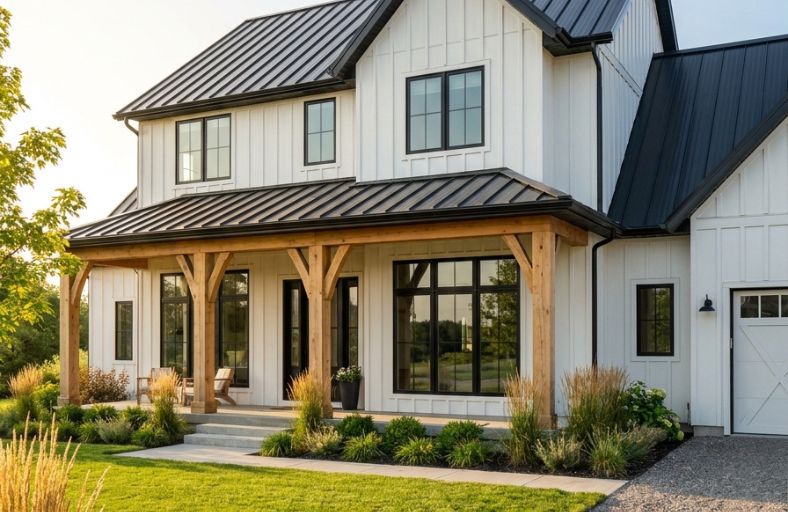
While regional styles like Modern Indochine thrive in Southeast Asia, the U.S. residential market in 2026 is heavily dominated by Modern Farmhouse and Transitional aesthetics.
These styles perfectly blend classic American architectural heritage with sleek, contemporary lines, making them immensely popular among buyers and custom-home builders alike.
Architecturally, a 4-bedroom Modern Farmhouse or Transitional home utilizing premium board-and-batten siding, exposed timber beams, and large black-framed windows typically sees interior and exterior finishing costs starting at $60 to $120 per square foot.
Although opting for these curated architectural styles can elevate your initial finishing budget by 15% to 20%, they deliver exceptional economic value.
Houses built with these high-demand aesthetics command significantly shorter days on market (DOM) and yield a 10% to 15% premium in resale value, making them highly lucrative investments in both the traditional real estate and high-end rental markets.
Comprehensive Cost Summary and Contingency Planning
Building a four-bedroom sanctuary requires a holistic financial view. By 2026, a standard turnkey package for a new construction 4-bedroom home in the United States averages between $350,000 and $700,000 (excluding the cost of land).
To ensure the project runs smoothly and to protect yourself from common “budget nightmares”, such as sudden supply chain disruptions, weather delays, or unexpected site conditions, industry experts strictly recommend maintaining a 10% to 20% contingency fund.
This financial cushion guarantees you can successfully cross the finish line without compromising on structural integrity or your interior design vision.