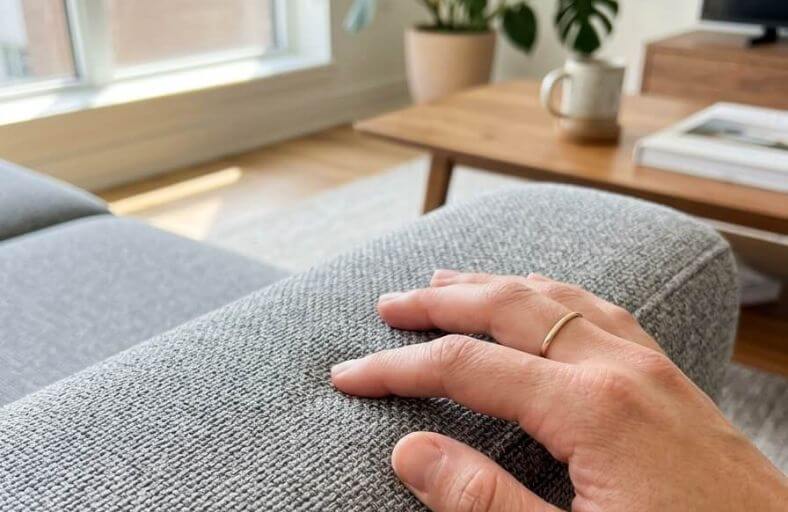
Sunset light hits your living room, but instead of a cozy sanctuary, your eyes land on a sofa that has surrendered to gravity.
The once-plump cushions now resemble deflated balloons, and the fabric is pilling so aggressively it looks like a weathered sweater.
This is the moment many homeowners realize their expensive centerpieces are failing prematurely.
While a standard sofa usually claims a decade of life, the reality depends on the invisible engineering beneath the upholstery.
Navigating the world of frame joints, foam density, and textile rub counts is the only way to ensure your investment stands the test of time.
Full-Grain Leather Integrity
Choosing full-grain leather is the closest you can get to a multi-generational furniture investment. Unlike genuine leather, which uses weaker lower layers, full-grain retains the entire thickness of the hide where fiber density is highest.
This dense network of collagen provides natural resistance to punctures and mechanical stretching that synthetic options simply cannot match.
In a well-maintained home, a full-grain piece can easily last twenty to thirty years, developing a beautiful patina rather than peeling away.
The longevity of this material is truly a function of its biological origin. If you maintain the pH balance with semi-annual conditioning, the fibers remain flexible enough to withstand decades of daily use without cracking.
| Leather Type | Composition | Lifespan | Strength |
| Full-Grain | Intact upper hide | 25+ Years | Maximum durability |
| Top-Grain | Sanded upper hide | 15-20 Years | High resistance |
| Split/Genuine | Lower hide layers | 5-10 Years | Prone to tearing |
| Bonded | Reconstituted scraps | 2-5 Years | Peels quickly |
While the initial cost is higher, the long service life makes it a cost-effective choice for long-term comfort.
Textile Abrasion Resistance
The secret to a fabric sofa that doesn’t look shabby after two years lies in its rub count. Professionals use the Martindale or Wyzenbeek tests to simulate the friction of a human body moving against the textile.
For a sofa to survive a high-traffic household, you should look for a heavy-duty rating of at least 30,000 double rubs.
Performance polyesters are often the champions here because they are inherently resistant to UV-induced fading and microbial rot, which are common in humid environments.
While natural fibers like linen offer a cooling aesthetic, they typically have a shorter lifespan of about five to ten years in heavy-use homes.
By choosing a tight-weave performance fabric, you ensure the yarns won’t pill or thin out at high-friction points like the armrests and seat edges.
Kiln-Dried Hardwood Frames
A sofa’s skeleton determines if it will remain stable or become a squeaky mess within months.
High-quality frames are constructed from kiln-dried hardwoods like Oak, Maple, or Beech. This specialized drying process removes up to 95% of the moisture, stabilizing the wood’s internal structure.
In humid climates like the Central Highlands of Vietnam, using non-dried wood is a recipe for disaster.
Raw wood stays active, swelling and shrinking as humidity levels fluctuate, which eventually pulls joints apart and warps the rails.
Kiln-dried wood has reached an equilibrium that makes it immune to these shifts, allowing a sturdy frame to last fifteen to twenty years.
Investing in a hardwood frame ensures your sofa provides the same level of support on year ten as it did on day one.
High-Density Polyurethane Foam
Cushion failure is the primary reason sofas are discarded, with nearly 85% of sagging issues caused by foam compression rather than spring issues.
The key to longevity is foam density, measured in pounds per cubic foot. High-density (HD) or high-resiliency (HR) foam with a rating of 2.5 lb/ft³ or higher is the industry benchmark for durability.
Lower density foams, often found in budget furniture, contain more air and fewer polymer cells.
Under the repeated stress of sitting, these air cells collapse, creating permanent sitting craters within 6 to 12 months.
In contrast, high-density foam distributes weight across a thicker cellular network, allowing it to spring back to its original shape for 10 to 15 years.
| Foam Grade | Density | Typical Lifespan | Performance |
| Ultra High-Density | 3.5+ lb/ft³ | 15+ Years | Commercial grade resilience |
| High-Density | 2.5-3.5 lb/ft³ | 7-15 Years | Premium shape retention |
| Medium-Density | 1.8-2.5 lb/ft³ | 3-5 Years | Standard home use |
| Low-Density | < 1.8 lb/ft³ | 1-3 Years | Quick to sag and flatten |
If your current cushions are flat but the frame is solid, replacing the inserts with HR foam can effectively reset your sofa’s lifespan.
Mortise and Tenon Joinery
The structural integrity of a sofa is decided at its joints. The most durable frames utilize mortise and tenon joinery, a traditional technique where a wooden protrusion fits into a precisely carved hole.
This mechanical interlock, reinforced with high-quality glue and wooden dowels, creates a bond that resists the lateral forces and weight shifts of daily use.
You should be wary of frames held together solely by staples, nails, or industrial glue.
These fasteners lack the surface area to distribute stress and can eventually chew through the wood fibers, leading to a wobbly or squeaky frame within a few years.
For a piece intended to last over a decade, look for corner blocking. This involves screwing extra triangular blocks of wood into the frame’s corners to prevent racking, ensuring the sofa remains square and stable even if it is moved frequently.
Eight-Way Hand-Tied Suspension
The suspension system acts as your sofa’s shock absorber, protecting both the frame and the cushions from excessive stress. The eight-way hand-tied system is widely considered the gold standard for durability.
In this labor-intensive process, heavy-gauge steel coils are manually secured to the frame and each other using high-strength twine in a complex web pattern.
This interconnected design ensures that when you sit down, the load is distributed across all surrounding springs, preventing any single coil from reaching its fatigue limit.
While sinuous (S-shaped) springs are a high-quality and durable modern alternative, they may lack the multidirectional support of a hand-tied system.
Avoid sofas that rely on simple elastic webbing alone, as these straps tend to stretch and lose tension within three to five years, leading to the dreaded hammock effect where you sink too deeply into the seat.
Weekly Vacuuming Protocol
One of the most overlooked silent killers of upholstery is common household dust. Microscopic particles of grit and silica act like tiny pieces of sandpaper.
Every time you sit down, these particles are ground into the fabric fibers, slowly cutting through the yarns and causing the material to thin or tear prematurely.
Implementing a weekly vacuuming routine using an upholstery attachment is a scientifically backed way to extend your sofa’s life.
By removing these micro-abrasives from the seams, crevices, and surfaces, you prevent the friction damage that leads to pilling and holes.
This simple five-minute habit can add years to the aesthetic vibrancy and structural integrity of your fabric, especially in environments where open windows allow outdoor dust to settle frequently.
Dehumidification in Tropical Climates
In regions like Dalat, Vietnam, ambient humidity is a silent destroyer of internal furniture components.
When relative humidity exceeds 60%, it creates an ideal environment for mold and mildew to thrive within the foam and fabric layers.
These microorganisms do more than cause odors; they secrete enzymes that chemically degrade natural fibers like cotton or linen.
Maintaining an indoor humidity level between 40% and 60% using dehumidifiers or air conditioning is the most effective defense.
Furthermore, you should place your sofa at least 1.64ft (50cm) away from exterior walls to encourage air circulation and prevent moisture pockets.
| Climate Factor | Target Range | Recommended Tool |
| Relative Humidity | 40% – 60% | Dehumidifier / AC |
| Air Circulation | 50cm gap from wall | Proper Placement |
| Internal Moisture | Dry / Stable | Silica Gel / Charcoal |
For added protection during misty seasons, placing charcoal bags or silica gel packets near the internal frame can help maintain a stable, dry micro-environment.
Leather Conditioning and pH Balance
Leather is a biological tissue that requires a careful balance of lipids to remain supple. Over time, natural oils evaporate or are absorbed by clothing, a process accelerated by air conditioning.
This desiccation causes collagen fibers to shrink and lose their ability to glide over one another. Without intervention, mechanical stress will eventually cause these fibers to snap, leading to permanent cracking.
Applying a pH-balanced leather conditioner every 6 to 12 months restores these essential oils and maintains the hide’s tensile strength.
For daily maintenance, wiping the surface with a dry microfiber cloth removes abrasive dust and corrosive salts from human sweat before they can penetrate the finish.
Consistent care ensures that a top-grain leather sofa develops a beautiful patina over its 20-year lifespan instead of peeling.
Cushion Rotation and Flipping
Uneven wear is a major contributor to premature sofa failure, as most users tend to sit in the exact same spot daily.
This habit subjects a specific area of the foam and frame to 90% of the daily mechanical stress, leading to “sitting craters” or the “hammock effect” where the support system loses its ability to rebound.
A systematic rotation protocol is the best way to distribute this load effectively. For removable cushions, moving the left unit to the right and flipping them over weekly ensures that the foam cells experience even compression cycles.
For fixed-cushion designs, regular massaging or fluffing helps redistribute the internal filling and prevents the formation of permanent dents.
This simple maintenance habit can double the lifespan of your cushioning by slowing down the onset of compression set.
Corner Blocking and Screw-Holding Capacity
The structural stability of a sofa frame depends heavily on how its corners are reinforced.
Premium frames utilize corner blocking, which involves triangular blocks of wood glued and screwed into every internal angle of the frame.
This detail provides the diagonal stability necessary to prevent racking, the tendency of a frame to twist or become misshapen under lateral pressure.
Screws and bolts are superior to staples or nails because their threads grip the wood fibers, providing higher screw-holding capacity in dense hardwoods.
While staples are a hallmark of budget-tier manufacturing, they often lack the surface area to distribute stress, eventually chewing through the wood and causing joints to wobble.
A corner-blocked frame with threaded fasteners can survive decades of rigorous use without losing its structural integrity.
UV Protection and Solution-Dyeing
Ultraviolet (UV) radiation is a relentless enemy of upholstery, triggering photo-oxidation that breaks down fiber polymer chains.
This process leads to irreversible color fading and makes fabrics brittle, significantly increasing the risk of tearing.
In sun-drenched homes, strategic placement away from direct sunlight is the first line of defense.
To maximize lifespan, prioritize solution-dyed fabrics. Unlike traditional piece-dyeing where color is only on the surface, solution-dyeing integrates pigment into the liquid polymer before the fiber is created.
This ensures the color remains vibrant for decades, even when exposed to intense UV rays. Additionally, using UV-resistant window films or keeping curtains closed during peak hours can prevent the sun-burning effect that dries out leather and weakens textile integrity.
Microbiological Defense in Humid Zones
In high-humidity environments, organic residues like skin cells and sweat act as a nutrient base for mold and bacteria.
This microbial growth doesn’t just create musty odors; it physically eats into the structural fibers of your sofa.
Modern performance fabrics now often incorporate antimicrobial treatments, such as silver-ion technology, to inhibit this growth.
For existing furniture, regular cleaning with natural antifungal agents like a diluted vinegar-water solution can prevent spores from taking root on wooden components.
It is critical to ensure that cushions are thoroughly aired out and never placed against damp exterior walls, which act as moisture traps.
By maintaining a hygienic surface and a dry internal environment, you protect the internal foam and wood from the slow rot that defines tropical furniture failure.
Frame vs. Foam
Understanding whether your sofa is suffering from foam fatigue or a frame fracture is vital for its long-term management.
Sagging cushions where the seat looks flat in the middle are typically a foam issue, which is an easy and affordable fix involving new high-density inserts.
Foam failure is usually signaled by discolored or crumbling material when you unzip the cover.
However, structural failure is more terminal. If you hear loud creaking or popping sounds when sitting down, it often points to loose joints or broken springs.
A wobbly frame or visible cracks in the internal wooden rails suggest that the skeleton has reached its limit.
While a tired cushion can be revived for a fraction of the cost of a new sofa, a fractured frame rail often indicates that the piece has completed its functional lifecycle and needs professional rebuilding or replacement.