Many older homes and smaller bedrooms were built without enough closet space, leaving homeowners to find creative ways to add storage where none currently exists.
Building a closet in a bedroom is a project that’s more achievable than most people assume, and it doesn’t always require knocking down walls or hiring a contractor.
With careful planning around layout, materials, and available space, you can create a functional closet that blends seamlessly into the room. The result is dramatically improved organization and a noticeably more livable bedroom.
Choosing Between Reach-In and Walk-In
Every successful build begins with understanding the footprint. A reach-in closet is the space-saving champion, typically integrated into an existing wall with a depth of 24 to 30 inches.
This configuration is perfect for smaller bedrooms because it utilizes vertical storage without encroaching on floor space.
If you have the luxury of at least 25 to 50 square feet to spare, a walk-in closet transforms the room into a private dressing suite.
| Feature | Reach-In Closet | Walk-In Closet |
| Standard Depth | 24 – 30 inches | 4 – 8+ feet |
| Access Style | Front-access only | Step-in movement |
| Best For | Small rooms / Minimalists | Primary suites / Couples |
Walk-ins allow for multi-wall storage and even islands or seating, but they require a much higher investment of both square footage and budget. Use painter’s tape on the floor to visualize these options before you commit to the frame.
Squaring Layouts with the 3-4-5 Rule
Precision in the layout phase prevents a domino effect of errors during door and drywall installation.
To ensure your new walls meet the existing ones at a perfect 90-degree angle, professionals rely on the 3-4-5 rule.
Start at the corner where your new closet wall will begin. Measure 3 feet along the existing wall and make a mark. Then, measure 4 feet out along your proposed new wall line.
The diagonal distance between these two marks must be exactly 5 feet. If the measurement is longer or shorter, your corner is not square, which will lead to binding doors or unsightly gaps in the trim later on.
For larger walk-in projects, you can scale this up to a 6-8-10 or 9-12-15 ratio to increase accuracy over longer distances.
Framing Wall Plates and Studs
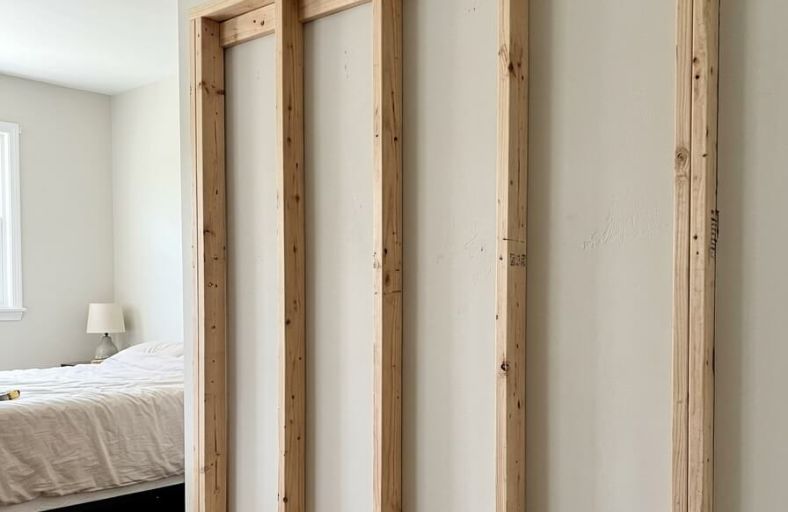
The skeleton of your closet is built using 2×4 lumber to create a rigid, load-bearing structure. Installation begins with the horizontal plates.
The bottom plate is secured directly to the subfloor with construction adhesive and screws.
If you have carpet, you must cut it back to ensure the wood sits flush on the wood or concrete. For the top plate, use a stud finder to locate the ceiling joists for a secure attachment.
Vertical studs are then cut to fit tightly between these plates and spaced 16 inches apart on center.
When connecting the studs to the plates, use a technique called toe-screwing, where you drive screws at a 45-degree angle from both sides to ensure a rock-solid connection.
This framing creates the strength needed to hold heavy clothes and future shelving systems without sagging.
Installing Headers and Trimmers
Engineering the door frame is where the closet takes its final shape. You must create a rough opening that is slightly larger than your actual door to allow for leveling and hardware installation.
This involves installing king studs (full height), trimmers (jack studs that support the header), and the header itself, which is the horizontal beam spanning the opening.
A standard professional rule is to make the rough opening 2 inches wider and 2.5 inches taller than your actual door panels.
This provides the necessary wiggle room for proper fitting and smooth operation. Once the header is secure, the section of the bottom plate spanning the doorway is cut and removed with a handsaw to create a flush threshold.
If you are using prehung doors, the frame is fixed to the opening using thin shims to ensure it is perfectly level and plumb.
Electrical and Lighting Compliance
Safety is paramount in closet lighting because of the close proximity to flammable fabrics. The National Electrical Code (NEC) mandates that all light sources be fully enclosed to mitigate fire hazards.
Open bulbs, pendant lights, and pull-chain fixtures are strictly prohibited as they represent significant risks.
You must also maintain specific clearances from the storage area, which is the volume where clothes and shelves are located.
For surface-mounted LED or incandescent fixtures, a 12-inch clearance is required, while recessed fixtures need only 6 inches of clearance.
Additionally, all closet lighting must be controlled by a wall switch located at the entrance for easy access.
Drywalling and Finishing
Enclosing the frame with drywall turns your carpentry project into a permanent architectural feature.
Use 1/2-inch drywall sheets and cut them by scoring the back with a utility knife before snapping them for a clean, straight edge.
Fasten the boards using drywall screws every 12 inches along the studs, ensuring the screw heads are slightly dimpled below the surface without tearing the paper.
For outside corners that are prone to impact, reinforce them with a metal or plastic corner bead before applying joint compound.
Taping and mudding the joints should be done in three progressively wider layers, with light sanding between each coat to ensure a seamless transition to your existing bedroom walls. Finish by priming and painting the interior before installing any rods or shelves.
Optimizing Rods and Shelving
The interior layout is where you maximize every square inch based on your specific wardrobe needs.
A common professional approach is to build a central tower of shelves and then attach hanging rods to the sides.
For most users, a double-hang configuration is the most efficient way to utilize vertical space.
| Storage Element | Recommended Height (from floor) | Best For |
| Top Shelf | 84 inches | Seasonal items, blankets |
| Upper Rod (Double) | 80 to 82 inches | Shirts, blouses |
| Lower Rod (Double) | 40 inches | Pants, skirts |
| Single Rod (Long) | 66 to 70 inches | Dresses, trench coats |
| Shoe Shelves | 8 to 12 inches (spacing) | Sneakers, heels |
This involves stacking two rods to accommodate shorter items like shirts and folded pants. If you have long dresses or coats, reserve a section for a single-hang rod.