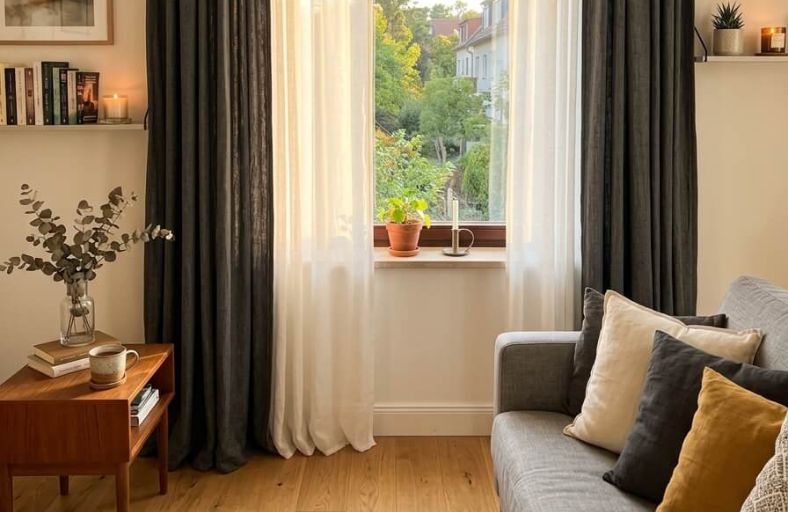
Walking into a beautifully furnished living room only to find curtains that stop abruptly at the windowsill is like wearing a tuxedo with flip-flops.
This aesthetic nightmare instantly shrinks your space and undermines even the most expensive furniture.
Window treatments are the silent architects of your home, capable of stretching ceilings toward the sky or turning a drafty corner into a cozy sanctuary.
Getting it right involves a delicate dance between textile science and geometric precision. Let’s transform your windows from mere apertures into stunning focal points that elevate your entire lifestyle.
Master the High and Wide Rule
The secret to a designer-grade living room lies in the geometric placement of your hardware.
Hanging your curtain rod directly on the window frame is a common mistake that visually shortens your space.
Instead, professional stylists recommend mounting the rod at least 4 to 6 inches above the window frame.
In rooms with standard ceilings, you can even go halfway between the trim and the ceiling to draw the eye upward and maximize verticality.
To ensure the window looks expansive rather than cramped, extend the rod 8 to 12 inches past the window trim on each side.
Using a multiplier of 2.5x to 3x is the industry standard for high-end, luxury living rooms, ensuring the fabric never looks “skimpy” when drawn.
Strategic Light Filtration
Selecting the right opacity is about balancing your need for privacy with the room’s natural light requirements.
Different sections of your living room may demand different levels of light control based on their orientation to the sun.
| Fabric Type | Light Control Level | Best For |
| Voile / Sheer | High transparency | Daytime privacy, softening views |
| Light-Filtering | Medium diffusion | Brightening rooms while reducing glare |
| Blackout | 100% light blocking | Media rooms, preventing furniture fading |
For maximum flexibility, use a double-rod kit. This allows you to hang sheers on the back rod for a breezy daytime look and heavier, lined drapes on the front for nighttime privacy.
This layered approach not only adds depth and body to your window treatment but also allows you to precisely regulate the room’s atmosphere throughout the day.
Humidity-Smart Textiles for Misty Climates
In regions with high humidity or misty conditions, your fabric choice is a health and maintenance priority. Traditional heavy drapes can act as moisture traps, fostering the growth of mold and creating a musty smell.
Natural fibers such as linen and hemp are the “gold standard” for humid environments. Linen is incredibly breathable, dries fast, and is naturally anti-bacterial.
Hemp is equally impressive, offering natural mildew resistance and exceptional durability.
If you prefer synthetic options for easier maintenance, choose acrylic or polyester blends specifically treated for moisture resistance.
These humidity-smart textiles allow air to circulate freely, preventing dampness from being trapped against the windowpane and ensuring your living room stays fresh despite the external mist.
Enhance Comfort with Thermal Linings
Living rooms with large windows can lose a significant amount of energy, making the space feel chilly in winter or overheated in summer.
Thermal-insulated curtains are engineered to act as a barrier, with research from the U.S. Department of Energy suggesting they can reduce residential heat loss by up to 25%.
These curtains typically feature a multi-layered construction: a decorative outer fabric, a light-colored backing to reflect heat, and often a cotton flannel interlining to trap air.
This interlining is the key to maintaining a toasty environment during cool highland nights.
Beyond temperature control, the density of thermal fabrics provides excellent sound-dampening properties, which is a major bonus for homes located near busy streets or high-traffic areas.
By investing in quality linings, you’re not just buying décor; you’re installing a high-performance system for year-round environmental control.
Defining Your Hemline Style
The way your curtains meet the floor acts as the final punctuation mark for your room’s style. The most popular and practical choice is the float, where curtains hang roughly 1/2 inch above the floor.
This creates a crisp, modern look that is incredibly functional, as it prevents the fabric from collecting dust and makes cleaning a breeze.
For a more high-end, tailored feel, the kiss or touching length is ideal, where the fabric gently grazes the floor surface.
| Hemline Style | Technical Description | Aesthetic Impact |
| Float | 1/2 inch (1 cm) above floor | Modern, clean, and low maintenance |
| Touching | Gently grazes the floor | Tailored, professional, and sophisticated |
| Puddle | 1 to 6 inches of extra fabric | High drama, romantic, and luxurious |
If you are aiming for drama, the puddle style adds 1 to 6 inches of extra fabric that pools elegantly on the ground.
While beautiful, keep in mind that puddling drapes are high maintenance; they require frequent reshaping and are best suited for low-traffic formal areas where they won’t be tripped over or quickly soiled.
Hardware Upgrades for Style and Function
Modern window hardware has evolved far beyond the basic rod. One of the most significant upgrades today is the French return rod. Instead of a decorative end cap, the rod curves at a 90-degree angle to fasten directly to the wall.
This eliminates the light gaps at the edges of your windows and adds a custom, architectural look to the space. For those who prefer a minimalist vibe, invisible track systems are a major trend.
These tracks can be recessed into the ceiling, allowing the fabric to fall in a continuous, seamless wall that makes any room feel taller.
To truly future-proof your living room, consider motorization. Systems from brands like Somfy or Dooya allow you to adjust your drapes via smartphone apps or voice commands.
This is not just a luxury; it is a functional necessity for large windows or hard-to-reach areas, ensuring you can manage light and heat with zero physical effort.
Aesthetic Coordination and Color Theory
Your color choice determines whether your curtains act as a supporting actor or the “star of the show.” To make a small living room feel larger, match your curtain color to your walls.
This creates a monochromatic, cohesive environment with fewer visual breaks, allowing the eye to sweep across the room uninterrupted.
Neutral shades like beige, cream, and soft gray are perennial favorites because they reflect solar heat and never go out of style.
Conversely, if your room lacks a focal point, bold contrast is your best friend. Deep navy or emerald curtains against a white wall create a dramatic statement and add significant visual weight.
When it comes to patterns, remember the rule of balance: if your rug or sofa is heavily patterned, stick to solid curtains.
If your furniture is neutral, a subtle jacquard weave or tone-on-tone pattern can provide the perfect amount of visual interest without overwhelming the senses.