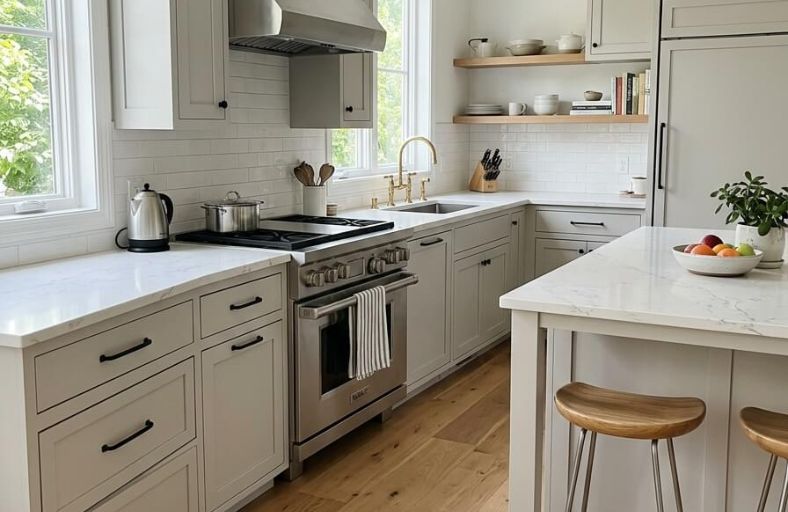
Walking into a kitchen where the stone is flawless but the hardware feels flimsy is like wearing a designer suit with plastic buttons. It is a subtle mismatch that ruins the entire vibe of the room.
Hardware acts as the jewelry of the kitchen, providing that final tactile connection between you and your home.
Every time you reach for a snack or prep a meal, you are interacting with these small but mighty metal accents.
Choosing the right pieces transforms a standard cabinet into a statement of style and makes your daily routine feel a bit more luxurious.
Knobs, Pulls, and Specialty Styles
The first step in your hardware journey is understanding the functional “anatomy” of your options.
Each category offers a different ergonomic experience and visual weight. Knobs are the most traditional choice, requiring only a single mounting hole.
They act as a natural pivot point for swinging doors and are generally more budget-friendly.
Pulls, or handles, utilize two mounting points and provide significantly more leverage. This makes them the superior choice for heavy drawers or pull-out pantries where a full-hand grip is needed.
| Hardware Type | Best Application | Grip Style | Design Vibe |
| Knob | Upper cabinet doors | Pinch / Pivot | Classic / Transitional |
| Pull (Handle) | Lower drawers / Pantries | Full-hand wrap | Modern / Functional |
| Cup Pull | Medium drawers | Hooking | Farmhouse / Vintage |
| Edge Pull | Slab doors / Drawers | Fingertip hook | Minimalist / European |
Specialty hardware like cup pulls or edge pulls offers a specific aesthetic; cup pulls lean toward farmhouse charm, while edge pulls provide a nearly invisible, minimalist profile for modern slab cabinetry.
The Mathematical Golden Ratio
Scale is where most DIY projects go wrong. Hardware that is too small looks like a mistake, while oversized pieces can overwhelm the cabinetry.
To achieve professional balance, designers use the 1/3 rule: the length of your pull should be approximately one-third of the width of the drawer front or the height of the cabinet door.
When measuring, always use the overall length of the hardware rather than the center-to-center screw distance. If your drawer width falls between standard sizes, it is always better to size up.
For example, a 12-inch drawer perfectly accommodates a 4-inch pull, but a 30-inch drawer feels much more intentional with a 10-inch handle.
| Drawer Width | Ideal Pull Length (1/3) | Alternative Setup |
| 12 inches | 4 inches | 1 Knob |
| 18–24 inches | 6–8 inches | 1 Pull |
| 30–36 inches | 10–12 inches | 2 Pulls (placed on thirds) |
| 42+ inches | 14+ inches | 2 Pulls or 1 oversized bar |
Precision Coordinates
Symmetry is the secret to a high-end look. For upper cabinets, the standard is to place knobs or the bottom hole of a pull 2.5 to 3 inches from the bottom corner of the door.
On lower cabinets, this measurement is mirrored from the top corner to keep the hardware within easy reach.
For drawers, centering the hardware both horizontally and vertically is the most common aesthetic choice. However, for very deep bottom drawers, placing the hardware in the top third can be more ergonomic, as it saves you from leaning over too far.
If you are using two pulls on a wide drawer, divide the drawer into three sections and center the pulls on the left and right “one-third” lines for perfect balance.
Durability and Visual Heat
The finish of your hardware dictates the temperature of the room. Cool metals like chrome and stainless steel are neutral and professional.
Chrome is highly reflective and luxurious but shows every fingerprint, while brushed nickel is the ultimate low-maintenance workhorse that hides smudges well.
Warm metals, including brass, bronze, and gold, are trending for their ability to make a kitchen feel cozy and lived-in. If you want a heritage feel, look for unlacquered brass.
This is a living finish that will tarnish and develop a unique patina over time, adding historical character to your space.
For a bold, grounded look, matte black provides high contrast against light cabinets and works beautifully in industrial or modern farmhouse designs.
The Strategic Mix
The old design rule that all metals in a kitchen must match is officially over. Modern, high-end kitchens now focus on mixed metals to create depth and a collected-over-time feel. However, mixing finishes must be intentional to avoid looking like a mistake.
The most effective strategy is the 70/30 ratio: select one dominant metal for roughly 70 percent of the room and an accent metal for the remaining 30 percent.
Typically, your cabinet hardware serves as the dominant finish, while your light fixtures or the faucet act as the accent. To ensure a successful mix, keep the sheen consistent even if the colors differ.
For example, mixing a matte black faucet with matte brass hardware works because the eye perceives the contrast in color but the similarity in texture.
Experts suggest avoiding mixing two different metals from the same color family, such as chrome and polished nickel, as they are close enough to look like a manufacturing error rather than a deliberate choice.
Matching Hardware to Cabinetry
The profile of your hardware should act as an extension of your cabinet door style. Shaker cabinets are the most versatile blank canvas in kitchen design.
They pair beautifully with classic round knobs and cup pulls for a traditional look, or long, thin bar pulls for a transitional aesthetic.
Flat-panel or slab cabinets are the hallmarks of modern design and require sleek, geometric hardware with no ornate detailing. Recessed edge pulls or ultra-thin bar pulls are the preferred choices here.
Traditional raised-panel cabinetry requires hardware with more visual weight, such as handles with flared ends or textured knurling.
| Cabinet Style | Recommended Hardware | Visual Goal |
| Shaker | Knobs, Cup Pulls, or Bar Pulls | Versatility / Transitional |
| Slab / Flat-Panel | Edge Pulls or Linear Bar Pulls | Minimalism / Precision |
| Raised Panel | Ornate Knobs or Knurled Pulls | Heritage / Luxury |
| Inset | Latches or Classic Small Knobs | Vintage / Authentic |
Always ensure that the hardware is proportional to the stile or frame of the cabinet door so it does not hang off the edge.
Comfort Meets Beauty
A beautiful kitchen is a failure if it is not comfortable to use daily. Ergonomics focus on how the human hand interacts with hardware hundreds of times a week.
Finger clearance is the most overlooked measurement; there should be a minimum of 7/8 inch of clearance between the cabinet face and the handle bar to allow fingers to slide behind it comfortably.
For households with children or elderly residents, pulls are far superior to knobs. Pulls allow for a full-hand grip rather than a pinch-grip, which is vital for those with limited hand strength or arthritis.
According to ADA principles, hardware should be operable with one hand and require no more than 5 pounds of force to operate.
D-shaped or U-shaped pulls are the gold standard for accessibility because they can even be operated with a single finger or a closed fist.
Solid vs. Hollow Materials
Weight is often the best indicator of quality in cabinet hardware. Solid brass is considered the gold standard of the industry, offering a heavy, substantial feel and immense durability.
These pieces are less likely to bend or warp and hold their finish significantly longer than plated alternatives. If you want a living finish that ages gracefully, solid, unlacquered brass is the way to go.
Lower-cost hardware is often made from zinc die-cast or hollow stainless steel tubes. While these can look identical to solid pieces in a photo, they feel light and tinny in your hand.
Over time, the plating on cheaper zinc hardware can peel or tarnish, revealing a dull metal underneath.
When budgeting, remember that hardware is a high-touch item; spending a bit more here directly impacts how luxurious your home feels every single day.
| Material | Durability | Tactile Feel | Price Range |
| Solid Brass | Excellent | Heavy / High-end | $$$ |
| Solid Stainless | Excellent | Professional | $$$ |
| Zinc Die-Cast | Moderate | Light | $ |
| Hollow Steel | Low | Cheap / Light | $ |
Precision Tools and Techniques
The difference between a DIY project and a professional finish lies in the installation. Even a tiny misalignment is visible when viewing a long row of cabinets.
Professionals never eyeball the placement. Instead, they use a cabinet hardware jig or a custom template.
These tools allow you to lock in your coordinates and repeat the exact hole placement across every door with zero deviation.
To protect your cabinetry during the process, apply painter’s tape to the front of the door before drilling. This allows you to mark your measurements clearly and prevents the drill bit from slipping.
To prevent the wood from splintering when the drill bit exits the back, hold a sacrificial block of wood tightly against the interior side while drilling. Precision is the ultimate key to achieving that polished, high-end designer look.
The Troubleshooting Guide
Many design failures stem from common aesthetic nightmares that are easily avoided. The most frequent is the postage stamp effect, where tiny knobs are used on massive drawers, making the scale look completely out of sync with the room.
If a drawer is wider than 24 inches, you should always either size up to a longer pull or use two separate pieces of hardware.
Another nightmare is the crooked square. Geometric or square knobs must be perfectly level; if they rotate even slightly, they appear broken. For high-traffic kitchens, round knobs are the most forgiving because they never look crooked.
Finally, be wary of overly trendy novelty shapes like anchors or gears. These often lose their appeal quickly and can be physically uncomfortable to use compared to timeless, ergonomic silhouettes.