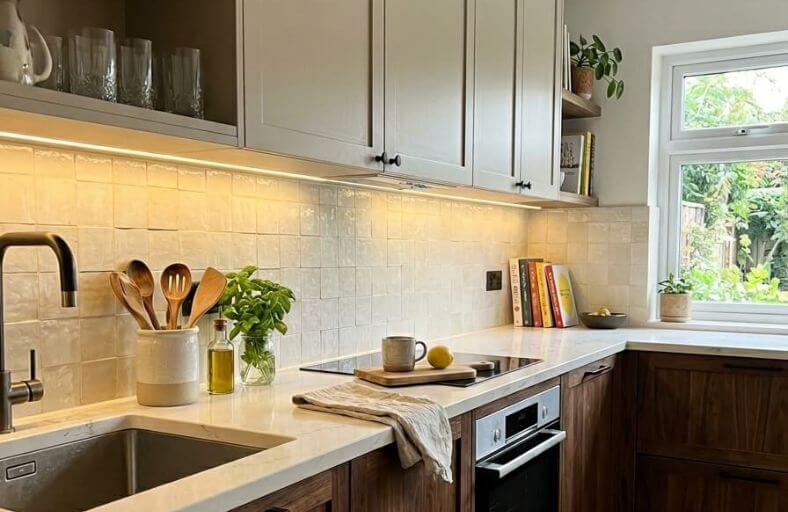
That morning cup of coffee loses its magic the moment you notice the budget-friendly cabinet door near the kettle is actually peeling away from its core. It is a quiet tragedy.
What started as a dream renovation quickly spiraled into a textured nightmare of warped wood and sticky hinges.
Kitchen cabinets are the architectural backbone of your home. They endure steam, grease, and thousands of slams every year.
Choosing the right ones is about much more than picking a pretty color. It is a high-stakes balance of material science, structural engineering, and your family daily rhythm.
Functional Workflow and Zone-Based Planning
The modern kitchen has evolved past the simple work triangle of the 1940s toward a sophisticated zone-based layout. This human-centric approach prioritizes how your family actually moves.
Effective cabinet selection begins with a rigorous audit of your daily habits: do you bulk shop and need deep pantry towers, or are you an avid chef requiring landing zones for heavy appliances?
By grouping related items into distinct zones, you minimize unnecessary steps and reduce the risk of accidents.
| Kitchen Zone | Primary Goal | Essential Cabinet Element |
| Prep Zone | Efficient ingredient processing | Pull-out spice racks, knife drawers |
| Cooking Zone | Safe access to heat and tools | Deep drawers for heavy pots and pans |
| Cleaning Zone | Waste management and sanitation | Integrated trash bins, waterproof sink bases |
| Pantry Zone | Long-term dry storage | Floor-to-ceiling pull-out towers |
For example, the prep zone should feature cabinets with integrated knife blocks, while the cleaning zone requires water-resistant substrates to handle localized humidity.
Framed vs. Frameless
The structural integrity of your kitchen relies on the choice between framed and frameless construction.
Framed cabinetry, the traditional American standard, utilizes a solid wood face frame attached to the box.
This frame acts as a rigid anchor for hinges and helps the cabinet remain square even on uneven walls.
In contrast, frameless or European-style cabinetry eliminates the face frame entirely, relying on thicker side panels for stability. The primary benefit here is maximized storage.
Without the lip of a face frame, you gain approximately 10% more usable interior volume, allowing for wider drawers and easier access to large appliances.
While frameless units offer a sleek, modern look, they require a higher level of installation precision.
Advanced Material Substrate Engineering
Longevity is determined by the core material hidden beneath the paint or veneer. Cabinet-grade plywood remains the gold standard for box construction due to its cross-grain architecture.
By layering veneers with alternating grain directions, plywood resists the natural warping and splitting caused by kitchen humidity.
For painted doors, medium-density fiberboard (MDF) is often preferred. Because it is composed of wood fibers and resin compressed under high heat, MDF provides a perfectly smooth, pore-free surface that prevents grain telegraphing over time.
However, standard MDF is highly susceptible to water damage and can swell irreversibly if exposed to leaks.
For high-traffic areas, look for moisture-resistant additives or HDF (High-Density Fiberboard) for superior durability.
Chemical Finish and Coating Durability
The finish is the primary barrier between your wood and the harsh kitchen environment. Conversion varnish (CV) is widely considered the highest-performance coating for residential cabinets.
As a post-catalyzed lacquer, it undergoes a chemical cross-linking process that creates a dense, non-reversible film. This makes it exceptionally resistant to heat, household chemicals, and mechanical abrasion.
Polyurethane is another durable alternative, available in oil-based formulas that provide a warm amber tone or water-based versions that offer a clear, low-VOC option.
While budget-friendly thermofoil finishes offer a seamless look, they carry the risk of delamination near heat sources like dishwashers or ovens.
For a kitchen intended to last decades, industrial-grade conversion varnish provides the best long-term value.
Aesthetic and Textural Integration
Design trends indicate a move toward tactile authenticity, replacing sterile gloss with super-matte and textured wood grains.
Homeowners are embracing moody palettes, deep navy, charcoal gray, and forest green, to create sophisticated focal points.
Two-tone cabinetry remains a powerful strategy, often pairing dark base units with warm neutrals like Painted Oat, taupe, or sage green upper cabinets to ground the space while keeping it visually airy.
The resurgence of natural wood, particularly walnut and white oak, adds a biophilic connection that softens minimalist designs.
| Trend | Visual Impact | Key Finish/Material |
| Moody Palettes | Visual depth and drama | Charcoal, Navy, Burgundy |
| Earthy Greens | Calming, biophilic energy | Sage, Olive Green |
| Super Matte | Light absorption, hides prints | Matte or Satin coatings |
| Natural Grains | Warmth and texture | Walnut, White Oak |
Micro Shaker doors, featuring ultra-thin rails, are also gaining traction as a bridge between traditional and contemporary aesthetics.
High-End Internal Organization and Motion Hardware
The true value of modern cabinetry lies behind the doors, where internal engineering has transformed storage into a high-efficiency delivery system.
Soft-close hinges and full-extension drawer glides are now considered baseline requirements, preventing cabinet wear and ensuring full access to drawer interiors.
For the notorious Bermuda Triangle of kitchens, the blind corner, innovative pivot-and-slide systems like LeMans or Magic Corner units bring nested trays into full view.
Vertical storage has also seen a revolution; slim pull-out spice racks and dedicated knife blocks within drawers enhance safety and declutter countertops.
Furthermore, appliance garages with integrated power allow for a streamlined look without sacrificing convenience.
Indoor Environmental Health and IAQ Standards
As homes become more airtight for energy efficiency, the chemicals emitted by new cabinets can significantly impact indoor air quality (IAQ).
Traditional composites and finishes often release Volatile Organic Compounds (VOCs) and formaldehyde, which are linked to respiratory irritation and long-term health risks.
To ensure a healthy environment, prioritize cabinets with “CARB2” compliance, which meets strict formaldehyde emission limits.
For the highest standard, look for Greenguard Gold certification; these products are tested for over 10,000 chemicals and are safe for sensitive environments like schools.
| Health Standard | Primary Protection | Key Threshold |
| CARB2 / TSCA Title VI | Limits formaldehyde in wood | ≤ 0.09 ppm for particleboard |
| Greenguard Gold | Broad chemical emission safety | ≤ 220 µg/m³ Total VOCs |
| FSC Certified | Sustainable wood sourcing | Verified forest management |
Utilizing water-based or UV-cured finishes further reduces VOC levels compared to solvent-based alternatives.
Technical Lighting Systems Integration
Lighting has transitioned from a basic utility to a primary design feature that defines a kitchen’s luxury and functionality. A balanced scheme requires three layers: task, ambient, and accent lighting.
Task lighting is most effective when LED tape lights or linear bars are mounted toward the front edge of upper cabinets.
This placement ensures light is directed onto the workspace rather than reflecting off the backsplash or creating a glare on polished countertops.
For display cabinets or open shelving, puck lights provide focused beams that highlight textures and fine dishware.
Modern systems also include toe-kick lighting, which adds a gentle ambient glow near the floor, perfect for safe nighttime navigation and creating a floating aesthetic for the cabinetry.
| Lighting Type | Best Application | Key Benefit |
| LED Tape/Strip | Under-cabinet task areas | Continuous, shadow-free light |
| Puck Lights | Glass-front display cabinets | Focused accent spotlights |
| Linear Bars | Long, uniform countertop runs | Robust, consistent illumination |
| Toe-Kick LEDs | Base cabinet perimeter | Ambient nightlight and mood |
Experts recommend a Color Rendering Index (CRI) of 90 or higher to ensure food colors appear natural and appetizing.
Strategic Budget Tiering and Project Management
Navigating a cabinet remodel requires a clear understanding of the three primary market tiers: stock, semi-custom, and custom.
Stock cabinets are the most budget-friendly, pre-manufactured in standard sizes, while custom cabinets offer unlimited flexibility for unique layouts but command the highest price.
A common strategy to maximize ROI is tier mixing, using custom cabinetry for a high-impact island while opting for semi-custom or quality stock units for perimeter walls.
Homeowners must also account for hidden costs that can derail a project, such as installation, which typically requires 10% to 20% of the cabinet budget to ensure units are perfectly level.
Skimping on quality to save money often leads to premature failures, whereas focusing on structural elements like plywood boxes and high-cycle hardware ensures long-term value.
| Project Tier | Price Estimate (Avg. Kitchen) | Lead Time |
| Stock / RTA | $5,000 – $12,000 | Immediate to 2 weeks |
| Semi-Custom | $12,000 – $25,000 | 4 to 8 weeks |
| Custom | $30,000 – $80,000 | 10 to 16 weeks |
| Refacing | $4,000 – $10,000 | 2 to 4 weeks |
Maintenance and Preservation Science
The longevity of a cabinet’s finish is often compromised not by use, but by improper cleaning. Contrary to popular natural cleaning advice, vinegar is highly destructive to high-end finishes like conversion varnish and polyurethane.
With a pH approx 2.4, vinegar’s acetic acid can hydrolyze the ester bonds in these coatings, leading to a 32% gloss loss and visible finish crazing in as little as 12 weeks.
The evidence-based protocol for preservation involves using pH-neutral surfactants (pH approx 7.0) diluted in distilled water.
Distilled water is critical because the minerals in tap water can react with soaps to leave a hazy residue.
Cleaning should always be performed with a damp, never wet, microfiber cloth, wiping strictly in the direction of the wood grain to avoid scoring the surface with trapped dust particles.