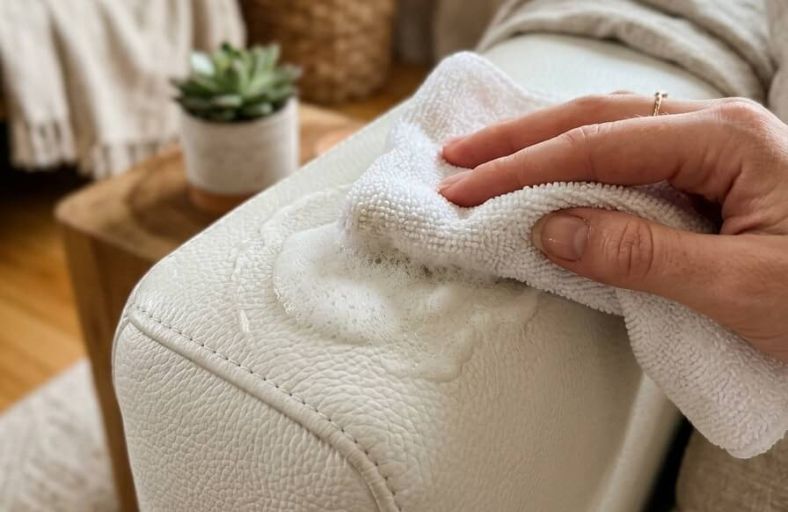
Few pieces of furniture make a statement quite like a white leather sofa, but keeping it looking pristine requires a bit more attention than darker upholstery.
Sweat, body oils, ink, and everyday grime can build up gradually, leading to yellowing or dullness if not addressed regularly.
Unlike fabric sofas, leather needs specific care to avoid cracking, drying out, or discoloration over time.
Fortunately, simple household solutions and a consistent cleaning routine can keep your sofa looking as good as new.
Advanced Vacuuming
The foundational stage of white leather maintenance begins with the rigorous removal of dry particulate matter.
In the context of material science, dust is a collection of microscopic abrasives consisting of silica, skin cells, and environmental pollutants.
When these particles settle into the grain and are subjected to the mechanical pressure of sitting, they act like ultra-fine sandpaper, microscopicly scoring the protective topcoat.
This increases the surface area available for liquid contaminants to bond, making the leather appear grey over time.
| Component of Debris | Impact on White Leather | Remediation Strategy |
| Silica/Sand | Mechanical abrasion of topcoat | Soft-brush vacuuming |
| Skin Cells (Sebum) | Biological staining and yellowing | Weekly dry buffing |
| Atmospheric Soot | Deep grain grey-scale tinting | Microfiber capture |
A professional protocol requires a vacuum with a soft-brush attachment to navigate seams and crevices where debris accumulates. Soft bristles are essential to dislodge particles without causing secondary scratches.
Surface Tension
Once dry particulates are extracted, the next phase involves remediating water-soluble soils.
The primary challenge lies in the chemistry of the material; leather is naturally acidic, with a stable pH range typically between 3.5 and 5.5.
Most household cleaners are highly alkaline (pH 8-12), which can cause a catastrophic chemical reaction, leading to the breakdown of tanning agents and eventual cracking.
The aqueous protocol utilizes a pH-balanced, non-detergent soap, often a mild liquid body wash, mixed with distilled water.
Distilled water is a non-negotiable requirement; tap water contains minerals that leave tide marks upon evaporation.
Maintaining this acidity ensures the leather fibers remain tight and resilient. Use a damp-only approach, as excessive moisture can penetrate seams and lead to internal mold growth.
Lipid Remediation via Adsorptive Capillary Action
Accumulation of lipids, primarily body oils (sebum) and hair products, is a persistent threat to white leather.
These oils are absorbed into the porous structure, where they oxidize and result in dark, tacky patches on headrests and armrests.
The “Powder Method” utilizes adsorptive capillary action to draw these deeply embedded oils back to the surface.
Absorbent materials like cornstarch or talcum powder act as a molecular sponge. When applied, the powder creates a concentration gradient that encourages lipids to migrate from the dense leather fibers into the porous powder.
The Application Process:
- Blotting: Use a dry microfiber cloth to remove excess surface oil.
- Saturation: Apply a thick layer of cornstarch over the affected area.
- Rest: Allow it to sit for at least 12 hours, or ideally overnight, to fully absorb the grease .
Chemical Solvent Intervention for Pigment-Based Stains
Ink stains on a white sofa require immediate and specific chemical intervention because ink requires a solvent to break down its molecular structure.
Acting quickly is vital; the longer a pigment sits, the deeper it penetrates the polyurethane topcoat.
The most successful home method involves 70% isopropyl alcohol (rubbing alcohol). Dip a cotton swab in a small amount of alcohol and dab the stain from the outer edges toward the center to prevent spreading.
Never rub aggressively, as this can strip the white pigment along with the ink. Because alcohol is a powerful drying agent, you must follow up with a leather conditioner to restore the lipid balance and prevent the treated spot from becoming brittle or cracking.
Mitigation of Textile Dye Transfer (Denim)
Indigo migration from dark denim is a nightmare for white leather owners. This occurs when dye molecules from clothing re-dye the leather topcoat through friction and heat.
If noticed early, this can often be removed with a specialized leather cleaner or even baby wipes for light maintenance. However, deep stains require a dedicated dye transfer remover that dissolves the pigment without stripping the underlying hide.
| Severity | Recommended Action | Tool |
| Surface Transfer | Immediate wiping with non-detergent soap | White microfiber |
| Set-in Blue Stains | Application of specialized dye blocker | Leather brush |
| Deep Penetration | Solvent-based professional cleaning | Solvent stick |
Applying a leather shield or protector after cleaning is vital. These products create an invisible barrier that prevents dye from penetrating the clear coat, making future spills much easier to blot away.
Natural Acidification
For organic soil and light maintenance, a natural solution using white vinegar is highly effective.
Vinegar has a pH level of approximately 2-3, which complements the naturally acidic nature of leather.
A balanced mixture usually consists of one part white vinegar to two parts distilled water. This solution acts as a mild solvent to break down surface grime without the harshness of alkaline industrial chemicals.
The protocol involves lightly misting the surface and wiping in circular motions. Experts warn never to use straight vinegar, as its high acidity can be too aggressive for the finish if not properly diluted.
Following this treatment, it is essential to buff the leather dry with a clean cloth to ensure no acidic residue remains, which could cause long-term drying.
Micro-Abrasive Erasure
The use of melamine foam (Magic Erasers) is a controversial but powerful mechanical protocol for white leather. Chemically, these sponges act like ultra-fine sandpaper (roughly 3000 to 5000 grit), physically “sanding” away the top layer of the stain.
While effective for scuffs that chemical cleaners cannot reach, this method must be used with extreme caution on white leather.
Because it is abrasive, it strips away the polyurethane protective topcoat along with the dirt.
On white leather, this damage is less visually apparent than on dark colors, but it leaves the material vulnerable.
Rules for Mechanical Erasure:
- Dampen: Always use the sponge wet to lubricate the abrasive action.
- Zero Pressure: Use the lightest touch possible to avoid “suction bruising.”
- Restore: Immediately apply a high-quality leather conditioner to replace the stripped protective finish and prevent cracking.
Lipid Replenishment
Conditioning is the non-negotiable conclusion to any cleaning ritual. While aqueous cleaners and solvents effectively lift dirt, they simultaneously strip away the natural lipids that keep leather fibers supple.
Without replenishment, white leather becomes brittle, losing its elasticity and developing micro-fissures that eventually lead to deep cracks.
High-quality conditioners, such as those from Leather Honey or Lexol, penetrate the surface to moisturize the fibrous structure from within.
| Conditioner Type | Primary Benefit | Recommended Use |
| Conditioning Cream | Minimal color change; high nourishment | Fine furniture |
| Wax-Based | Excellent surface water resistance | High-traffic areas |
| Oil-Based (Lanolin) | Deepest fiber softening | Heavily dried leather |
Apply the product using a fresh microfiber cloth in small, circular motions. Allow it to absorb for approximately 15 minutes before buffing the surface with a dry towel to remove any tacky residue.
For white leather, consistency is key; a full conditioning treatment every six months acts as a primary defense against the aging process.
Photolytic Degradation and UV Protectant Strategy
The greatest environmental threat to a white sofa is photolytic degradation, commonly known as yellowing.
This is a natural oxidation process where exposure to UV rays, heat, and oxygen breaks down the proteins and dyes in the hide.
While oxidation is inevitable over several decades, it is significantly accelerated by direct sunlight. To mitigate this, modern maintenance relies on UV protectant shields.
Products like Leather Honey or Tyger 2-in-1 now incorporate UV filters that act as a sunscreen for your upholstery.
These specialized coatings block harmful radiation, preventing the chemical bond breakage that turns a brilliant white into a dull yellow.
Strategic Placement Tips:
- Position the sofa at least 2 meters away from south-facing windows.
- Utilize breathable cotton covers during peak sunlight hours.
- Apply a UV-enhanced protector every 3 to 4 months for maximum shielding.
Subsurface Extraction and Professional Restoration
When surface treatments fail to address deeply ingrained contaminants, professional restoration becomes necessary.
This is especially true for tacky headrests or dye transfer that has moved past the clear coat into the pigment layer.
Professional technicians utilize subsurface extraction techniques, such as low-moisture foam cleaning, which lifts soils without over-saturating the internal foam or batting.
In cases where the white color has already been compromised by scuffs or permanent stains, experts can perform a full color restoration.
This involves cleaning with specialized industrial solvents, followed by the application of a color-matched pigment and a new polyurethane topcoat.
If your sofa shows signs of structural peeling or severe dehydration, professional intervention is the only way to safeguard your investment and restore its original radiance.