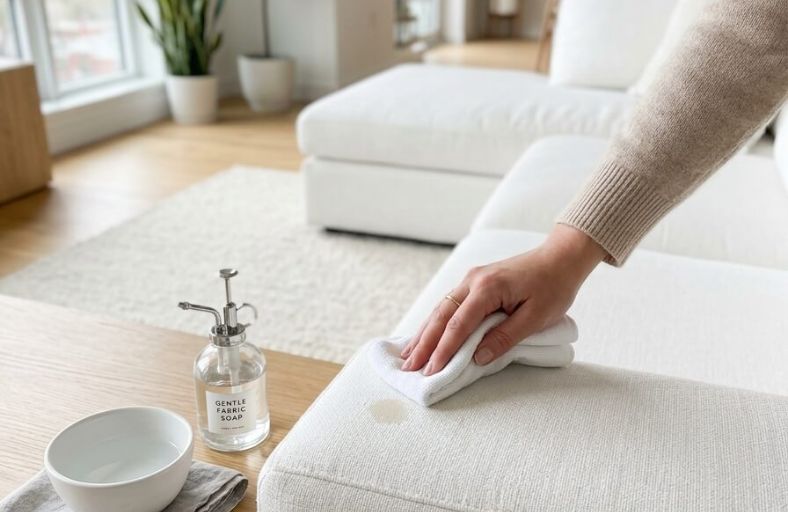
White couches attract attention for all the right reasons, and unfortunately also for all the wrong ones when they are not properly maintained.
Dirt, oils, spills, and general everyday use show up more visibly on white upholstery than on any other color, which means regular cleaning is not optional. It is essential!
The good news is that most white couch stains and general dinginess are very treatable with the right products and approach.
Acting quickly on fresh spills, using gentle but effective cleaning solutions, and knowing when to call in a professional are all part of a successful white couch maintenance strategy.
These tips give you everything you need to keep yours looking genuinely beautiful.
Systematic Dry Soil Extraction through Precision Vacuuming
The most effective way to keep your white couch looking fresh starts with a vacuum, not a spray bottle. Every day, your sofa acts like a giant filter, trapping dust, skin cells, and pet dander.
If left alone, the simple act of sitting on the couch grinds this grit deep into the fibers. This process acts like sandpaper, shearing the fabric and leading to unsightly graying or pilling.
For an expert clean, use a soft-bristle upholstery attachment every week. Make sure to dive into every seam, crevice, and the hidden gap between the cushions where dirt loves to hide.
Don’t forget the frame underneath the cushions; removing dust there prevents the “bellows effect,” where sitting down puffs internal dust back up through the fabric.
This proactive extraction is your first line of defense against the mud effect that happens when a liquid spill meets a dusty surface.
Care Tag Deciphering and Forensic Fiber Analysis
Before any liquid touches your furniture, you must consult the manufacturer’s care tag. These codes are not mere suggestions; they are the chemical laws governing your couch’s survival.
Using the wrong cleaner can lead to permanent water rings, shrinkage, or fiber damage.
| Code | Cleaning Method | Best For |
| W | Water-based cleaners | Synthetic fibers like polyester |
| S | Solvent-based cleaners | Natural fibers like linen or silk |
| WS | Water or solvent | Flexible but requires a spot test |
| X | Vacuum only | Delicate velvets or specialty weaves |
Always locate every tag, as back cushions and frames might occasionally have different instructions. Once you identify the code, perform a spot test on a hidden area, like the back of the skirt or the underside of a cushion.
This ensures the cleaner won’t cause discoloration or change the fabric’s texture before you commit to the whole piece.
Alkaline Deodorization and Odor Neutralization with Baking Soda
White couches often fall victim to invisible dirt, such as odors and body oils that make the room feel stale.
Baking soda is a natural, alkaline powerhouse that neutralizes acidic odors from pets, sweat, and food rather than just masking them.
Its chemical structure allows it to absorb trapped moisture and odor molecules directly from the fibers.
To refresh your couch, sprinkle an even layer of baking soda over the entire surface and let it sit for at least 20 to 30 minutes.
For deeper issues, leaving it overnight provides maximum absorption. Because baking soda is a very mild abrasive, it also helps loosen dirt particles clinging to the fabric through static electricity.
Finish by vacuuming thoroughly to lift away both the powder and the trapped grime. This monthly ritual keeps your white sanctuary smelling as clean as it looks.
Aqueous Micellar Cleaning for Water-Safe (Code W) Fabrics
For modern white couches marked with a “W,” a simple aqueous solution is the gold standard for lifting surface soil.
This method relies on surfactants, which are molecules that attach to oil and dirt, trapping them in “micelles” so water can wash them away.
The professional recipe is straightforward: mix one teaspoon of clear, neutral-pH dish soap (like Dawn) with 16 ounces of warm distilled water. It is vital to use clear soap to avoid accidental dye transfer to your white fabric.
Always use a low moisture approach; dampen a clean white microfiber cloth with the solution and dab the fabric gently.
Saturating the couch can trap moisture in the foam padding, leading to mold or permanent water rings. By blotting rather than rubbing, you lift the soil without fraying the delicate fibers.
Non-Polar Solvent Application for Delicate (Code S) Fibers
When a white couch is composed of natural fibers like silk, wool, or high-end linen, traditional soap and water can cause permanent damage.
These fibers are prone to water rings, which are essentially mineral deposits and redistributed dirt that settle at the edges of a wetted area.
For these “S” coded fabrics, you must use non-polar solvents, often known as dry cleaning fluids.
These liquids dissolve oils and greases without penetrating the hydrophilic core of the fiber, preventing shrinkage and warping. Using a solvent requires a safety-first mindset.
These chemicals are volatile, so ensure the room is well-ventilated. Apply a small amount of the solvent to a clean, white, lint-free cloth and gently dab the stain from the outside in.
Because solvents evaporate quickly, they do not leave the fabric wet for long, which is the only safe way to treat a “dry clean only” white velvet or linen blend.
Bio-Catalytic Enzymatic Breakdown for Organic Matter
Many stubborn stains on a white couch are organic in nature, such as blood, sweat, or food spills.
These are protein-based stains that set if treated with heat. To remove them, turn to the science of enzymes.
Enzymes are biological catalysts that break down complex organic molecules into smaller, water-soluble fragments.
| Enzyme | Targets | Examples |
| Proteases | Proteins | Blood, sweat, dairy products |
| Lipases | Fats and Oils | Grease, butter, skin oils |
| Amylases | Carbohydrates | Sauces, starchy foods |
Use a dedicated enzymatic cleaner specifically labeled for upholstery. These cleaners often require a “dwell time” of 5 to 10 minutes to allow the biological process to occur before the area is blotted clean.
This method is far more effective than scrubbing, as it literally “eats” the stain at a molecular level without damaging the delicate white fibers.
Indigo Mitigation and Denim Dye Extraction
The greatest threat to a white couch is “crocking” or dye transfer from raw denim jeans.
Dark blue indigo dye is often not fully fixed to denim fibers and can rub off through simple friction, leaving a blue shadow on your cushions.
The professional response involves a two-step process. First, use an oxygen-based bleach solution mixed with cool distilled water. Oxygen bleach uses oxidation to break the chemical bonds of dye molecules.
Blot the area gently, moving to a clean section of your white cloth as it picks up the blue pigment. If the stain persists, a small amount of 70% isopropyl alcohol can act as a solvent to lift the remaining dye.
Always perform a spot test first, as alcohol can affect some natural fiber finishes. Follow up with a distilled water rinse to remove any chemical residue and prevent future yellowing.
Lipid-Based Conditioning for Porous Leather and Faux Leather Surfaces
White leather and faux leather (PU/PVC) require a different chemical strategy than fabric.
Real leather is essentially skin; it has pores that can dry out, leading to cracks that trap dirt and make the white surface look fractured and aged.
Faux leather, while more resilient to moisture, can become brittle if cleaned with harsh household degreasers.
| Feature | Real White Leather | Faux White Leather |
| Absorbency | Higher | Lower |
| Best Method | pH-balanced leather cleaner | Mild soap and warm water |
| Maintenance | Conditioning is vital | Wipe weekly with damp cloth |
| Main Risk | Drying and staining | Peeling and cracking |
For real leather, use a specialized cleaner followed by a lipid-based conditioner. The conditioner “plumps” the fibers, creating a sacrificial layer that prevents spills from soaking in.
For faux leather, a simple mix of 3-4 drops of mild dish soap in a liter of warm water is sufficient. Always dry the surface immediately with a soft towel to prevent water from degrading the synthetic backing or seams.
Deionized/Distilled Hydration and Ring Prevention
The “halo” effect or water ring is the primary enemy of the DIY cleaner. These rings are caused by the mineral content in tap water, which leave a crusty residue after the H₂O evaporates.
Distilled water is virtually mineral-free, allowing it to neutralize these residues safely.
To prevent rings, use only distilled or deionized water for both your cleaning solution and the rinsing step.
When rinsing, adopt the “feathering” technique: wet a larger area around the original stain with distilled water and blot it dry from the outside in.
This prevents a hard boundary from forming as the fabric dries. If you already have a mineral ring, lightly spraying it with distilled water and blotting can often make the mark disappear by re-dissolving the trapped minerals.
Surface Tension Modification and Protective Coatings
The final solution is proactive: applying a high-performance fabric protector. These products modify the surface energy of the textile fibers.
A treated fiber has a very low surface energy, making it difficult for liquids to “wet” the surface.
Instead of soaking in, liquids will form high-contact-angle beads that sit on top of the weave, buying you time to blot them up.
Experts recommend reapplying protectors (like Scotchgard) every 6 to 12 months, especially on high-traffic areas like armrests and seat cushions. Ensure the couch is completely clean and dry before application.
Spray the protector evenly, making two light passes rather than one heavy, saturating soak.
This fundamental barrier transforms standard upholstery into performance fabric, allowing for a stress-free lifestyle where a spill is merely a temporary inconvenience rather than a permanent disaster.
Expert’s Stain-Specific Cheat Sheet
| Spill Type | Recommended Expert Action |
| Coffee / Tea | Blot immediately, dab with soap/distilled water, rinse, air dry |
| Red Wine | Blot, apply vinegar/distilled water mix (1:1 ratio), blot until lifted |
| Grease / Food Oil | Cover with cornstarch for 20 minutes, vacuum, then use clear soap |
| Ink / Pen Marks | Dab with isopropyl alcohol on cotton swab (Test first!), rinse with water |
| Mud / Dirt | Allow to dry completely, vacuum thoroughly, then spot clean with soap |
The Long-Term Maintenance Schedule
- Weekly: Vacuum the entire surface using a soft brush attachment. Pay attention to seams where grit accumulates.
- Monthly: Apply the baking soda deodorization technique to absorb oils and refresh the fiber scent.
- Every 6 Months: Rotate all cushions to ensure even wear and prevent UV yellowing. Reapply fabric protector to high-traffic zones.
- Yearly: Hire a professional for hot water extraction or a deep steam refresh to pull out deeply embedded pollutants.