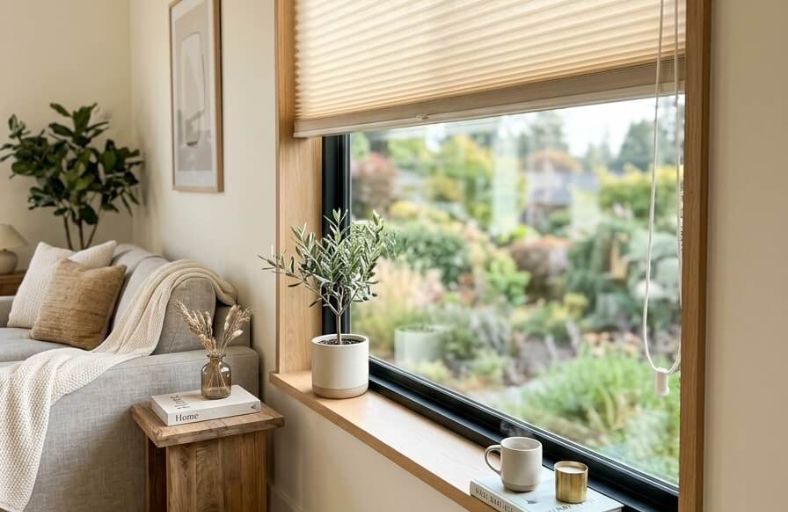
A bright summer afternoon should feel like a relaxing escape, but inside your living room, it often feels like sitting directly inside a preheated oven.
When the outdoor temperature climbs, your home can quickly trap heat, turning your cozy sanctuary into an oppressive, sticky greenhouse.
While flipping the air conditioner to its lowest setting is tempting, it often leads to a staggering utility bill. Fortunately, you can reclaim your comfort using simple, science-backed physics.
By managing thermal pathways, optimizing airflow, and making minor behavioral tweaks, you can easily transform your space into a refreshing, budget-friendly oasis of cool relief.
Upgrade to Insulated Window Treatments
Windows are your home’s main thermal weak points, letting in massive amounts of outdoor heat.
To stop this radiant energy, standard curtains will not cut it because warm air simply bypasses them through a convective loop. Instead, upgrade to insulated cellular shades.
Also known as honeycomb shades, their unique design features pockets of stagnant air that act as physical barriers against heat conduction. When tightly fitted on side tracks, they block up to 60% of incoming solar heat.
If you prefer fabric curtains, choose medium-colored thermal drapes with a white plastic backing, which can slash heat gain by 33%.
For maximum efficiency, seal the sides of your drapes to the wall using magnetic tape or Velcro. This simple trick stops hot air from escaping around the edges and spilling directly into your living space.
Apply Smart Solar Window Films
If you love your natural view but hate the blistering greenhouse effect, retrofitting your glass with solar control window films is a game-changer.
These thin, multi-layered polyester coatings are applied directly to your window panes to reflect and absorb solar energy before it ever crosses into your room.
Ceramic solar films use advanced nanotechnology to block up to 90% of invisible near-infrared heat while keeping your room bright and perfectly clear.
Meanwhile, low-emissivity (Low-E) films reflect heat back outside in the summer and keep indoor warmth inside during the winter.
| Film Type | Heat Rejection | Best For |
| Ceramic Film | 80% to 90% | Hot, sunny climates |
| Low-E Film | 75% to 85% | Mixed climates |
| Metalized Film | 40% to 60% | High glare reduction |
Installing these films can lower indoor temperatures by up to 10°F on hot days, giving your air conditioner a much-needed break.
The Aerodynamics of Cross-Ventilation
Ventilation is the most energy-efficient way to cool your home, but it requires strategic timing.
Keep your windows and doors tightly shut during the hottest hours of the day to seal out scorching air.
Once the outdoor temperature drops below your indoor temperature in the evening, it is time to create a wind-driven breeze.
Open windows on the windward side of your home (where the breeze enters) and the leeward side (where air escapes).
This pressure difference forces stale, warm indoor air out while pulling cool, fresh air inside.
To supercharge this setup, place a window fan in a leeward window blowing outward.
Keep adjacent windows closed and open windows in rooms furthest away. This mechanical assist forces a continuous, refreshing stream of cool air to sweep through the entire living area.
Spin Your Ceiling Fan in Summer Mode
Ceiling fans do not actually cool the air in a room; instead, they cool your body directly using a clever physics trick called the wind-chill effect.
By evaporating moisture from your skin, a fan can make a room feel up to 4°F cooler than the thermostat reads.
To achieve this summer breeze, stand directly under your fan and look up. The blades must rotate counterclockwise.
This setting pushes air straight down in a powerful, direct column of cool air. Ensure your fan’s blade pitch is set to at least 12 degrees to maximize this downward force.
Running your fan in summer mode allows you to raise your air conditioner’s thermostat by 4°F with zero loss in comfort, cutting your cooling energy costs by up to 30%. Remember to turn fans off when leaving, as they only cool people, not rooms.
Harness the Power of Plant Transpiration
Did you know that your houseplants can double as natural air conditioners? Through a biological process called transpiration, plants absorb water through their roots and release moisture into the air from tiny pores in their leaves.
This evaporation absorbs sensible heat, cooling the immediate surrounding environment and shaving an average of 1°C (1.8°F) off the room temperature.
For the best cooling results, choose soft-leaved plants with large surface areas, such as Boston ferns, bamboo palms, rubber plants, or snake plants.
Group your plants together to establish a highly effective, self-sustaining humid microclimate.
Just make sure to keep them properly watered, as dry soil forces them to shut their pores and stop transpiring to conserve moisture.
Finally, place them at least 3 to 5 feet away from HVAC vents so the dry, moving air does not dehydrate them.
Ice Bowl Hack
If you need instant, localized relief while sleeping or watching television, the classic “ice bowl” trick is a highly reliable option.
Simply fill a large bowl or pot with ice cubes, ice packs, or frozen water bottles and place it directly in front of a non-oscillating fan. Point the fan directly toward your seating or sleeping spot.
As the warm room air flows over the ice, heat transfers from the air to the melting ice. This phase change lowers the temperature of the moving air, blowing a cool, refreshing breeze directly at you.
It can create a personal “cool zone” that drops the perceived temperature by 5 to 7°F within a 6-foot radius, lasting up to 4 hours.
However, keep thermodynamics in mind: freezing water inside your kitchen freezer releases heat into your home.
To prevent net warming, use ice frozen in an outdoor garage freezer, or buy bags of ice from the grocery store.
Ban Vampire Plugs and Parasitic Heat Loads
Your home is full of stealthy heaters that fight against your cooling efforts. Traditional incandescent bulbs, for instance, release a staggering 90% of their energy as heat.
Swapping them for ENERGY STAR certified LEDs instantly cools your light fixtures while saving up to 75% on lighting energy.
Unplugging standby electronics also makes a noticeable difference. Many devices continuously draw electricity and emit heat even when turned off; these are known as vampire loads.
Consolidate your entertainment setup onto a smart power strip to easily cut off this unnecessary thermal energy.
| Heat Source | Cool Alternative | Energy Saved |
| Incandescent bulbs | LED lighting | 75% less energy |
| Full-sized oven | Toaster oven | 33% to 50% savings |
| Vampire electronics | Smart power strip | Eliminates standby load |
Finally, skip the full-sized oven on hot afternoons, as it acts like a massive space heater in your kitchen. Choose cool cooking methods like microwaves or toaster ovens instead.