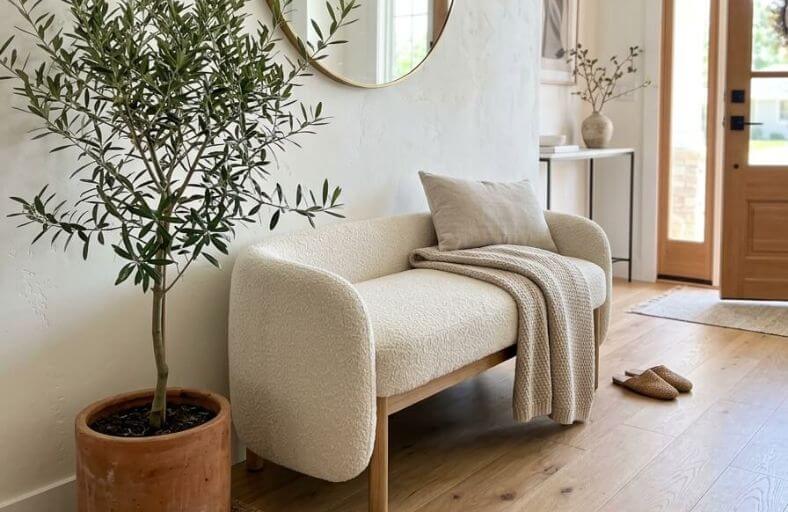
The front door swings open, and suddenly, you are standing in the middle of a private conversation, stepping directly onto the living room rug with wet shoes and a handful of mail.
It is the classic “direct-to-living” dilemma where the transition from the chaotic outside world to your peaceful sanctuary feels jarring and incomplete. Without a dedicated foyer, your home lacks a psychological “airlock” to decompress.
Creating a foyer in an open-concept space is not about building walls, but about mastering the art of spatial zoning through clever furniture and sensory cues.
The Power of the Console Table Anchor
The console table is the quintessential piece for engineering a foyer where none exists.
By placing a narrow table perpendicular to the front door, you establish an immediate visual barrier and a dedicated “drop zone” for daily essentials.
This piece acts as a functional anchor, signaling that you have entered a distinct zone of the home.
For high-traffic open plans, cabinet-style consoles or sideboards with drawers are superior choices because they conceal the inevitable clutter of keys, wallets, and mail.
To ensure a professional finish, maintain the table depth between 12 and 15 inches to keep walkways clear, ideally at least 36 inches for comfortable movement.
Adding a catch-all tray or a small stone bowl on the surface provides a no-brainer spot for small items, preventing the frantic morning search for keys.
Defining Zones with High-Durability Area Rugs
Rugs are powerful tools for visual zoning because they anchor a space without physical boundaries.
In an open living room, a high-quality rug creates a “landing pad” that psychologically separates the entry from the seating area.
To create a polished look, leave approximately 12 to 24 inches of bare floor between the rug and the walls.
| Rug Size | Best Use Case | Benefit |
| 3′ x 5′ | Small apartments | Defines a tight corner |
| 5′ x 7′ | Large open plans | Creates a spacious room feel |
| Runner | Narrow entry paths | Guides traffic flow intuitively |
Choose durable materials like wool or high-end synthetics that can withstand dirt and moisture.
Low-pile options are recommended to avoid tripping hazards and to ensure the front door can swing open freely without snagging.
Creating a Hallway Through Sofa Orientation
One of the most effective ways to carve out a foyer is to use the back of your furniture as a literal wall. Instead of facing your sofa toward the entrance, turn it so its back is toward the door.
This placement creates a natural hallway between the entry and the living area, directing traffic flow around the seating zone rather than through it.
To enhance this effect, place a long sofa table directly behind the couch. This adds a layer of depth and provides a surface for lamps or decorative bins to handle the drop of daily items.
This orientation provides refuge, the psychological feeling of security that comes from having a protected back while you relax.
It effectively hides the utilitarian entry area from the eyes of those sitting in the lounge, preserving the room’s aesthetic.
The Pause Point
A functional foyer is more than just a place to drop keys; it is a place to pause.
Incorporating a bench or a pair of accent chairs near the entrance provides a vital psychological cue that you have transitioned into the private realm .
For 2026, the trend is shifting toward Soft Sculptural Forms, think benches with rounded edges and bouclé or tactile linen upholstery that feel safe and welcoming to the touch .
In an open living room, a bench should be narrow enough to maintain a clear 36-inch walkway but deep enough for comfort, usually between 14 to 18 inches.
If your space is exceptionally tight, consider tucking two small ottomans under your console table that can be pulled out only when needed .
This setup offers the luxury of a seating area without the permanent footprint, maintaining the airy feel of your open-concept design while preventing the awkward standing-on-one-leg shoe removal dance for your guests .
High-Performance Vertical Storage
When floor real estate is at a premium, your walls must do the heavy lifting. Vertical storage is the secret to keeping a direct-to-living entry from becoming a clutter magnet.
Strategic hooks and floating shelves allow you to reclaim the “dead space” on walls, providing a home for backpacks, coats, and umbrellas that would otherwise end up on your sofa .
| Element | Ideal Placement | Function |
| Multi-Level Hooks | 36″ & 60″ high | Accessible for both children and adults to hang bags/coats. |
| Floating Shelves | Eye-level (approx. 5-6′) | Acts as a “foyer-lite” for keys and sunglasses in narrow halls . |
| Wall-Mounted Cabinets | Above floor level | Provides closed storage to hide visual clutter without taking floor space. |
For a high-end look, opt for wall hooks made of natural stone or brushed metal, which serve as functional art.
By creating a vertical drop zone, you ensure that the mess stays within the first 24 inches of the door, preserving the curated aesthetics of your main living space.
Lighting as a Boundary
Lighting is perhaps the most subtle yet effective way to delineate a foyer in an open plan. By providing the entry zone with its own dedicated light source, you signal its autonomy from the rest of the room .
A statement pendant or a small chandelier centered over the rug creates an “invisible wall” that visually defines the entrance from above .
To create a professional, layered effect, avoid relying solely on overhead lights. Wall sconces flanking a mirror or a warm table lamp on your console can add depth and a sense of welcome that a single ceiling light cannot achieve.
As we look toward 2027, designers are favoring organic-shaped fixtures and matte metal finishes like darkened steel or muted brass, which provide a soft, sophisticated glow rather than a harsh, clinical brightness.
This specialized lighting acts as a biological regulator, helping your brain switch from the high-energy outside world to the restorative atmosphere of your home .
Structural Delineation with Pony Walls
A pony wall , a partial stud partition typically standing 36 to 48 inches high, is a professional favorite for creating a clear physical divide without sacrificing the airy volume of an open concept room.
It effectively blocks the view of cluttered shoe racks or utilitarian items from the primary seating area while providing a solid surface against which you can place an entryway bench or a hutch.
This structural cue signals a formal beginning to the home, offering the psychological sense of refuge by protecting the living space from the direct swing of the front door.
Beyond its role as a divider, a pony wall can be enhanced with architectural details like wainscoting or bold paint colors to distinguish the entry side from the living side.
This differentiation provides a clear visual signal that you have moved from a public exterior zone into a private sanctuary.
By maintaining the upper half of the space open, you ensure that natural light continues to flow freely throughout the entire floor plan, preserving the expansive feel that makes open living rooms so desirable.
Defining Boundaries with Material Transitions
One of the most effective sensory boundaries you can create is a literal change underfoot.
Installing an impervious entry pad using waterproof materials like porcelain tile, luxury vinyl, or natural stone creates a functional zone that can handle the grit and moisture of the outside world.
This visual contrast acts as a non-verbal stop sign for guests, instinctively showing them where outdoor gear should be removed before stepping onto the living room’s hardwood or carpet.
| Flooring Material | Durability | Trend Factor |
| Porcelain Tile | Extremely High | High-end fluted or textured finishes |
| Natural Stone | High | Timeless marble or slate for a luxury feel |
| Luxury Vinyl | High | Waterproof, cost-effective, and versatile |
When choosing materials, ensure the transition between the entry pad and the main flooring is kept level to prevent tripping hazards and maintain a seamless architectural look.
For 2026, designers are increasingly using large-format tiles to create a spacious appearance and minimize grout lines, which further helps in keeping the drop zone easy to clean and visually uncluttered.
Multi-Functional Double-Sided Shelving
When permanent construction is not an option, a double-sided shelving unit serves as a brilliant multi-functional divider.
Unlike a solid wall, open shelving allows natural light to permeate both the entry and the living room while providing vital storage for books, baskets, and curated decor.
This approach allows the space to evolve over time, as the shelves can be rearranged to suit changing needs or seasonal styles.
For a sophisticated look that aligns with upcoming trends, choose units with rounded silhouettes or Soft Sculptural Forms to keep the transition feeling fluid rather than rigid.
Placing larger opaque baskets on the lower shelves effectively handles the shoe drift and hides visual clutter, while the upper shelves act as a gallery for personal objects or biophilic elements like trailing plants.
This dual-purpose piece ensures that every square inch of your open floor plan is working hard to provide both organization and aesthetic appeal.
Statement Mirrors
A mirror is a non-negotiable element for any entryway, serving both a functional and a psychological purpose. Practically, it allows for a last-minute appearance check before you head out the door.
Aesthetically, a large mirror reflecting the living area can make a narrow “non-existent” foyer feel twice as large by bouncing natural light into the deeper corners of the room.
For 2026, the trend is moving toward Organic Shapes, think arched or irregularly shaped mirrors that break up the rigid lines of an open floor plan.
| Mirror Type | Best For | Psychological Effect |
| Large Arch | High ceilings | Adds grandeur and softness |
| Full-Length (Door Mounted) | Tiny entryways | Expands the sense of openness |
| Round Mirror | Above a console | Promotes flow and continuity |
These softer forms feel safe and welcoming, contrasting with the sharp corners of doors and cabinets.
Exploiting the Door Swing and Dead Space
In many open-concept homes, the foyer is non-existent because the door opens directly against a wall. To create a foyer here, you must take advantage of the door swing itself.
A door that swings in toward the seating area actually creates a temporary barrier that blocks sightlines into your private conversation zone.
If you have a narrow wall of only 23 inches, focus on leg-free furniture. A wall-mounted floating shelf for keys and a set of vertical hooks can provide all the utility of a mudroom without taking up a single inch of floor space.
You can even mount a floor-length mirror to the back of the entry door to expand the visual volume of the landing zone every time the door is closed.
Biophilia and the Sanctuary Signal
The final step in defining your foyer is to use sensory signals that tell your brain you are officially home.
Incorporating greenery through tall plants like snake plants or fiddle leaf figs can act as a living room divider, softening the transition from the exterior world.
Research in environmental psychology suggests that viewing natural textures and plants reduces cortisol levels almost instantly, making the foyer a decompression chamber.
Layering personal elements, such as a gallery wall of family photos or nature photography, creates a story for your home.
These items serve as a psychological anchor, shifting your focus from the public sphere to your personal history.
When you pair a soft-scented candle with organic textures like a wool rug or a wood-toned cabinet, the entryway ceases to be a hallway and becomes a soulful introduction to your life.