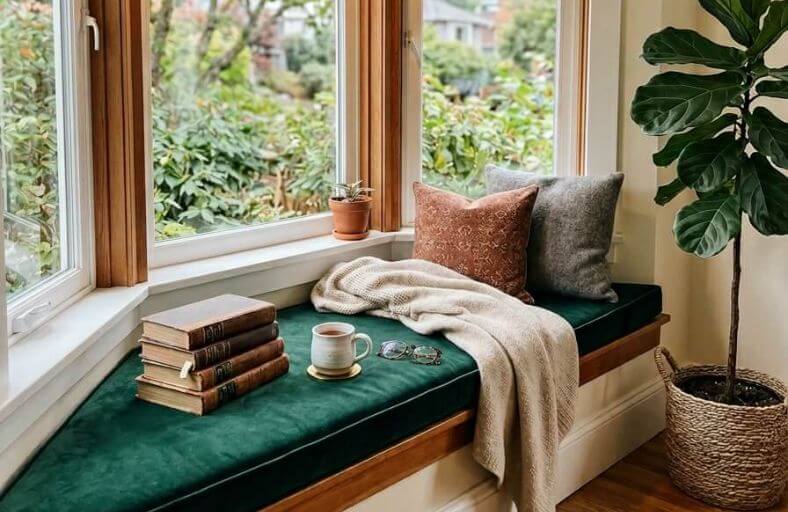
Dust bunnies dance in the awkward void of an underutilized alcove while heavy, dated curtains stifle the potential of a room’s best feature.
For many homeowners, a bay window feels less like an architectural asset and more like a decorating puzzle that is impossible to solve.
These beautiful protrusions were originally designed to flood Victorian homes with light and status, yet today they often sit empty or cluttered.
Transforming this space does not require a massive renovation. With a strategic approach to seating, light, and greenery, that drafty corner can become the most sought-after sanctuary in your house.
The Built-In Window Seat with Hidden Storage
A bespoke window seat is the ultimate way to reclaim lost square footage. To ensure it is actually comfortable and not just a decorative ledge, you should stick to standard ergonomic measurements.
The seat should ideally rest 16 to 20 inches from the floor, including the cushion, which mirrors the height of a standard dining chair.
For depth, 18 inches is perfect for casual sitting, while 24 inches or more allows you to lounge and read for hours.
| Storage Type | Best For | Ease of Access |
| Hinged Lid | Seasonal items | Moderate |
| Pull-out Drawers | Daily essentials | High |
| Open Cubbies | Kids’ toys or baskets | High |
Integrating storage beneath the seat is a brilliant move for smaller homes. You can choose between hinged lids or pull-out drawers to keep your living area tidy.
While hinged lids are easier for DIY projects, drawers offer better access without needing to move your plush pillows every time you need a blanket.
Inspiring Home Office Workstation
In an era of remote work, your bay window offers the premier corner office experience.
The abundance of natural light is scientifically proven to boost serotonin and focus, making it a high-performance zone for creativity.
For the best result, consider installing a floating desk that spans the entire width of the bay.
This creates a clean, built-in look that feels integrated into the room’s architecture rather than squeezed in as an afterthought.
The biggest challenge with a window-facing desk is screen glare. Positioning your monitor perpendicular to the window is the best way to save your eyes from strain.
If you must face the glass, invest in light-filtering sheer curtains or adjustable Roman shades. These allow you to bask in the view while diffusing the harsh rays that wash out your screen.
European-Style Dining Banquette
Converting a kitchen bay window into a dining banquette is a classic space-saving strategy that adds instant charm.
A built-in bench allows you to fit more people into a smaller footprint than individual chairs ever could.
To make the most of this setup, you should pair your seating with a pedestal table.
Unlike traditional four-legged tables, a pedestal base offers maximum legroom and makes it much easier for guests to slide in and out of the nook without bumping their knees.
| Table Shape | Best Bay Type | Seating Capacity |
| Round Pedestal | 3-Sided Canted | 4 People |
| Oval Pedestal | Large Bow Window | 5-6 People |
| Rectangular | Box Bay | 4-5 People |
Always use high-performance fabrics like solution-dyed acrylics for your seat cushions. Since this is a high-traffic dining area, you want materials that are resistant to spills and easy to wipe clean.
Sun-Drenched Indoor Jungle
The multi-directional light of a bay window makes it a paradise for indoor horticulture. To create a professional plant gallery look, you should use a layering technique. Place larger floor plants like a
Fiddle Leaf Fig or Monstera on the edges to frame the view, then line the sill with smaller potted herbs or succulents.
Success depends entirely on which way your window faces. South-facing windows are heat traps, making them perfect for sun-loving desert species. North-facing windows offer cooler, indirect light that is ideal for hardy foliage.
| Orientation | Light Level | Plant Recommendations |
| South | Intense and Direct | Cacti, Succulents, Jade |
| North | Low and Indirect | Snake Plant, ZZ Plant, Ferns |
| East | Bright Morning Sun | Orchids, Pothos, Peace Lily |
Be sure to use decorative drip trays under your pots. This simple step protects your wooden sills from moisture damage and keeps the area looking pristine.
Mastering Layered Window Treatments
To achieve a cocooning effect that feels both luxurious and functional, design trends suggest moving away from single-blind solutions in favor of layered textures.
This approach involves pairing soft, translucent sheers that filter daylight with structured heavier drapes for evening privacy.
For curved bow windows, flexible tracks are the gold standard because they can be bent by hand to follow the architectural line perfectly.
Precision is critical when measuring for these treatments. You should treat the bay as a series of straight sections rather than one curve, measuring each flat pane individually.
Don’t forget to account for stackback, the space curtains occupy when open. Extending your rod 12 inches beyond the window frame on each side ensures you don’t block the precious glass area when the sun is out.
| Hardware Type | Best Application | Key Benefit |
| Flexible Tracks | Bow or Curved Windows | Follows curves seamlessly |
| Elbow Connectors | Angled/Canted Bay | Adjustable for 90° to 150° angles |
| Individual Rods | Narrow/Framed Units | Simpler and budget-friendly |
Ultimate Reading Nook and Mini-Library
Transforming a bay window into a dedicated reading sanctuary satisfies the human need for prospect and refuge, a clear view of the outside from a protected enclosure.
To create a high-end library feel, install built-in bookshelves on the side walls of the bay. This frames the window while keeping your favorite titles within arm’s reach.
Lighting is the secret ingredient for an evening nook. Instead of relying on harsh overhead lights, install wall-mounted sconces on a dimmer switch or a slim floor lamp tucked into the corner.
Since reading sessions can last for hours, ensure the seat height remains between 16 and 20 inches from the floor to maintain proper ergonomic posture.
This setup not only boosts your personal well-being but also increases the home’s resale value by showcasing a smart, functional use of space.
Sophisticated Plantation Shutters for Privacy and Insulation
If your bay window faces a busy street, plantation shutters are the premier choice for balancing privacy with natural light.
Unlike bulky curtains, shutters are fitted bespoke to your window’s exact measurements, creating a clean, architectural finish that feels like a permanent part of the home rather than an accessory.
| Shutter Style | Privacy Level | Light Control |
| Full Height | Maximum | Adjustable slats for full room |
| Café Style | Medium | High (Top remains open) |
| Tier-on-Tier | High | Excellent (Top and bottom operate separately) |
Beyond aesthetics, shutters offer a significant thermal advantage. In older homes with drafty glass, they act as an extra layer of insulation, reducing heat loss in the winter and keeping rooms cooler in the summer.
For the best of both worlds, consider Café style shutters, which cover only the bottom half of the window.
This blocks the eyes of passersby while letting the top half of the bay flood your room with sunshine.