Dusty textbooks leaning haphazardly against tangled charging cables create a visual static that dulls the energy of an entire room.
This aesthetic nightmare often turns a beautiful piece of furniture into a mere graveyard for forgotten clutter.
However, a bookcase should be more than just storage; it is a curated gallery of your life and style.
By approaching your shelves with intentionality, you can transform that chaotic jumble into a sophisticated focal point.
1. The Blank Slate Reset
Every professional styling project begins with a total evacuation of the shelves. It is impossible to achieve a designer-level result by simply moving items around a crowded unit.
Removing every single object allows you to break the psychological attachment to old, suboptimal arrangements.
Once the shelves are bare, take the opportunity to wipe them down and assess the physical dimensions of each section to understand the scale you are working with.
As you sort through your collection, categorize items into three distinct groups:
| Category | Action |
| Keepers | High-quality books and meaningful decor that reflect your personality. |
| Relocators | Functional items that belong in other rooms or hidden storage. |
| Donated | Tattered paperbacks or items that no longer spark joy or fit your style. |
This editing process is essential for visual hygiene. It ensures that only the pieces you genuinely value make it back onto the display, preventing the bookcase from feeling like a repository for unwanted junk.
2. Alternating Book Orientations
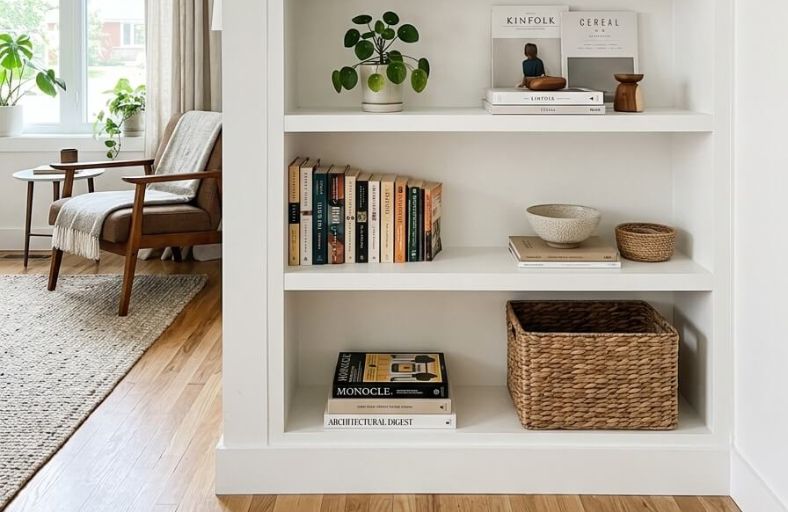
Books are the structural foundation of your display, but lining them all up vertically like a library shelf can feel monotonous.
To create a rhythmic and non-linear flow, you must vary the orientation between vertical rows and horizontal stacks. This simple shift immediately adds depth and breaks up the rigid, repetitive lines of the unit.
Horizontal stacking is a secret weapon for any content strategist. By laying three to five books on their sides, you create a “riser” or a platform.
This platform is the perfect spot to nestle a small sculptural object or a candle, adding vertical interest to an otherwise empty space.
For the best look, place larger books at the bottom of the stack to ensure physical and visual stability.
If your book covers are too distracting, consider removing the dust jackets to reveal the classic cloth bindings beneath for a more timeless, high-end feel.
3. The Rule of Thirds & Triangle Method
The difference between a haphazard arrangement and a professional one often comes down to mathematical composition. Instead of centering every object, visualize a 3×3 grid over each shelf section.
Placing your focal points at the intersections of these lines creates more energy and tension than basic symmetry.
To achieve stability across multiple shelves, use the “Triangle Method.” This involves positioning three objects of varying heights to form an invisible triangle across the unit.
For example, you might place a tall vase on the top left, a medium stack of books in the center of the middle shelf, and a small decorative bowl on the bottom right.
- Left Third: Tall anchor object (e.g., a vase or tall books).
- Middle Third: Lower profile item or horizontal stack.
- Right Third: Medium-height grouping or greenery.
This technique guides the eye in a “zigzag” pattern across the entire bookcase, ensuring that no single area feels too heavy or neglected.
4. Layering for Dimensional Depth
A common mistake is placing all items in a single line along the front edge of the shelf. To create a “landscape” that feels professional, you must master the art of layering from back to front.
This creates depth and makes the shelves appear deeper and more open.
Start with the “background plane” by leaning a framed piece of art or a decorative tray against the back of the shelf. This adds pattern and interest behind your books.
Next, place your “middleground” items, such as a standing row of books or a medium-sized vessel.
Finally, anchor the vignette with a “foreground” object, a small, high-texture piece like a brass sphere, a small bowl, or a strand of beads draped over a stack of books.
This three-dimensional approach ensures that your bookcase looks artfully composed from every angle, rather than appearing flat and two-dimensional.
5. Biophilic Softness
Integrating greenery is the most effective method to break up the rigid, straight lines inherent in a bookcase’s structure.
Organic elements introduce a sense of life and motion that inanimate objects simply cannot provide.
For higher shelves, trailing plants like Pothos or Ivy are the preferred choice, as their cascading vines create a beautiful “waterfall” effect that softens sharp vertical edges.
On lower levels, small succulents or sculptural air plants can add a vibrant pop of color without overwhelming the surrounding decor.
It is important to consider light levels when selecting species; plants placed deep within a shelf may need to be rotated with those in brighter areas or supported by subtle LED grow lights to maintain their health.
By mixing the structured geometry of books with the fluid shapes of nature, you create a balanced, biophilic environment that feels fresh and inviting.
6. Material and Texture Interplay
High-end shelf design is fundamentally tactile, relying on the interplay of contrasting surfaces to create a sense of richness and complexity.
A common mistake is using too many similar textures, which can make a display feel flat. Instead, aim to harmonize different finishes by pairing smooth, polished materials with rough, matte ones.
| Texture Type | Recommended Material | Visual Impact |
|---|---|---|
| Shiny | Glass, polished metal, or lacquer | Adds light and a touch of luxury. |
| Matte | Ceramic, stone, or unfinished wood | Provides a grounded, modern feel. |
| Textured | Woven baskets, linen, or coral | Introduces organic depth and warmth. |
The goal is to achieve a balanced repetition. Repeating a specific finish, like a touch of gold or a certain wood tone, across different shelves helps unify the entire unit without making it look too “matchy.”
7. Strategic Negative Space
The final and perhaps most crucial step is embracing negative space. It is tempting to fill every available inch, but leaving 20-30% of each shelf empty is the easiest way to make your arrangement look intentional rather than cluttered.
These “breathing rooms” allow the eye to rest and ensure that your most prized items truly stand out.
To check your progress, take a photograph of your bookcase with your phone. The camera lens often reveals imbalances, such as a gap that feels accidental or an area that is visually lopsided, which the human eye might overlook in person.
Professional stylists often step back and view the shelves from across the room to ensure the “zigzag” flow is working correctly.
Remember, a bookcase is a dynamic installation; do not be afraid to refresh it seasonally to keep your home feeling energized.