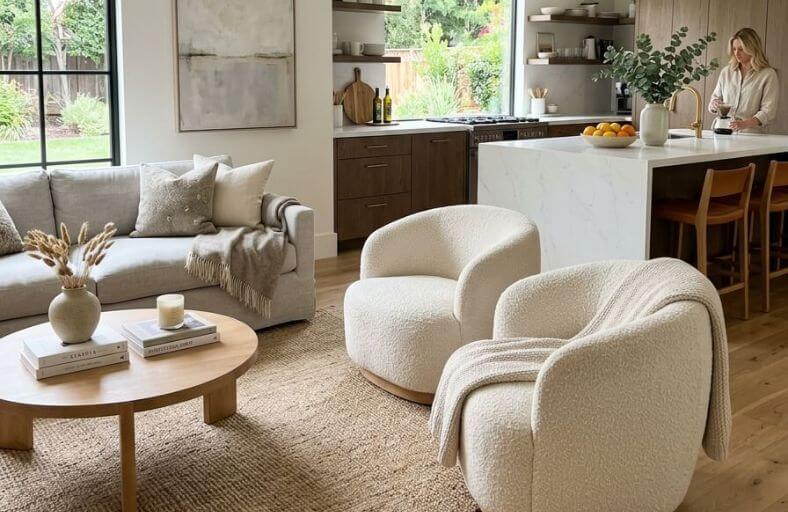
A sterile living room often suffers from a stiff arrangement where every piece of furniture hugs the walls, creating a cold and uninviting void in the center.
This “showroom” layout lacks the personality and warmth that truly makes a house feel like a home.
The strategic placement of an accent chair is the secret weapon professional designers use to break this monotony.
By introducing new textures, bold colors, and intentional angles, you can bridge architectural gaps and turn awkward corners into functional destinations.
Mastering the Mathematics of Scale
The most common mistake in home decorating is choosing a chair that looks like it belongs in a different house. To avoid a room that feels disjointed, you must balance the physical size of the chair with the visual weight of your existing sofa.
A massive, overstuffed club chair will swallow a delicate apartment-sized sofa, while a tiny slipper chair will look lost in a room with high ceilings.
Proportion is key to a professional look. If your living room features high ceilings, look for chairs with a back height of at least 35 inches to help fill that vertical volume.
Additionally, pay close attention to seat height. For a comfortable conversation area, your accent chair’s seat should be within 2 to 4 inches of your sofa’s height.
This prevents guests from feeling like they are sitting on the floor while looking up at everyone else, ensuring a socially balanced environment for everyone.
Creating Natural Conversation Zones
Furniture should never feel like it was dropped into a room at a right angle. Placing chairs perfectly parallel to walls creates a formal, “stiff” atmosphere that discourages relaxation.
Instead, use the 45-degree rule to breathe life into your seating arrangement. By angling your accent chairs toward the center of the room or toward the primary sofa, you immediately signal that the space is designed for social interaction.
This angled orientation does more than just look good; it improves the flow of the room. It guides the eye toward focal points like a fireplace or a large window without blocking the path.
If you are working with a long, narrow room, placing a pair of chairs at an angle at the far end can effectively “shorten” the space and make it feel much cozier.
This simple shift in geometry transforms a walk-through area into a dedicated spot for catching up with friends.
Turning Dead Corners into Functional Nooks
Every home has that one awkward corner that seems to collect dust rather than style. You can reclaim this “dead space” by creating a curated vignette.
A single accent chair, when paired with a small side table and a dedicated light source, becomes an instant reading nook or a wellness retreat.
This is especially effective in bedrooms, where a plush chair near a window offers a place to unwind away from digital screens.
To make the spot feel intentional rather than cluttered, follow the “Rule of Three” for accessories. Place a soft throw blanket over the arm of the chair for texture, a small lamp on the side table for warmth, and perhaps a single piece of art on the wall behind it.
This creates a “room within a room” effect. In entryways, a smaller, armless chair provides a stylish perch for guests to remove their shoes, making a great first impression.
Zoning Open-Concept Layouts
In modern homes where the kitchen, dining, and living areas flow together, it can be difficult to tell where one “room” ends and another begins. Accent chairs are perfect tools for defining these invisible boundaries.
You can use a pair of chairs to create a “visual wall” by placing their backs toward the kitchen or dining area. This anchors the living zone without the need for physical dividers that block natural light.
When choosing a chair for these transition zones, consider its width and style based on the space available. Here is a quick guide to help you match your chair to your room type:
| Room Category | Typical Width | Best Chair Styles |
| Compact Studio | 25 – 28 inches | Slipper, Armless, Acrylic |
| Standard Living Room | 29 – 34 inches | Club, Barrel, Wingback |
| Grand Open Concept | 35+ inches | Swivel, Chaise, Chair-and-a-half |
Using swivel chairs in these open layouts is particularly clever, as it allows the occupant to rotate between watching television and conversing with someone in the kitchen.
Playing with Materiality and Tactile Layering
Upholstery is where your accent chair truly earns its title. To create a designer-inspired look, you should practice “tactile layering,” which is the art of mixing different fabric textures to add depth to a room.
If your primary sofa is a smooth linen, consider an accent chair in a nubby bouclé or a plush velvet. This contrast makes the room feel curated rather than “matchy-matchy”.
For high-traffic areas, performance fabrics are a must-have as they are treated to resist stains and withstand daily wear.
Leather is another fantastic option for families because it develops a beautiful patina over time and is incredibly easy to wipe clean. Here is a quick maintenance guide for popular fabrics:
| Fabric Type | Vibe | Maintenance Level | Best For |
| Velvet | Luxurious & Bold | Moderate | Formal living rooms |
| Leather | Sleek & Timeless | Low | Families and pets |
| Bouclé | Cozy & Organic | Moderate | Reading nooks |
| Linen | Airy & Coastal | High | Sunrooms |
Injecting Personality with the Rule of Three
An accent chair is the perfect vehicle for bold colors and patterns that might feel overwhelming on a large sofa.
To mix patterns like a pro, follow the “Rule of Three” by combining one large-scale pattern (like a floral), one medium-scale pattern (like a geometric), and one small-scale pattern (like a stripe or herringbone).
As long as they share one or two common colors, the look will remain cohesive rather than chaotic.
The trend is shifting toward “Sophisticated Maximalism”. Deep, moody jewel tones like burgundy, emerald green, and royal blue are taking center stage.
These rich colors add a sense of history and “bougie” comfort to any room, especially when paired with dark wood frames or brass accents.
If you prefer a calmer look, warmed-up neutrals and earth tones are also rising in popularity for a grounded, elegant environment.
Optimizing Lighting and Orientation
A beautiful chair will remain unused if it sits in a dark, forgotten corner. To make your accent seating functional, you must pair it with a dedicated light source.
A tall floor lamp positioned next to the chair creates a “vignette” that draws the eye and transforms a simple piece of furniture into a meaningful destination.
Orientation is equally important. If you place a chair near a window, consider the sun’s direction. For east-facing windows, the chair should face inward so the morning sun falls over your shoulder while you read.
For west-facing windows, you might need light-filtering sheers to prevent intense afternoon glare.
Remember to leave at least 30 to 36 inches of clearance for major traffic paths to ensure the chair enhances the room flow rather than blocking it.