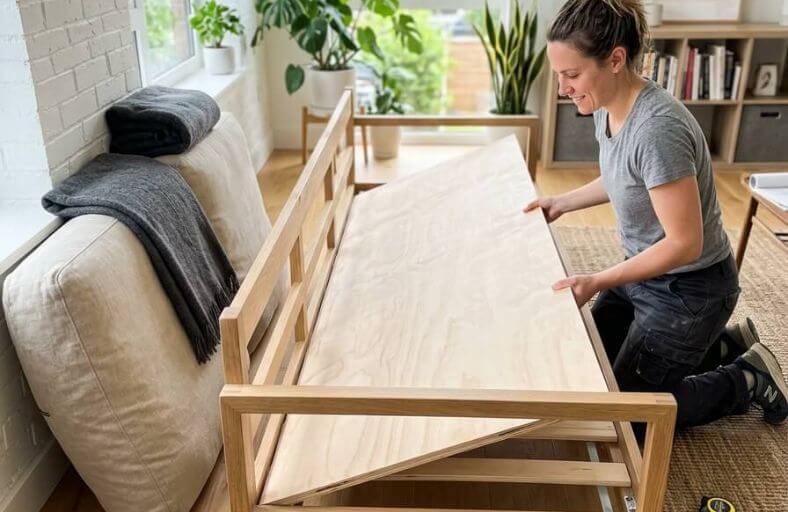
Before you write off a sagging couch as beyond saving, it is worth understanding exactly why it is sagging in the first place. The fix depends entirely on the cause.
Flattened cushion filling needs one solution. Broken or worn-out springs need another.
A warped or cracked support board beneath the seat cushions is a third issue entirely. Each one is fixable with the right approach and the right materials.
These practical tips cover every common cause of couch sagging and give you a clear, step-by-step plan for addressing each one at home, saving you hundreds, or even thousands, of dollars compared to replacing the entire sofa.
Steam Revitalization
Your flat cushions might just be “thirsty” for a little thermodynamic intervention. Polyurethane foam is a cellular polymer that traps tiny air pockets. Over years of use, these cell walls collapse and flatten.
High-pressure steam acts as a miracle worker by heating these microscopic air bubbles, causing them to expand and push the foam back to its original dimensions.
To do this at home, remove the cushion cover and slowly pass a garment steamer over the surface of the foam core.
You will often see a wave of expansion as the material puffs back up and regains its color.
This is the ultimate budget-friendly fix that restores plushness without spending a dime on new materials.
Just ensure the foam is completely air-dried before re-zipping to prevent any unwanted moisture buildup.
High-Density Foam Core Replacement
When steam isn’t enough, it’s time for a core transplant. Most factory-standard sofas use low-density foam that fatigues quickly.
Upgrading to High-Density (HD) or High-Resiliency (HR) foam can extend your sofa’s life by a decade.
| Metric | Recommended Value | Why It Matters |
| Density | 1.8 – 2.5 lbs/ft³ | Dictates durability and lifespan |
| ILD | 35 (Medium-Firm) | Determines the support level |
| Thickness | Cover Height + 0.5″ | Prevents fabric wrinkling |
The secret to a perfect fit is to ignore your old, squashed foam. Instead, measure the inside of your cushion cover from seam to seam.
A professional rule of thumb is to add an extra half-inch to the thickness measurement to ensure a snug, wrinkle-free fit. For a balance of durability and comfort, use the following metrics:
Dacron Batting Wrap
Even the best foam core looks a bit boxy without a professional finish. Dacron batting is a polyester fiber wrap that serves as the bridge between your firm foam and the sofa fabric.
It smooths out the sharp edges of the foam and creates a “crowned” look, making the cushion appear full and inviting.
Functional benefits include acting as a low-friction layer, which makes sliding the foam insert back into the tight fabric cover much easier.
To apply it like a pro, use a light coat of spray adhesive to bond the batting to the foam, preventing it from bunching up over time. This simple addition is what separates a DIY repair from a high-end restoration.
Sinuous Spring Tensioning
If your cushions are firm but the seat still dips, the problem is likely in the structural engine room underneath.
Modern sofas rely on sinuous (zigzag) springs that can pop out of their clips or lose tension over time.
To fix this, flip the sofa and peel back the dust cover to reveal the metal architecture. You will need a pair of locking pliers to grab the end of any detached spring.
Using the pliers as a lever against the wooden frame, slowly stretch the spring until it can be guided back into its metal clip.
If a clip is broken, replace it with a new zinc-plated version secured with 3-inch screws to prevent it from pulling out of the hardwood again.
Webbing Restoration
If your sofa uses a network of fabric straps instead of springs, you are likely dealing with stretched or frayed webbing.
Over time, these elastic belts lose their “memory,” leaving your cushions with no foundation but a gaping hole.
To restore this support, you must flip the piece and remove the old straps. When installing new jute or rubber webbing, a webbing stretcher is your best friend.
It allows you to pull the material taut until it sounds like a wide guitar string when plucked.
A critical professional secret is the “W” stapling protocol. Instead of driving staples in a straight line, which can cause the wood to split along the grain, stagger your staples in a W-formation.
Fold the end of the webbing back over the first row of staples and drive a second set to lock it in place.
For maximum durability, use a basket-weave pattern by alternating horizontal and vertical strips, weaving them over and under each other to distribute weight evenly.
Frame Sistering and Reinforcement
Sometimes the sag isn’t in the cushions or the springs but in the very “bones” of the furniture. A cracked wooden rail or a loose joint can cause a dramatic and dangerous dip.
If you hear a sharp crunch or feel the sofa shifting, you likely have a structural break. The most effective fix is a technique called “sistering.”
This involves taking a new piece of high-quality plywood or hardwood and bridging the break by gluing and screwing it alongside the damaged section.
| Component | Common Issue | Fix Method |
| Main Rail | Vertical Crack | Sistering with plywood |
| Corner Joint | Racking / Swaying | Adding triangular corner blocks |
| Leg Mount | Wobbly / Stripped | Installing a metal T-nut plate |
Use a generous amount of wood glue and 3-inch screws to ensure the bond is stronger than the original wood fibers.
For wobbly legs, don’t just tighten the screw; install a heavy-duty mounting plate to give the leg a fresh, stable surface to anchor into.
Plywood Support Intervention
For those looking for an immediate lift without a full teardown, the plywood support board is a classic buy-time champion.
This solution is particularly effective for budget-friendly sofas or pieces where the suspension is only mildly weakened.
By placing a solid barrier between the frame and the cushions, you prevent the foam from sinking into the gaps of a failing foundation.
To do this right, measure the length and width of the seating deck directly under the cushions.
Have a local hardware store cut a piece of 0.5-inch plywood or particleboard to these exact dimensions.
To prevent the board from feeling like a hard slab, you can layer a thin sheet of foam or interlocking foam mats on top of the wood before replacing the cushions.
While this is often a temporary fix, it can easily add another year or two of life to a well-loved sofa while you plan for a more permanent restoration.