Discovering that your cat has urinated on your couch is one of the most dreaded moments for any pet owner.
The smell alone can feel overwhelming, and without the right treatment, it has a stubborn way of lingering long after you think the problem has been solved.
Cat urine is particularly challenging to remove because it contains uric acid crystals that bond deeply to fabric fibers and reactivate with moisture, bringing the odor right back even after cleaning.
Acting quickly and using the correct products makes all the difference between fully eliminating the problem and simply masking it temporarily.
Immediate Extraction
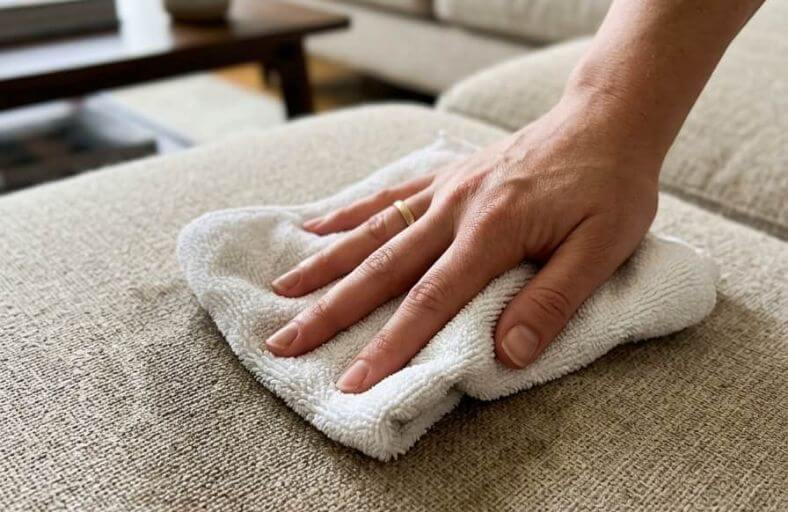
The moment you spot a damp patch, speed is your best friend. Grab a thick stack of white paper towels or a clean microfiber cloth immediately.
The secret here is vertical pressure: press down firmly for at least 30 seconds to draw the liquid upward and out of the cushion foam.
Never, ever rub the spot. Rubbing acts like a piston, forcing the urine deeper into the internal polyurethane foam and spreading the stain horizontally across the fabric fibers .
Continue blotting with fresh towels until no more moisture transfers to the cloth. If you have a wet-dry vacuum or a portable extractor like a Bissell Little Green, use it now to pull out any remaining liquid.
This physical removal is the most important step in preventing a permanent “reservoir effect” inside your furniture foam.
Forensic Mapping with UV Light
Cat urine contains uric acid and salts that are invisible once dry but emit a pungent odor for years. To truly clean your couch, you must see the unseen. A 365nm UV blacklight is the gold standard for this forensic task.
Unlike cheaper 395nm lights that glow mostly purple, a 365nm light makes urine crystals fluoresce with a bright, high-contrast yellow or green glow.
Turn off all the lights and scan the entire sofa, including the vertical side panels and the back.
Male cats often spray vertically, so the contamination might not just be on the seat. Use chalk or a piece of tape to mark the exact perimeter of every glow you find.
Remember that the subsurface contamination zone in the foam is usually twice as large as the visible surface stain, so map a generous treatment zone around every spot.
Enzymatic Saturation Protocol
Standard detergents only mask odors; they cannot break the chemical bonds of uric acid.
You need an enzymatic cleaner, a biological catalyst that eats the organic waste. Look for products containing Proteases (to break down proteins) and Ureases (to neutralize urea).
When applying, don’t just mist the surface. You must saturate the area with a volume of cleaner equivalent to the amount of urine expelled. For a deep-seated stain, this might mean pouring the solution slowly so it soaks into the foam core.
Once applied, give it a dwell time of at least 15 minutes, though for older stains, letting it sit for several hours is better.
These enzymes need a moist environment to work, so for heavy jobs, cover the area with plastic wrap to slow down evaporation. This allows the biological reaction to dismantle the uric acid into harmless gases .
Decoding Your Fabric Care Tags
Before you douse your sofa in liquid, you must check the manufacturer’s care tag. Upholstery is classified by “Cleaning Codes” that dictate which substances are safe to use.
Applying water to the wrong fabric can cause permanent shrinkage, dye bleeding, or “tide marks”.
| Code | Meaning | Cleaning Protocol |
| W | Water-based | Safe for enzymatic sprays and steam cleaning. |
| S | Solvent only | Use dry-cleaning solvents; water will leave rings. |
| WS | Water or Solvent | Most flexible; test a small area first. |
| X | Vacuum only | Professional help only; liquids will ruin the piece. |
If your couch is Code S (like some silks or fine wools), a traditional water-based enzymatic cleaner can be dangerous.
In these cases, look for specialized “dry foam” enzymatic cleaners or professional-grade bridge solvents that can treat the stain without saturating the fibers.
Always test your cleaner on a hidden patch, like the underside of a cushion, before treating the main display area.
Managing the Sub-Surface “Reservoir Effect”
Cat urine follows the laws of fluid dynamics, meaning a small surface spot often hides a massive “reservoir” inside your cushion foam.
When liquid hits the foam, it spreads in a cone-like shape due to capillary action, making the underground contamination much wider than it appears.
To combat this effectively, you must apply the “two-foot rule”: if the surface stain is one foot wide, you should saturate a two-foot area around it to catch the hidden wicking edges.
If your cushions are removable, take them out of their covers to treat the inner foam directly. For heavy, set-in saturation, professionals sometimes use a syringe to inject concentrated enzymatic cleaner into the foam core at two-inch intervals.
After saturating, compress the foam rhythmically with your hands to help the solution distribute through every open cell.
This ensures the enzymes digest the uric acid crystals trapped deep inside, preventing the odor from reactivating during humid weather. Finally, use a high-powered wet-vac to extract the liquid from the core.
Specialized Tactics for Sensitive “Code S” Fabrics
If your couch has an “S” cleaning code, standard water-based enzymatic cleaners are usually off-limits because they can cause permanent fiber shrinkage, dye bleeding, or unsightly tide marks.
For these sensitive materials, such as certain silks or high-end velvets, you must employ “surgical moisture” techniques.
One effective DIY approach for (S) coded microfiber involves using 70% rubbing alcohol in a spray bottle; it dissolves organic oils and evaporates rapidly without leaving water rings.
For a more professional enzyme treatment, choose a dry foam enzymatic cleaner. These products use oxygen-infused foam that cleans the surface without soaking moisture into the delicate internal fibers.
Simply apply the foam, let it dwell for the time specified on the label, and extract it almost instantly using an upholstery attachment on your vacuum.
This localized approach prevents the fibers from swelling or undergoing the structural stress of a traditional bath, keeping your luxury furniture in pristine condition.
Pheromonal Sabotage and Behavioral Deterrents
Successful remediation is as much about psychology as it is about chemistry. If even a microscopic trace of the original scent remains, your cat’s superior nose will recognize it as a territorial waste zone and they will likely return to mark it again.
To break this cycle, you must avoid any cleaners containing ammonia; since cat urine naturally contains ammonia, these products effectively signal to your pet that the spot is a dedicated litter area.
Once the area is cleaned and dry, you can sabotage their instincts by applying a synthetic pheromone spray.
These products mimic the safe facial pheromones cats use to mark their favorite territories, psychologically re-categorizing the couch as a place for resting rather than elimination.
Additionally, use tactile deterrents during the treatment phase. Most cats find the crinkling sound of aluminum foil or the sticky texture of double-sided tape highly unpleasant.
These simple barriers provide a negative stimulus that discourages them from jumping onto the couch while your cleaning solutions are still working their magic.